
Bhakti Yoga: The Path of Divine Love and Devotion
Explore Bhakti Yoga — the path of divine love and devotion — through its scriptural foundations in the Bhagavad Gita, Narada Bhakti Sutras, and Bhagavata Purana. Discover the nine forms of devotion (Navadha Bhakti), the lives and teachings of great saints including Narada, Ramanuja, Chaitanya Mahaprabhu, Mirabai, Tukaram, and Kabir, and the transformative practices that bring the seeker into living union with the Divine.
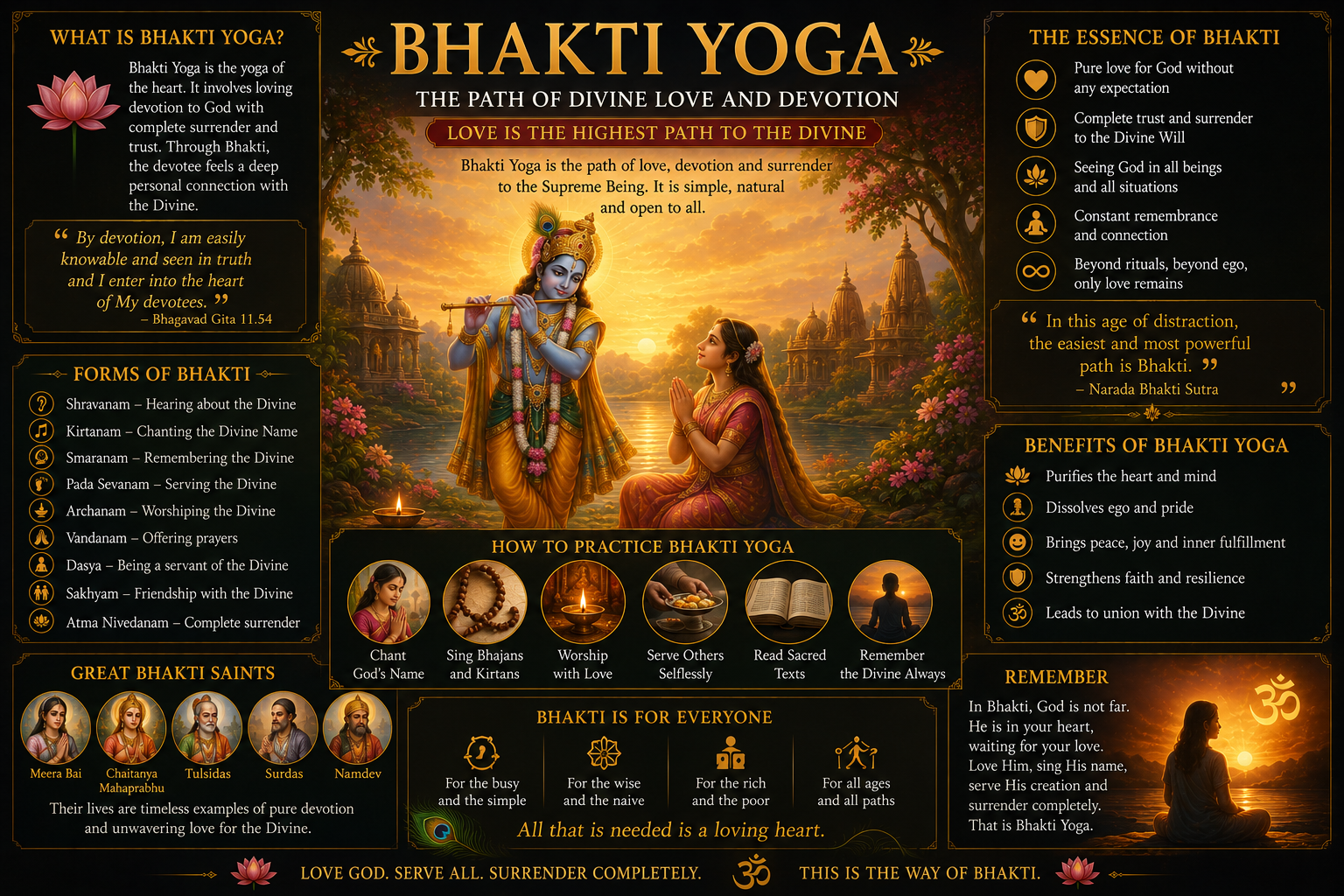
In the vast and luminous landscape of Hindu spiritual philosophy, few paths shine with as warm and immediate a radiance as Bhakti Yoga — the yoga of divine love and devotion. While other yogic paths may demand rigorous intellectual discipline, physical mastery, or complex ritual knowledge, Bhakti Yoga opens its arms to every sincere seeker, regardless of caste, creed, gender, or scholastic ability. Its sole requirement is the heart’s genuine longing for the Divine.
The word Bhakti derives from the Sanskrit root bhaj, meaning “to share,” “to participate in,” or “to revere.” At its essence, Bhakti is the living relationship between the devotee and the Divine — a relationship characterised by love, trust, surrender, and an ever-deepening intimacy with the Infinite. Yoga, meaning “union,” completes the term’s meaning: Bhakti Yoga is the path by which the individual soul attains union with the Supreme through the transformative power of love.
Across millennia, Bhakti has inspired some of India’s greatest saints, poets, and mystics — from the sage Narada who codified its principles, to philosopher-saint Ramanuja who gave it theological grounding, to the ecstatic devotion of Chaitanya Mahaprabhu, the fearless love-songs of Mirabai, the down-to-earth wisdom of Tukaram, and the mystical verses of Kabir. Their lives and teachings form a river of devotional wisdom that continues to nourish spiritual seekers the world over.
This article offers a comprehensive exploration of Bhakti Yoga — its scriptural foundations, its nine classical forms, its great saints, its relationship to other yogic paths, its daily practices, and its ultimate goal: the blissful union of the soul with the Supreme Being.
What Is Bhakti Yoga?
Bhakti Yoga is one of the four classical paths of yoga described in Hindu spiritual tradition — alongside Jnana Yoga (the path of knowledge), Karma Yoga (the path of selfless action), and Raja Yoga (the path of meditation and mental discipline). While all four paths ultimately lead to the same destination — liberation (moksha) and union with the Divine — each addresses a different dimension of human nature.
Bhakti Yoga addresses the emotional and relational dimension of the human being. It recognises that the deepest longing of the human heart is not merely to understand the Absolute or to be free from suffering, but to love and to be loved — and it sees this longing as the surest vehicle for spiritual realisation. Rather than suppressing or transcending emotion, Bhakti Yoga purifies and redirects it, channelling the energy of love away from transient objects and toward the eternal source of all love.
The Bhakta — the practitioner of Bhakti — does not seek to merge into an impersonal Absolute and lose all individuality. Instead, the Bhakta cherishes a loving relationship with a personal form of the Divine, known as the Ishta Devata (chosen deity). This personal relationship can take many forms: the devotee may relate to the Divine as a servant to a master (dasya), as a friend to a friend (sakhya), as a child to a parent (vatsalya), or as a lover to the Beloved (madhurya). Each of these modes of relationship is sacred, each is a valid doorway into the Divine presence.
What distinguishes genuine Bhakti from mere sentiment or superstition is its quality of ananya bhakti — undivided, exclusive love directed toward the Supreme. The Bhakta’s love is not bargaining (“I will worship if you grant my wish”), nor is it fearful servility. It is a freely-given, joyful, wholehearted offering of the self to the Divine, sustained by faith, nourished by grace, and matured through devoted practice.
Scriptural Foundations of Bhakti Yoga
Bhakti Yoga is not a later development or a popular simplification of “higher” philosophical teachings. It has deep roots in the most ancient and authoritative scriptures of the Vedic and post-Vedic tradition.
The Bhagavad Gita
The Bhagavad Gita, delivered by Lord Krishna to the warrior Arjuna on the battlefield of Kurukshetra, contains some of the most sublime teachings on Bhakti ever articulated. In Chapter 12, entirely devoted to Bhakti Yoga, Krishna declares: “Those who fix their minds on Me, who worship Me with perpetual devotion and with supreme faith — I consider them the best knowers of yoga” (12.2). He goes on to describe the qualities of the ideal devotee — one who is free from hatred, who is compassionate toward all beings, who is free from ego and possessiveness, who is unaffected by joy and sorrow alike.
In Chapter 9, Krishna makes the remarkable declaration: “Whatever you do, whatever you eat, whatever you offer in sacrifice, whatever you give away, whatever austerity you perform — do that as an offering to Me” (9.27). This verse encapsulates the spirit of Bhakti Yoga: the transformation of every act of daily life into an act of divine worship. And in Chapter 18, Krishna offers his final, most intimate teaching: “Fix your mind on Me, be devoted to Me, worship Me, bow down to Me. So shall you come to Me. I promise you truly, for you are dear to Me” (18.65).
The Narada Bhakti Sutras
The Narada Bhakti Sutras is one of the most focused and authoritative treatises on Bhakti in all of Sanskrit literature. Attributed to the divine sage Narada — who is himself regarded as the supreme exemplar of devotion — it consists of 84 aphoristic sutras (concise statements) that define the nature, characteristics, and fruits of Bhakti.
Narada opens with the declaration: “Bhakti is of the nature of supreme love towards God” (Sutra 2). He distinguishes Bhakti from mere religious observance, from emotional attachment to worldly things, and from philosophical speculation. True Bhakti, he says, is its own reward — it is not a means to anything else, including liberation, because it is itself the highest state of being. When love of God arises in the heart, the devotee becomes immortal (amrita) and completely satisfied.
Narada also enumerates eleven forms of Bhakti, including devotion to the Lord’s glories (guna-sakti), to His form (rupa-sakti), to His worship (puja-sakti), and to His remembrance (smarana-sakti). His sutras emphasise that Bhakti requires complete renunciation of worldly attachments and complete surrender to the Divine will — not in a spirit of defeat or resignation, but in joyful trust that the Divine holds all things in loving care.
The Bhagavata Purana
The Bhagavata Purana (or Srimad Bhagavatam), composed of twelve books and 18,000 verses, is widely regarded as the greatest scripture of the Bhakti tradition. Its opening verse declares that it is the ripened fruit of the Vedic tree of knowledge — and indeed, it represents the fullest blossoming of devotional theology in Sanskrit literature.
The Bhagavatam portrays the Divine — primarily as Lord Vishnu and His avatara Krishna — not as a remote, impersonal Absolute, but as a Being of infinite love, beauty, and playful grace (lila). The stories of Krishna’s childhood in Vrindavan, his friendships with the cowherd boys, his tender relationship with his mother Yashoda, and above all the Rasa Lila — the divine dance with the devoted Gopis — are presented not as mere mythology but as windows into the innermost nature of divine love.
The Bhagavatam’s ninth chapter of the Eleventh Book contains the famous Navadha Bhakti — the nine forms of devotion — which have become the foundational framework of Bhakti practice across all traditions. The text also contains the teachings of the great Bhakta Prahlada, who demonstrated that unwavering devotion can protect the devotee even against the most terrible adversity.
The Nine Forms of Bhakti: Navadha Bhakti
The Navadha Bhakti — the nine forms of devotional practice — was articulated most clearly by the child-devotee Prahlada in the Bhagavata Purana (7.5.23-24) and elaborated further in the Ramacharitmanas of Sant Tulsidas. These nine forms are not sequential stages but parallel avenues of devotion, each suited to different temperaments and life situations.
- Shravana (Hearing) — The first and most accessible form of Bhakti is attentive, reverent listening to the name, glories, and stories of the Divine. Hearing the Bhagavatam recited, attending discourses on scripture, listening to devotional songs — all these cultivate the inner ear of the soul. The great king Parikshit attained liberation by hearing the Bhagavatam for seven days.
- Kirtana (Singing/Chanting) — The ecstatic singing of God’s names and glories is considered by many Bhakti teachers to be the most powerful spiritual practice for the current age (Kali Yuga). It purifies the mind rapidly, generates tremendous spiritual energy, and awakens the heart’s natural love for the Divine. The Hare Krishna maha-mantra, popularised by Chaitanya Mahaprabhu, is its most celebrated expression.
- Smarana (Remembrance) — The constant, loving remembrance of the Divine — keeping the Lord’s name or form in the forefront of the mind throughout all activities. This is the practice that the sage Narada himself exemplifies, walking the three worlds eternally absorbed in remembrance of Narayana.
- Pada Sevana (Serving the Lord’s Lotus Feet) — The devotee seeks to serve the Divine directly — in the form of the deity in the temple, in the Guru, and in all beings. This is the Bhakti of dedicated, loving service, exemplified by Hanuman’s tireless and selfless service to Lord Rama.
- Archana (Worship) — The ritualistic worship of the Divine through the offering of flowers, incense, light (aarti), food (naivedya), and other sacred items. Puja — the daily worship of the deity in the home shrine or temple — is the most common expression of this form of Bhakti.
- Vandana (Prostration and Prayer) — The humble offering of praise, prayer, and physical prostration before the Divine. Vandana dissolves the devotee’s ego and cultivates complete openness before God. The great hymns of the Vedas, the Vishnu Sahasranama, and the prayers of the Alvars are all expressions of Vandana.
- Dasya (Servant Attitude) — Relating to the Divine as a devoted servant relates to a beloved master — with complete loyalty, eagerness to serve, and the joy of belonging entirely to the Lord. Hanuman is the supreme exemplar of Dasya Bhakti.
- Sakhya (Friendship) — The intimate, trusting friendship with the Divine, as demonstrated by Arjuna’s relationship with Krishna, or by the cowherd boys of Vrindavan who played freely with Krishna as their dearest friend, without awe or distance.
- Atma Nivedana (Self-Surrender) — The complete offering of the self to the Divine — body, mind, intellect, emotions, will, and ego. This is the highest form of Bhakti, the culmination of all devotional practice. King Bali, who offered everything to Lord Vamana, exemplifies this supreme surrender.
Key Bhakti Saints and Their Teachings
The living proof of Bhakti Yoga’s power is found not only in ancient scriptures but in the lives of those who practised it most fully — the great Bhakti saints whose songs, teachings, and transformed lives have inspired millions across the centuries.
Narada — The Divine Messenger of Devotion
Narada, the celestial sage who wanders the three worlds with his vina (lute) and the perpetual chant of “Narayana, Narayana” on his lips, is revered as the archetypal Bhakta and the preeminent teacher of devotional wisdom. In the Puranas, Narada appears as a divine counsellor, initiating seekers into devotion, transmitting the grace of the Lord, and catalysing the spiritual journeys of countless heroes and sages.
Narada’s core teaching, encapsulated in the Narada Bhakti Sutras, is that love of God is its own justification and its own reward. He teaches that Bhakti arises not through intellectual effort but through the grace of great souls (mahapurushas) and through a small fragment of divine grace (divya-prasada). His life demonstrates that the highest spiritual attainment is not the cold tranquillity of the impersonal Absolute but the living, breathing, eternally joyful love of the personal God.
Ramanuja — The Philosopher of Loving Surrender
Sri Ramanujacharya (1017–1137 CE) was the towering philosophical genius of the Bhakti tradition, whose theological system — Vishishtadvaita Vedanta (qualified non-dualism) — provided a rigorous metaphysical foundation for devotional spirituality. Against the Advaita position of Shankaracharya, which held that personal devotion belongs to a lower level of understanding, Ramanuja argued that the individual soul and the world are real — they constitute the very “body” of the Supreme Being, Vishnu.
For Ramanuja, Prapatti — complete surrender to the Lord — is the highest path, accessible to all regardless of caste or gender. His commentaries on the Brahma Sutras, the Bhagavad Gita, and the Upanishads presented a God who is not merely an abstract principle but a Being of infinite auspicious qualities (kalyana gunas), deeply personal, and intimately involved in the lives of devoted souls. Ramanuja’s theology has remained the philosophical backbone of the Sri Vaishnava tradition to this day.
Chaitanya Mahaprabhu — The Embodiment of Divine Love
Sri Chaitanya Mahaprabhu (1486–1534 CE) of Bengal is perhaps the most dramatic and transformative figure in the entire history of the Bhakti movement. Regarded by his followers as the combined avatar of Radha and Krishna — Divine Love itself incarnate in human form — Chaitanya ignited a revolution of devotion that swept across Bengal, Odisha, and ultimately the entire Hindu world.
Chaitanya’s primary teaching was the practice of Sankirtana — the communal singing and dancing in praise of Krishna’s names. He held that in the age of Kali, chanting the holy names is the supreme means of God-realisation: Hare Krishna, Hare Krishna, Krishna Krishna, Hare Hare / Hare Rama, Hare Rama, Rama Rama, Hare Hare. He himself demonstrated the power of this practice, entering states of profound divine ecstasy (mahabhava) while chanting — weeping, laughing, trembling, and sometimes losing all outer consciousness in the overwhelming wave of divine love.
Chaitanya taught Achintya-bhedabheda-tattva — the doctrine of “inconceivable difference and non-difference” between the soul and God — a position that upholds both the reality of loving relationship and the unity underlying all existence. His six Goswami disciples systematised his teachings in a vast body of Sanskrit theological literature that remains foundational to the Gaudiya Vaishnava tradition.
Mirabai — The Princess Who Loved Krishna
Mirabai (c. 1498–1547 CE) is one of the most beloved figures of the entire Bhakti movement — a Rajput princess who chose the love of Lord Krishna over the demands of royal marriage, social convention, and physical safety. Born into the royal family of Merta in Rajasthan, Mirabai was devoted to Krishna from childhood, regarding him as her true husband and lord.
After her human husband’s death, Mirabai abandoned royal life entirely, wandering as a saint-poet and singing her passionate love-songs to Krishna. Her bhajans — which survive in their thousands and are sung to this day across India — are masterpieces of spiritual literature, combining intense personal longing, mystical insight, and poetic beauty. She sang of the pain of separation from the Beloved, of joy in His presence, of total indifference to social shame in her single-pointed devotion.
Mirabai’s life is a powerful testimony to the Bhakti teaching that divine love, once fully awakened, makes the devotee fearless and free from all worldly bonds. Her tradition holds that she ultimately merged with the image of Krishna at the Ranchhodrai temple in Dwarka — her body dissolving into the Divine she had loved with every atom of her being.
Tukaram — The Devotee of Vitthal
Sant Tukaram (1598–1650 CE) was a Maharashtra saint and poet whose abhangas (devotional verses) in the Marathi language have earned him a place among the greatest Bhakti poets of India. A man of humble origins — a grain merchant who suffered great personal losses — Tukaram found his refuge entirely in devotion to Vitthal (a form of Vishnu worshipped at Pandharpur).
Tukaram’s abhangas are remarkable for their radical honesty, their social critique, and their utter simplicity of devotion. He challenged the religious pretensions of the learned, insisting that true devotion required not scholarship or ritual mastery but an honest, humble, open heart. “God does not reside in any book,” he wrote, “God resides in the hearts of the saints.” He was a central figure in the Varkari tradition of Maharashtra, which continues in the great pilgrimages to Pandharpur to this day.
Kabir — The Weaver of Divine Unity
Kabir (c. 1440–1518 CE) stands in a unique position in the Bhakti tradition — a mystic poet who transcended sectarian boundaries, weaving together threads of Hindu devotion and Sufi mysticism into a seamless cloth of universal spirituality. A weaver by caste, Kabir is said to have been a disciple of the great Vaishnava saint Ramananda, yet his teachings broke free of all traditional religious labels.
Kabir’s dohas (two-line verses) and longer shabads are among the most quoted spiritual sayings in all of Indian literature. He attacked religious hypocrisy with fierce wit, mocked both Hindu and Muslim orthodoxies that prioritised outer form over inner transformation, and pointed relentlessly toward the formless, nameless Divine that dwells within every human heart. Yet his path was unmistakably one of love — love of the Divine in all its forms, love of humanity, and the love that dissolves all boundaries between “my religion” and “yours.”
Bhakti Yoga in Relation to Other Yoga Paths
A common question in discussions of Hindu spiritual philosophy is how Bhakti Yoga relates to the other classical paths — and whether any one path is superior to the others. The answer offered by the tradition’s greatest teachers is nuanced and worth exploring carefully.
Bhakti and Jnana (Knowledge): In the Advaita tradition, Jnana Yoga — the direct inquiry into the nature of the Self — is presented as the most direct path to liberation. Yet even Shankaracharya composed devotional hymns of great beauty. In practice, Bhakti and Jnana are not opposed: Bhakti purifies the mind and opens the heart so that the vision of Jnana can arise; and genuine Jnana — the direct recognition of one’s identity with the Absolute — spontaneously overflows as Bhakti toward all beings.
Bhakti and Karma (Action): Karma Yoga — the path of selfless service, in which all actions are performed as offerings to the Divine without attachment to results — is in many ways the natural expression of Bhakti in daily life. When the heart is full of love for God, all actions naturally become offerings. Bhakti provides the motivational foundation for Karma Yoga: it is love of God that makes it possible to serve all beings as manifestations of the Divine without the contamination of ego.
Bhakti and Raja Yoga (Meditation): Raja Yoga focuses on the systematic stilling of the mind’s fluctuations through ethical discipline, physical steadiness, breath control, and meditation. Bhakti Yoga can support and deepen this practice significantly: the loving focus on the Divine Beloved provides a powerful and natural object of meditation. Many great Raja Yogis have found that their practice deepened immeasurably when infused with the spirit of Bhakti.
Swami Vivekananda emphasised that all four paths are ultimately one — they address different facets of the same human being — and that the complete spiritual life integrates elements of all four. He saw Bhakti as particularly suited to the present age, and as the most universally accessible path: “You may take any path — Bhakti, Jnana, Raja, or Karma — but the end, the goal, is the same: liberation, union with God.”
The Role of the Guru in Bhakti Yoga
In all schools of Hindu spirituality, the Guru — the enlightened spiritual teacher — occupies a central and irreplaceable role. In the Bhakti tradition, the Guru is regarded not merely as a human teacher but as the very embodiment of divine grace, the living channel through which the current of Bhakti flows from the Lord into the hearts of seekers.
The ancient verse captures this perfectly: Guru Brahma, Guru Vishnu, Guru devo Maheshwara — Guru sakshat Param Brahma, tasmai Shri Guruve namaha (“The Guru is Brahma, Vishnu, and Shiva — the Guru is the visible Supreme Absolute — I bow to the Guru”). This reflects the profound spiritual reality that the Guru, having realised the Divine, has become a transparent vessel through which divine grace operates directly.
In the Bhakti tradition, the Guru performs several essential functions. First, the Guru initiates the disciple — transmitting a mantra or divine name that serves as the seed of the disciple’s devotion. Second, the Guru models the life of devotion — demonstrating through their own being what it means to live in constant awareness of the Divine. Third, the Guru serves as the first and most intimate object of the disciple’s Bhakti — for it is through the love of the human Guru that the disciple is gradually lifted toward love of the formless Divine.
Narada emphasises the importance of the Guru, stating that Bhakti is attained through the association of great devotees (mahanta-kripa) and a small fraction of divine grace (divya-kripa-lesha). The seeking of satsang — the company of holy beings and fellow devotees — is therefore a central practice in Bhakti Yoga, and the Guru is the supreme form of this holy company.
Practices of Bhakti Yoga
Bhakti Yoga is not merely a philosophy to be understood but a living practice to be embodied. The tradition offers a rich array of practices through which devotion is cultivated, deepened, and ultimately made continuous.
Japa — The Repetition of the Divine Name
Japa — the meditative repetition of a sacred name or mantra — is considered one of the most powerful and accessible of all Bhakti practices. The divine name is regarded in the Bhakti tradition not as a mere symbol pointing to the Divine, but as identical with the Divine itself: Nama and Nami (the Name and the Named) are one. Therefore, to repeat the divine name with love and attention is to be directly in the presence of God.
Japa is typically performed using a mala (rosary) of 108 beads, with the practitioner moving one bead per repetition of the mantra. This can be done silently (manasika japa), in a low murmur (upamshu japa), or aloud (vaikhari japa). Many Bhakti teachers recommend a daily practice of at least one mala (108 repetitions), ideally in the early morning hours (Brahma muhurta) before the day’s activities begin.
Kirtan and Bhajan — Congregational Devotional Singing
Kirtan — communal call-and-response singing of divine names and glories — and bhajan — devotional songs sung in group settings — are among the most joyful of all Bhakti practices. The power of collective devotional singing lies in the way it breaks down individual barriers: when many hearts sing together with genuine feeling, a field of devotional energy is generated that lifts each individual participant beyond their usual limitations.
Chaitanya Mahaprabhu held Sankirtana to be the supreme spiritual practice for the present age, and his tradition of ecstatic kirtan continues to this day in the ISKCON movement and countless Gaudiya Vaishnava communities worldwide. Across India, evening bhajan sessions (satsang) remain one of the most vital forms of community spiritual life.
Puja — Sacred Ritual Worship
Puja — the ritual worship of the deity in the home shrine or temple — is the daily embodiment of Bhakti for millions of Hindus. Through the offering of water, flowers, incense, flame, food, and other sacred items to the image of the chosen deity, the devotee offers the best of what they have to the Supreme. The deity is treated as an honoured guest and beloved presence in the home: awakened, bathed, dressed, fed, praised, and lovingly put to rest.
The spiritual value of daily Puja cannot be overstated. It establishes the habit of beginning each day in the presence of the Divine, trains the senses to serve God rather than merely the ego’s desires, and gradually saturates the home environment with a quality of sacred presence and peace.
Pilgrimage — The Sacred Journey
Pilgrimage to sacred sites — temples, rivers, mountains, and holy towns — is a living form of Bhakti Yoga in motion. The pilgrimage transforms ordinary travel into a sacred journey: the physical effort, the discomfort, the leaving-behind of ordinary life — all become offerings to the Divine. Arriving at a great shrine such as Tirupati, Vrindavan, Varanasi, or the Char Dham, the devotee stands in the physical presence of a place where the Divine has been intensely worshipped across centuries, and where the accumulated devotion of countless pilgrims creates a palpable spiritual atmosphere.
Satsang — The Company of the Holy
Satsang — literally “association with truth” or “company of the good” — refers to the practice of spending time in the company of other devoted seekers, reading and discussing scripture together, singing together, and sitting in the presence of a holy teacher. The Bhakti tradition places enormous emphasis on Satsang because spiritual life is contagious in both directions: the company of those whose hearts are absorbed in divine love naturally awakens the same quality in those who are receptive.
Bhakti in Daily Life
One of Bhakti Yoga’s most remarkable qualities is its capacity to transform every dimension of ordinary life into a field of spiritual practice. Unlike paths that require retreat from the world, Bhakti Yoga can be practised fully in the midst of family life, professional work, and social engagement.
The foundational principle is Ishvara Arpana — the offering of all actions, results, pleasures, and pains to the Divine. When cooking, the Bhakta cooks for God and offers the food before eating. When working, the Bhakta dedicates the work to God and surrenders the results. When relating to family members, the Bhakta sees each person as a manifestation of the Divine and serves them accordingly. Even grief, difficulty, and failure can be offered to the Divine — “This too is Your gift; I receive it with open hands.”
The practice of seeing the Divine in all beings — Daivic drishti or divine vision — is one of the most transformative expressions of Bhakti in daily life. When the Bhakta genuinely perceives the Lord’s presence in every face, every creature, and every event, the entire world becomes a temple and every moment becomes an act of worship. This is not a philosophical position to be merely believed but a living reality to be gradually revealed through devoted practice.
The tradition also emphasises the importance of maintaining the spirit of Bhakti in small, daily acts of generosity and compassion. Feeding the hungry, caring for the sick, protecting the vulnerable — all these are expressions of Bhakti when done in the spirit of serving God in the form of the human person in need. As the Bhagavata Purana beautifully states: “I am equally present in all beings. One who worships Me through the service of all beings — that one truly comes to Me.”
The Goal of Bhakti Yoga: Divine Union
The ultimate destination of Bhakti Yoga is variously described in the tradition, reflecting the different theological positions of different schools, but all agree that it involves a profound transformation of the self and its relationship with the Divine.
In the Vishishtadvaita school of Ramanuja, the goal is Mukti — liberation characterised by eternal, conscious communion with the personal Lord Vishnu in the divine realm of Vaikuntha. The individual soul retains its distinct identity but is fully realised as a particle of the Lord’s divine body, living in eternal bliss in the Lord’s presence.
In the Gaudiya Vaishnava tradition of Chaitanya, the highest goal is entry into the divine realm of Goloka Vrindavan, where the soul participates in the eternal lila (play) of Radha and Krishna — the supreme expression of divine love. The devotee’s siddha rupa (perfected spiritual form) is revealed, and they serve the Divine Couple in their eternal, blissful dance of love.
Across all these visions, certain features are constant: the eternal presence of the Divine, the complete dissolution of suffering, the full flowering of the soul’s unique nature, and the unimpeded flow of divine love. The Bhakta who has attained this state experiences ananda — a bliss that far surpasses any earthly pleasure — and sat-chit-ananda: eternal being, infinite consciousness, and unbounded bliss.
Narada, in his Bhakti Sutras, expresses this goal with characteristic simplicity: the mature Bhakta, absorbed in the love of God, “becomes immortal, becomes satisfied, becomes intoxicated with divine love, and rejoices in the Self alone.” They need nothing more, seek nothing else, because in that love they have found the source of all joy, all peace, and all being.
The Enduring Significance of Bhakti Yoga
In an age of unprecedented material complexity, psychological fragmentation, and spiritual searching, Bhakti Yoga offers something of inestimable value: a direct, living relationship with the Divine that is available to every human being, in every circumstance of life. It requires no special equipment, no institutional affiliation, no advanced degree in philosophy. It requires only a sincere heart and the willingness to turn that heart’s deepest love toward its ultimate source.
The Bhakti movement that swept across India from the 6th century CE onward was, among many things, a radical democratisation of spiritual life. The great Bhakti saints were women, low-caste artisans, merchants, and farmers — people who had no access to traditional scholarly or ritual privileges, yet who attained states of spiritual realisation that commanded the reverence of all. Their message was clear: God’s love is available to all, and love of God requires nothing but love itself.
Today, Bhakti Yoga continues to flourish across the world — in Hindu temples from Chennai to California, in the kirtan gatherings that draw thousands of seekers of all backgrounds, in the daily pujas of millions of households, and in the private devotional lives of countless individuals who have found in Bhakti a source of meaning, strength, and joy that nothing in the material world can provide. Its essence — the transformation of the human heart through divine love — is as relevant and as urgently needed today as it has ever been.
Key Takeaways
- Bhakti Yoga is the path of divine love and devotion — one of the four classical yoga paths — and is considered the most universally accessible spiritual path in the Hindu tradition, open to all regardless of caste, gender, or scholastic background.
- Its scriptural foundations rest on the Bhagavad Gita, the Narada Bhakti Sutras, and the Bhagavata Purana, which together present a comprehensive theology and practice of loving devotion to the personal God.
- The Navadha Bhakti (nine forms of devotion) — Shravana, Kirtana, Smarana, Pada Sevana, Archana, Vandana, Dasya, Sakhya, and Atma Nivedana — provide a complete framework of devotional practice suited to all temperaments and life situations.
- The great Bhakti saints — Narada, Ramanuja, Chaitanya Mahaprabhu, Mirabai, Tukaram, and Kabir — embodied Bhakti in their lives and transmitted its transformative power through their teachings, poetry, and personal example.
- Bhakti Yoga does not conflict with other yogic paths but complements and enriches them, providing the heart’s motivational force that makes all spiritual practice fruitful and sustained.
- The ultimate goal of Bhakti Yoga is divine union — the eternal, conscious, blissful relationship of the soul with its Supreme Beloved — a state of unending love, peace, and boundless joy described across all schools of the tradition.
Frequently Asked Questions
What is the difference between Bhakti Yoga and other forms of yoga?
While all four classical yoga paths — Bhakti, Jnana, Karma, and Raja — lead toward the same ultimate goal of liberation and union with the Divine, they engage different aspects of the human being. Bhakti Yoga primarily engages the heart and emotions, channelling the power of love toward the Divine. Jnana Yoga engages the intellect through direct self-inquiry. Karma Yoga engages the will through selfless action. Raja Yoga engages the mind through meditation and mental discipline. Most authentic teachers emphasise that an integrated spiritual life draws on all four, with Bhakti often serving as the unifying thread that infuses all the others with warmth and living purpose.
Do I need to believe in a personal God to practise Bhakti Yoga?
Traditional Bhakti Yoga involves devotion to a personal form of the Divine — the Ishta Devata (chosen deity). However, the essential quality of Bhakti is the orientation of love, trust, and surrender toward the Highest. Even those who approach the Absolute as an impersonal Reality can bring to their practice the qualities of Bhakti — reverence, gratitude, devotion, and surrender. Swami Vivekananda and other modern teachers have discussed how Bhakti can be adapted for those with different theological inclinations, while maintaining its essential spirit of wholehearted surrender.
What is Ishta Devata, and how does one choose it?
Ishta Devata means “chosen deity” — the personal form of the Divine with whom the devotee has the deepest natural affinity. In the Hindu tradition, the Supreme Reality manifests in many divine forms — Vishnu, Shiva, Devi, Ganesha, and many others — and each devotee is encouraged to find the form toward which their heart is naturally drawn. Traditionally, the Ishta Devata is revealed through initiation by the Guru. However, many devotees also find their Ishta Devata through their family tradition, through dreams and inner experiences, or through a spontaneous arising of devotion when they encounter a particular divine form or sacred image.
How can Bhakti Yoga be practised in modern daily life?
Bhakti Yoga can be woven into the fabric of modern life through a combination of daily formal practice and a continuous inner attitude of devotion. Formally, practices such as morning Puja (even a simple five-minute offering to the deity), daily Japa (repetition of the divine name, perhaps during a commute or quiet period), and participation in kirtan or satsang provide structure and community. Informally, the cultivation of the awareness that all beings, all situations, and all moments are expressions of the Divine — and the offering of all one’s actions to that Divine presence — gradually transforms the entire day into a continuous act of worship.
What is the relationship between Bhakti and divine grace?
In Bhakti theology, divine grace (Kripa or Prasad) plays an essential and irreplaceable role. While the devotee’s sincere effort, practice, and longing are necessary conditions for spiritual progress, they are not by themselves sufficient. The ultimate opening of the heart to divine love — the moment of genuine Bhakti — is always a gift of grace, not a product of personal effort alone. This is why Narada says that Bhakti arises from “a small fraction of divine grace.” The devotee’s practice creates the conditions of receptivity; grace is what actually fills those conditions with divine love. This understanding cultivates both diligence in practice and deep humility before the mystery of the Divine’s freedom to bestow itself wherever it will.
Is Bhakti Yoga compatible with other religious traditions?
The spirit of Bhakti — loving devotion to the Supreme, surrender of the ego, service of all beings as expressions of the Divine — is found, under different names and forms, in virtually every major religious tradition. The Christian mystical tradition (represented by figures such as Meister Eckhart, St. Teresa of Avila, and St. John of the Cross), Sufi Islam (as expressed in the poetry of Rumi and Hafiz), Jewish Hasidism, and Sikh Gurbani all share deep structural resonances with the Bhakti tradition. The great Bhakti saint Kabir famously drew on both Hindu and Sufi imagery in his spiritual poetry, pointing toward the universal dimension of divine love that transcends all sectarian boundaries and speaks to the deepest yearning of the human heart.
Related articles in Dharma & Philosophy
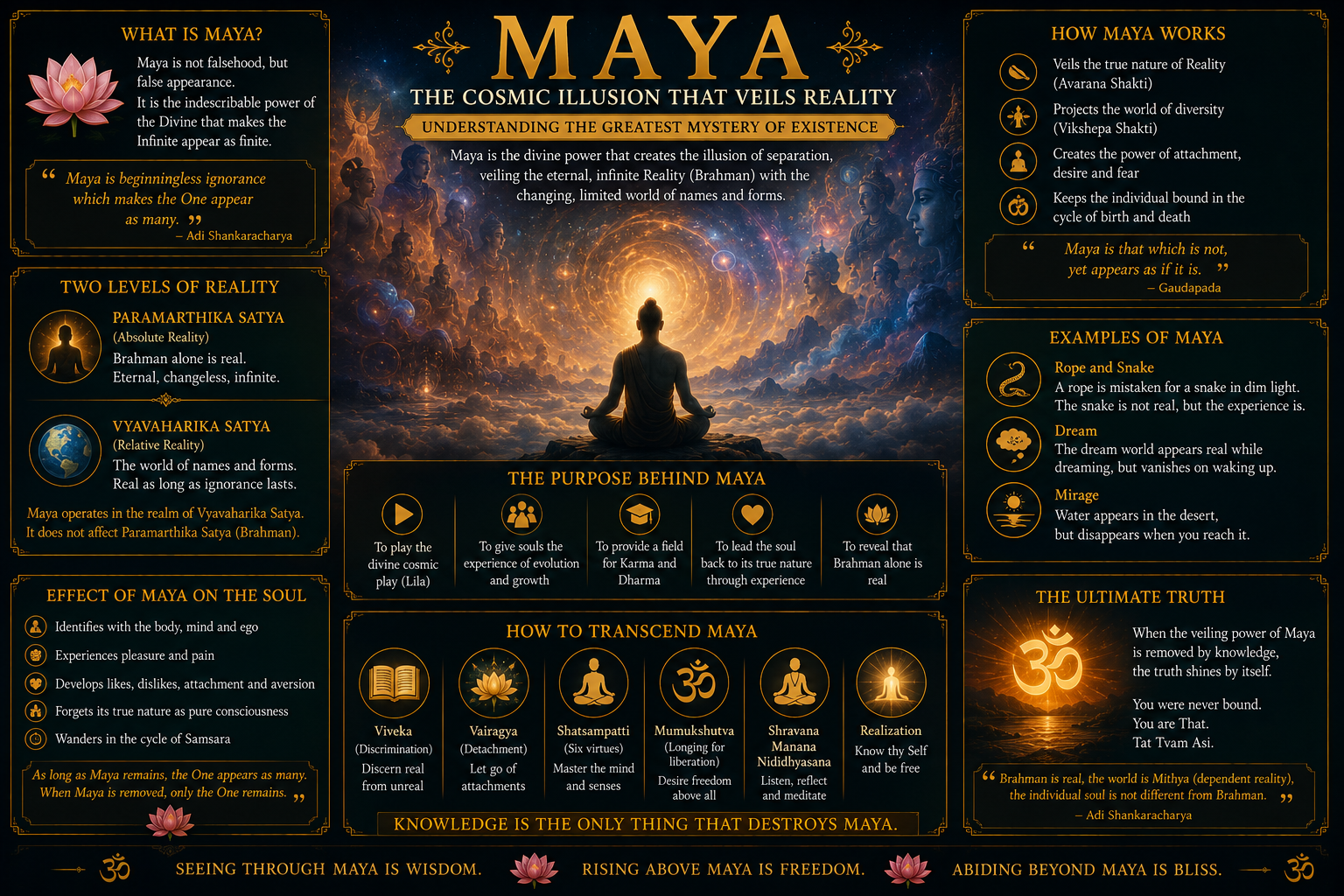
Maya doesn’t mean the world is fake — it means you’re misreading it. Explore the Vedic doctrine of cosmic illusion and why it’s the key to liberation.
Angiras is a primordial Vedic seer associated with sacred fire and a great body of hymns, and the forefather of an illustrious lineage of sages.
Gautama is a Saptarishi and Vedic seer whose name the tradition links to the sacred Godavari river and to deep lessons of patience and forgiveness.
Comments(0)
Loading comments…