
Navaratri: Nine Sacred Nights of the Divine Mother
Navaratri — the nine-night festival of the Divine Mother — is one of the most celebrated festivals in Hinduism. Explore its mythology, the nine forms of Devi, and how it is celebrated across India.
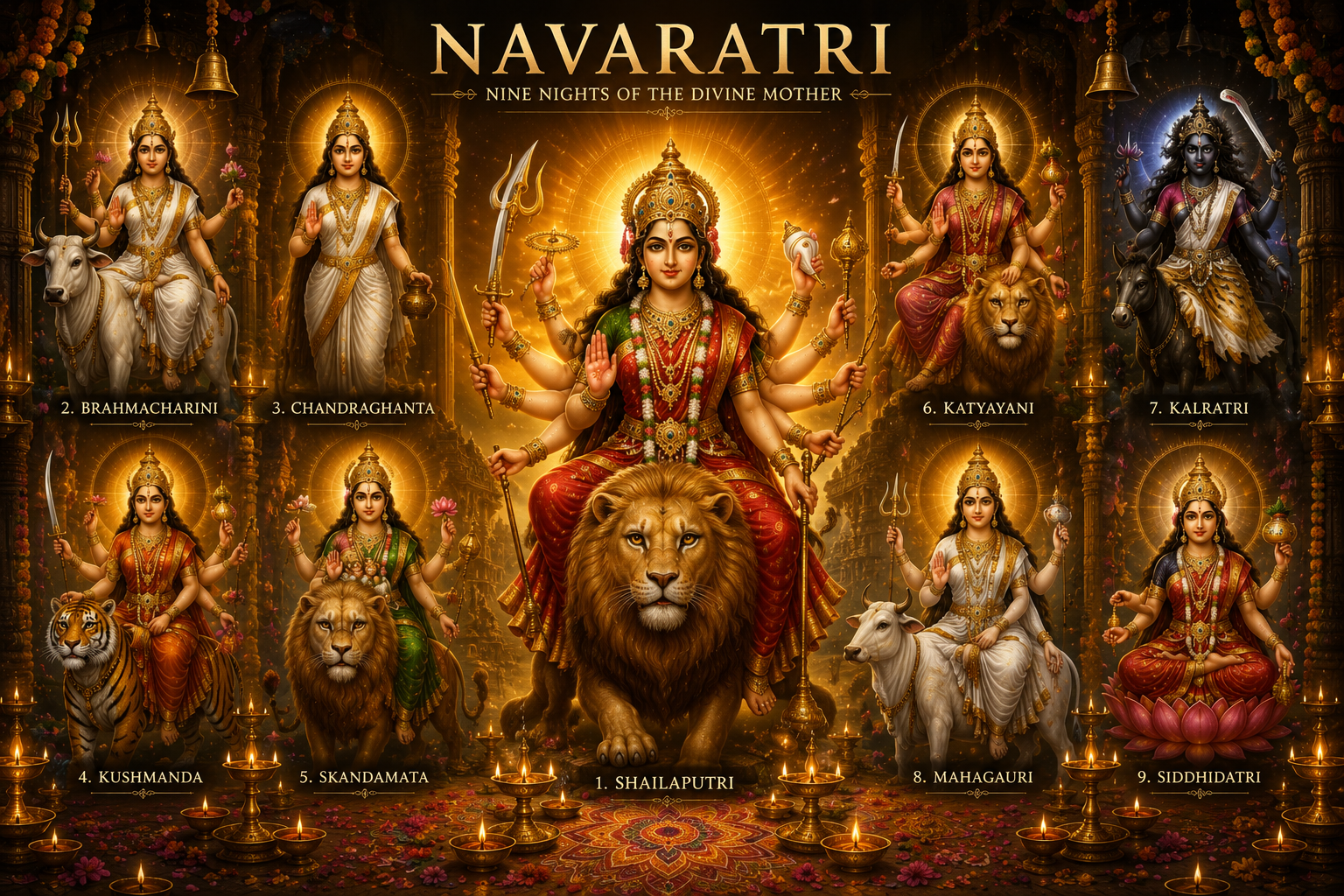
The Festival of the Divine Mother
Navaratri (Sanskrit: nava = nine, ratri = nights) is one of Hinduism''s grandest festivals, celebrated four times a year, with the Sharada Navaratri (autumn, September–October) and Chaitra Navaratri (spring, March–April) being the most significant.
For nine consecutive nights, the universe celebrates the triumph of the Divine Mother — Shakti — over the forces of darkness and ignorance.
The Mythology: Mahishasura Mardini
The primary legend of Navaratri tells of the demon Mahishasura (the buffalo demon), who had obtained a boon from Brahma that no man or god could slay him. Emboldened, he conquered the three worlds and drove the gods from heaven.
The gods, powerless, pooled their divine energies to create Durga — the supreme goddess, embodiment of collective divine power. Armed with weapons gifted by each deity, Durga rode her lion into battle. After nine days and nights of fierce combat, on the tenth day (Vijayadashami — Dussehra), she slew Mahishasura.
This is not merely a battle story — it is the eternal human struggle: the soul (symbolised by the gods) overpowered by the ego and its desires (Mahishasura), and the invocation of inner Shakti — the divine feminine power of awareness and will — to overcome them.
The Nine Forms of Devi (Navadurga)
Each night of Navaratri is dedicated to one of the nine manifestations of Durga:
| Night | Form | Significance |
|---|---|---|
| 1 | Shailaputri | Daughter of the mountains; primal earth energy |
| 2 | Brahmacharini | The ascetic; tapas and spiritual discipline |
| 3 | Chandraghanta | Warrior goddess; courage and grace |
| 4 | Kushmanda | The cosmic egg creator; the source of creation |
| 5 | Skandamata | Mother of Skanda/Murugan; maternal divine love |
| 6 | Katyayani | The fierce warrior; destroyer of arrogance |
| 7 | Kalaratri | The darkest form; destroyer of fear and ignorance |
| 8 | Mahagauri | The radiant white form; purity and peace |
| 9 | Siddhidatri | Bestower of siddhis; all supernatural powers |
Three Phases of Navaratri
The nine nights are also divided into three triads corresponding to the Trimurti''s consorts:
- Days 1–3: Worship of Durga — destruction of impurities and negativities
- Days 4–6: Worship of Lakshmi — invocation of abundance, prosperity, and inner wealth
- Days 7–9: Worship of Saraswati — invocation of wisdom, arts, and learning
Regional Celebrations
Navaratri is celebrated differently across India, each tradition equally magnificent:
- West Bengal / Odisha: Durga Puja — elaborate clay idols of Durga and her family are worshipped in enormous decorated pandals before being immersed in rivers on Vijayadashami
- Gujarat: Garba and Dandiya Raas — nine nights of ecstatic folk dance around a central lamp representing the goddess
- Karnataka / Tamil Nadu: Golu / Bommai Kolu — decorated step arrangements of dolls and figurines depicting sacred scenes
- Kullu, Himachal Pradesh: Elaborate processions of local deities converge on the Kullu valley
- Mysore, Karnataka: The Mysore Dasara is one of India''s most spectacular royal celebrations
The Tenth Day: Vijayadashami (Dussehra)
The festival culminates on Vijayadashami — the victory of good over evil. In North India, effigies of Ravana, Kumbhakarna, and Meghnad are burnt, celebrating Rama''s victory. In South India, it marks the day Arjuna retrieved his weapons from the shami tree before the Kurukshetra war. Students traditionally begin new studies on this auspicious day.
Spiritual Significance
Navaratri is above all an invitation to turn inward. The outer festival — the lights, the dance, the worship — mirrors the inner journey: clearing the darkness of ego (first three days), welcoming abundance of virtue (middle three), and awakening wisdom (final three). The devotee who completes this nine-night inner pilgrimage emerges, like the goddess, victorious over their own Mahishasura.
Related articles in Festivals & Rituals
Parvati is far more than Shiva's consort. She is the primordial Shakti who chose to be born, practised fierce austerities to win a god who wanted nothing, and became the very power without which Shiva cannot act. This is her complete story.
Goddess Lakshmi — the luminous consort of Vishnu and the divine embodiment of wealth, grace, beauty, and auspiciousness — is one of the most universally beloved deities in Hinduism. Worshipped daily in countless homes, invoked at every threshold, and celebrated grandly at Diwali, she is the divine principle that makes all flourishing possible. This encyclopaedic guide covers her origin, the eight Ashtalakshmi forms, her relationship with Vishnu, key mythology, iconography, mantras, festivals, and the profound Vedic philosophy of what wealth and abundance truly mean.
Lord Ganesha — the elephant-headed son of Shiva and Parvati — is the most universally worshipped deity in Hinduism. Before any journey, any enterprise, any prayer, any sacred text is opened, Ganesha is invoked first. This encyclopaedic guide covers every dimension of Ganesha: the competing origin myths, the deep symbolism of every element of his form, his role in all Hindu traditions, the Ganesh Chaturthi festival, the eight Ashtavinayaka shrines, his 108 names, key mantras, his philosophical significance, and his living presence in the world today.
Comments(0)
Loading comments…