
Devi Mahatmyam: The Complete Guide to the 700 Verses of the Goddess
A complete and in-depth guide to the Devi Mahatmyam (Durga Saptashati) — the 700 verses embedded in the Markandeya Purana that form the foundational scripture of the Shakta tradition. Covers the three great episodes (Madhu-Kaitabha, Mahishasura, Shumbha-Nishumbha), the Devi Kavach, Argala, and Kilakam, the “Ya Devi sarvabhuteshu” verse series, the theology of the supreme Goddess, and how to recite the text during Navaratri.
Few scriptures in all of Hinduism carry the concentrated power, the philosophical depth, and the daily living presence of the Devi Mahatmyam. Recited by millions every Navaratri, memorised by generations of priests and householders alike, and studied by scholars across centuries, this text of 700 Sanskrit verses stands as the single most authoritative declaration that the supreme reality of the universe is feminine — not a goddess subordinate to a male deity, but the absolute ground of all existence itself.
The name tells you everything: Devi (Goddess), Mahatmyam (greatness, glory, the sublime essence). The Greatness of the Goddess. Embedded within chapters 81 through 93 of the Markandeya Purana, the Devi Mahatmyam stands as the foundational scripture of the Shakta tradition — the stream of Hinduism that recognises the supreme divine power as Shakti, the primordial feminine energy that underlies all creation, preservation, and dissolution.
This in-depth guide covers every dimension of this magnificent text: its alternative names, its structure and three great narrative episodes, its philosophical theology, the auxiliary prayers (Kavach, Argala, Kilakam), its role in Navaratri recitation, and the tradition of commentary that has surrounded it for over a millennium.
Alternative Names of the Text
The Devi Mahatmyam is known by several names, each illuminating a different facet of the text:
- Durga Saptashati — “Saptashati” literally means “seven hundred” in Sanskrit (sapta = seven, shata = hundred). This name emphasises the form of the text: 700 verses in praise of Durga. It is the most common name used in North Indian and Bengali traditions.
- Chandi or Chandipath — “Chandi” is one of the Goddess’s most fearsome epithets, derived from the root meaning “fierce” or “wrathful.” Chandipath (the recitation of Chandi) is the standard term used in Bengal for the daily or ritual reading. The Goddess in her wrathful, demon-slaying aspect is Chandi.
- Devi Mahatmya (also spelled Devi Mahatmyam) — The Sanskrit compound meaning “the greatness/glory of the Goddess.” This is the scholarly and pan-Indian name, emphasising the text’s theological content rather than its form.
- Sri Sri Chandi — The honorific “Sri Sri” (doubly auspicious) prefixed to Chandi is used in many Eastern Indian traditions, particularly in West Bengal and Odisha, where the text is treated with the reverence accorded only to the most sacred objects.
All these names point to the same 700 verses. In practice, which name a devotee uses often signals their regional and sectarian background — a North Indian Shakta says “Durga Saptashati,” a Bengali says “Chandi” or “Sri Sri Chandi,” and an academic or pan-regional scholar says “Devi Mahatmyam.”
The Author, the Frame Story, and the Sage Medhas
The Devi Mahatmyam is embedded within the Markandeya Purana, one of the eighteen major Puranas of the Hindu tradition. The entire Markandeya Purana is structured as a dialogue between the sage Markandeya and his disciple Kraustuki (also called Bhaguri in some recensions). Within this dialogue, Markandeya narrates the story of a king who encounters the sage Medhas — and that story contains the Devi Mahatmyam.
The frame story is itself a profound piece of theology. King Suratha was a righteous and capable ruler whose ministers betrayed him, whose kingdom was conquered by enemies, and who was left stripped of everything he had built. Wandering in the forest in grief and confusion, he encountered a merchant named Samadhi who had been equally undone by fate — his own wife and sons had driven him out of his home and stolen his wealth, despite all he had given them.
The two men sat together in their shared misfortune. And yet — this is the philosophically important detail — both of them still felt attachment to the very people and things that had caused their ruin. Suratha still longed for his kingdom. Samadhi still felt affection for the family that had betrayed him. How, they wondered, could intelligent, experienced men remain entangled in such painful illusion?
They came to the hermitage of the sage Medhas and put this question to him: What is this power that deludes even the wise? What is this force that makes intelligent beings cling to suffering, that veils the true nature of things?
The sage Medhas answered with the Devi Mahatmyam. The force that creates this cosmic delusion, he told them, is not a mere error of individual minds — it is Mahamaya, the Great Illusion-Power of the Goddess herself. And to understand that power, one must understand her three great deeds in mythological time. Those three deeds are the content of the Devi Mahatmyam.
The frame story thus sets up the text’s central philosophical purpose: not merely to narrate heroic battles between gods and demons, but to explain why consciousness becomes entangled in the world, and how the same divine power that creates the entanglement is also the only power that can liberate from it.
The Structure: Thirteen Chapters, Three Charitas
The 700 verses of the Devi Mahatmyam are organised across thirteen chapters, which in turn fall into three great episodes called Charitas (literally “deeds” or “acts”):
- Prathama Charita (First Episode): Chapter 1 (~90 verses)
- Madhyama Charita (Middle Episode): Chapters 2–4 (~225 verses)
- Uttama Charita (Supreme Episode): Chapters 5–13 (~385 verses)
Each Charita is associated with a different aspect of the Goddess, a different pair of demon adversaries, and a different philosophical theme. They are also associated with the three gunas (qualities of nature): tamas (darkness/inertia), rajas (energy/passion), and sattva (clarity/goodness) — though commentators differ on which episode corresponds to which guna.
The Prathama Charita: Madhu, Kaitabha, and the Cosmic Sleep
The First Episode is set in primordial cosmic time — in the interval between two world-cycles (manvantaras), during the great dissolution (pralaya) when the universe has collapsed and the next creation has not yet begun. Lord Vishnu lies asleep on the cosmic serpent Ananta Shesha, floating on the waters of dissolution. His sleep is not ordinary sleep — it is Yoganidra, the divine yogic slumber, which is itself a power of the Goddess.
In this state of cosmic rest, two drops of wax emerge from Vishnu’s ears and take form as the demons Madhu and Kaitabha. (The symbolic resonance: they emerge from the ears, the organ of hearing, of Vishnu — suggesting they represent primordial tamasic and rajasic energies emerging from within consciousness itself.) These two terrible demons, fuelled by a boon of enormous strength, see Brahma sitting on the lotus that grows from Vishnu’s navel and move to kill him.
Brahma, the creator-god, is helpless — the only one who could save him, Vishnu, is held in the deep unconsciousness of Yoganidra. Brahma therefore prays to the Goddess herself — to Yoganidra, Vishnu’s sleep — asking her to withdraw from Vishnu so that he may wake and fight. The hymn that Brahma sings is one of the earliest and most important theological statements in the entire Devi Mahatmyam: the Goddess is both the creative power that sustains the universe and the power of knowledge that wakes consciousness from its slumber in ignorance.
The Goddess, pleased with Brahma’s prayer, withdraws her presence from Vishnu’s eyes. Vishnu awakens, sees the demons, and a cosmic battle of five thousand years ensues. Madhu and Kaitabha, intoxicated by the Goddess’s own power (she had granted them extraordinary strength precisely to make the battle worthwhile), finally offer Vishnu a boon. He asks for their deaths. They agree — but on the condition that he kill them on ground that is not submerged in water (since all the universe is currently dissolved). Vishnu expands his thighs to form an island above the primordial ocean, and on this piece of solid ground, slays them both.
Philosophical significance: The First Episode establishes the Goddess as Mahamaya — the supreme power of cosmic illusion and cosmic wakefulness simultaneously. She is not separate from Vishnu; she is the very power that enables his existence, his sleep, his awakening, and his action. Without her, consciousness cannot act. With her withdrawal, clarity and power return.
The Madhyama Charita: The Birth of Durga and the Slaying of Mahisha
The Middle Episode is the most visually iconic portion of the Devi Mahatmyam, and the source of the most celebrated image in all of Shakta iconography: Mahishasuramardini, the Goddess who slays the buffalo demon.
The demon Mahisha (the buffalo-demon, or more precisely, the demon who could assume the form of a buffalo) had performed enormous austerities and received the boon that no male being could ever kill him. Armed with this near-invincibility, he led an army that defeated the gods and drove them from heaven. The gods — Brahma, Vishnu, Shiva, and all the rest — were expelled from their own realm.
Gathering in their humiliation and rage, the gods’ anger and power coalesced into visible light — each god emanating from his body a blazing stream of energy. These streams of divine energy met and fused into a single, unified mass of light, which took the form of the Goddess Durga. She emerged fully formed, fully armed — each god contributing a weapon from his own arsenal:
- Shiva gave his trident
- Vishnu gave his discus (chakra)
- Indra gave his thunderbolt (vajra)
- Yama gave his rod of death (danda)
- Varuna gave his noose (pasha)
- Agni gave a spear
- The ocean god gave a garland of lotuses and other ornaments
- Vishvakarma, the divine architect, gave armour
- The Himalayas gave her a lion as her mount
Durga is thus not a single deity’s power — she is the synthesis of all divine power, the totality of cosmic energy in feminine form. The theology is explicit: no individual male deity was strong enough to face Mahisha, but the collective power of all of them, when unified, takes feminine form and conquers.
Mahisha, initially mocked the Goddess — the patriarchal arrogance of the demon assuming a woman could not pose a real threat — but was rapidly overwhelmed. The battle is described in vivid, terrifying detail across three chapters. Mahisha’s army is annihilated. The demon himself cycles through a series of transformations — buffalo, lion, man, elephant, buffalo again — but the Goddess matches each transformation. In the end, as Mahisha emerges half-man-half-buffalo from his buffalo form, Durga pins his neck under her foot and beheads him.
The gods celebrate with a magnificent hymn — the Aparajita Stuti, the Hymn to the Unconquered One — which is among the most theologically rich passages in the entire text, cataloguing the Goddess’s many forms and the cosmic functions she performs.
The Uttama Charita: Shumbha, Nishumbha, Kali, and the Final Battle
The Supreme Episode is the longest and most theologically elaborate of the three Charitas, spanning nine chapters and introducing several of the most important figures in the Goddess’s mythology.
The demons Shumbha and Nishumbha, brothers who rule the three worlds after driving out the gods once more, learn that a supremely beautiful goddess has appeared on the slopes of the Himalayas. She is Ambika — the Goddess in her most radiant, luminous form. Shumbha sends emissaries, then generals, then increasingly powerful armies to either bring her to him as his bride or destroy her. She refuses all overtures with quiet dignity and devastating humour — telling the emissaries that she had once made a foolish vow to marry only the man who could defeat her in battle, and since no one has managed that yet, she remains unmarried.
When the demon generals Chanda and Munda arrive with an army, the battle reaches a new level of intensity. From Ambika’s wrathful face emerges the terrifying goddess Kali — dark, emaciated, with a garland of skulls, a lolling tongue, riding a ghost. Kali slaughters vast portions of the demonic army and seizes Chanda and Munda by their hair, bringing their severed heads to the Goddess. For this deed, the Goddess grants Kali the name Chamunda — the slayer of Chanda and Munda.
Shumbha then dispatches the demon Raktabija (Blood-Seed), the most formidable of all — he possesses a terrible boon: every drop of his blood that falls to the ground instantly generates a new demon identical to himself in size and power. As the Goddess and her shakti forces wound Raktabija, his blood floods the battlefield and creates thousands of new demons. The situation seems unwinnable.
The solution comes through Kali: the Goddess instructs Kali to spread her vast tongue across the entire battlefield. Every drop of Raktabija’s blood — and every new demon created — is instantly consumed by Kali’s extended tongue before it can touch the ground. Simultaneously, the Goddess drives her spear through Raktabija, and with no blood left to regenerate him, he dies.
Shumbha’s brother Nishumbha is then killed in fierce battle. Finally, Shumbha himself comes forward. In a moment of theological climax, Shumbha accuses the Goddess of fighting with the help of others — the other goddesses (Brahmi, Vaishnavi, Maheshvari, and others) who have appeared to assist her. The Goddess responds with one of the most memorable statements in the entire text: these other goddesses are not separate beings — they are all her own manifestations, her own powers, emanated from herself for the purpose of battle. She withdraws them all back into her own body, standing alone.
The one-on-one battle between the Goddess and Shumbha that follows is the climax of the entire Devi Mahatmyam. Shumbha, after a tremendous fight that shakes the cosmos, is finally slain. With his death, the three worlds are restored to order, the gods reclaim heaven, and the Goddess herself disappears — promising to return whenever the world needs her.
The Auxiliary Texts: Kavach, Argala, and Kilakam
The Devi Mahatmyam is not recited in isolation. Before the 13 chapters of the main text, a traditional recitation includes three crucial auxiliary prayers, together called the Trisandhi (three junctions or three locks). These are:
The Devi Kavach (The Armour of the Goddess)
The word kavach means armour, and the Devi Kavach is exactly that — a complete armour of the Goddess’s divine names and forms, systematically assigned to protect every part of the devotee’s body. The prayer begins at the top of the head and works downward through eyes, ears, nose, throat, shoulders, chest, hands, abdomen, waist, thighs, knees, and feet — each body part being placed under the protection of a specific form of the Goddess.
The Kavach is among the most practically important protective texts in the Shakta tradition. Many devotees recite it daily even outside of Navaratri, particularly when setting out on journeys or facing difficult situations. The verses are vivid and specific: “May Aindri protect me in the east; may Agni-Vasini protect me in the southeast; may Varahi protect me in the south…” — the Goddess’s various forms are stationed at every cardinal and inter-cardinal direction, creating a sphere of divine protection around the devotee.
The Argala Stotram (The Bolt)
The Argala is a Sanskrit word for the bolt or pin that secures a door — and the Argala Stotram is understood to be the prayer that “unbolts” the full power of the Devi Mahatmyam for the devotee. It is recited between the Kavach and the main text.
The Argala Stotram opens with what has become one of the most recognisable invocations in all of Shakta worship:
Jayanti Mangala Kali Bhadrakali Kapalini, Durga Kshama Shiva Dhatri Swaha Swadha Namostute
This single verse strings together twelve of the Goddess’s names, each representing a different cosmic function: Jayanti (the victorious), Mangala (the auspicious), Kali (the dark/timeless), Bhadrakali (the benevolent dark one), Kapalini (the skull-bearer), Durga (the inaccessible/invincible), Kshama (forgiveness), Shiva (the auspicious one), Dhatri (the sustainer), Swaha (the sacrificial oblation — the Goddess as fire-sacrifice), Swadha (the ancestral offering — the Goddess as funeral rites). The verse is a theology in miniature: the Goddess encompasses all of existence from birth through death, from the fierce to the gentle, from the cosmic to the most intimate personal rites.
Each verse of the Argala ends with the refrain Rupam Dehi Jayam Dehi Yasho Dehi Dvisho Jahi — “Give me form (beauty/wholeness), give me victory, give me fame, destroy my enemies.” The “enemies” here are understood in the Shakta tradition not merely as external foes but as the inner enemies: kama (desire), krodha (anger), lobha (greed), moha (delusion), mada (arrogance), and matsarya (envy).
The Kilakam (The Pin)
If the Argala is the bolt that unlocks the text’s power, the Kilakam (pin or peg) is the protective mechanism that keeps that power properly contained and directed. The Kilakam is a shorter text that precedes the main Saptashati, narrating a divine dialogue about the conditions under which the Goddess’s power becomes fully accessible to the devotee.
The Kilakam contains the teaching that the Navarna Mantra — Om Aim Hreem Kleem Chamundaye Viche — is the seed (bija) of the entire text. This nine-syllabled mantra (navarna = nine seeds) is considered the most important mantra in Shakta worship. The three bija syllables represent:
- Aim — the bija of Saraswati, the power of knowledge and speech (associated with the Prathama Charita)
- Hreem — the bija of Mahamaya/Bhuvaneshvari, the power of cosmic illusion and sovereignty (associated with the Madhyama Charita)
- Kleem — the bija of Kameshvari, the power of desire, attraction, and fulfilment (associated with the Uttama Charita)
Together, the Kavach, Argala, and Kilakam form a complete preparatory sequence that orients the devotee’s body, speech, and mind before entering the full power of the 700 verses.
The Most Famous Verse: “Ya Devi Sarvabhuteshu”
Of all the verses in the Devi Mahatmyam, none is more widely known, more deeply memorised, or more theologically significant than the “Ya Devi sarvabhuteshu” series, which appears across multiple chapters of the Uttama Charita. The formula is:
Ya Devi sarvabhuteshu [attribute]-rupena samsthita, namastasyai namastasyai namastasyai namo namah
“To that Goddess who dwells in all living beings in the form of [attribute] — salutation to her, salutation to her, salutation to her, salutation again and again.”
The series cycles through an extraordinary range of attributes, asserting that the Goddess is present in all beings as:
- Chiti (consciousness, pure awareness)
- Buddhi (intelligence, discriminative wisdom)
- Nidra (sleep, the power of unconsciousness)
- Kshudha (hunger, the drive of need)
- Chhhaya (shadow, the reflection of the world)
- Shakti (power, energy, the capacity to act)
- Trishna (thirst, the fundamental desire for existence)
- Kshanti (patience, forbearance)
- Jati (species-consciousness, the instinct of being)
- Lajja (modesty, shame — the social conscience)
- Shanti (peace, the quiet of the mind at rest)
- Shraddha (faith, the capacity for devotion)
- Kanti (radiance, beauty, the luminosity of being)
- Lakshmi (prosperity, the goodness of abundance)
- Vritti (activity, the mental modifications that constitute experience)
- Smriti (memory, the continuity of the self through time)
- Daya (compassion, the movement toward the suffering of others)
- Tushti (contentment, the satisfaction of the present moment)
- Mata (the mother principle, the nurturing ground of all being)
- Bhrama (error, confusion — even delusion is a form of the Goddess)
The theological radicalism of this list cannot be overstated. By including not only elevated qualities like consciousness, wisdom, and compassion but also hunger, thirst, sleep, error, and shadow, the Devi Mahatmyam insists that all aspects of lived experience — including the painful, the unconscious, and the confused — are manifestations of the divine feminine. Nothing is excluded from the Goddess. Nothing falls outside her. This is the foundation of Shakta non-dualism.
The Narayani Stuti: The Complete Theological Statement
Near the end of the Devi Mahatmyam, after the defeat of Shumbha and Nishumbha, the gods offer the Goddess a comprehensive hymn of praise known as the Narayani Stuti — often considered the most complete and systematic theological statement of the Goddess’s nature in the entire text.
The Narayani Stuti addresses the Goddess as Narayani — literally “she who belongs to Narayana (Vishnu)” but understood in the Shakta context as “the feminine power that underlies the cosmic ocean (nara).” It catalogues her as:
- The power of creation, preservation, and dissolution in Brahma, Vishnu, and Shiva respectively
- The Saraswati (goddess of knowledge and arts)
- The Savitri (the Vedic goddess of solar light)
- The wife of Vishnu (Lakshmi) and the wife of Shiva (Parvati)
- The Shakti of Indra (Indrani)
- The power of good fortune (Shri) and the power of bad fortune (Alakshmi) — both
- The consciousness in every being
- The highest knowledge (para vidya) and ordinary knowledge (apara vidya)
The stuti concludes with the Goddess’s own promise to her devotees — a promise that runs through the end of the Devi Mahatmyam: whenever the world is threatened, whenever dharma falters, whenever good people call on her, she will manifest. She is never truly absent. She is the power within all things, and she will always be there when she is needed.
Philosophical Significance: Shakta Theology and the Supreme Feminine
The Devi Mahatmyam is not merely a collection of battle myths. It is a systematic theological statement that makes several claims unprecedented in earlier Hindu literature:
The Goddess as the Supreme Absolute
Earlier Vedic and Upanishadic literature recognised goddesses but generally placed them in secondary roles — Saraswati as Brahma’s consort, Lakshmi as Vishnu’s consort, and so on. The Devi Mahatmyam makes a radically different claim: the Goddess is not any deity’s consort or power — she is the supreme Brahma itself, in its active, dynamic, creative aspect. All the male deities are powerful only because she empowers them. When she withdraws, as she withdraws from Vishnu’s eyes in the First Episode, they become inert and helpless.
This is the first text in the Hindu tradition to articulate what scholars call Shaktism or Shakta Advaita — the non-dual philosophy that the ultimate reality is the Goddess herself, with all the apparent multiplicity of the world being her own creative self-expression (her Lila, or divine play).
Maya as the Goddess, Not as Illusion to Be Escaped
In the Advaita Vedanta tradition associated with Adi Shankaracharya, Maya is the power of cosmic illusion — the veil that makes the one Brahma appear as the many things of the world. Maya is, in that framework, something to be seen through and transcended on the path to liberation.
The Devi Mahatmyam takes a fundamentally different position. Mahamaya is the Goddess herself — the supreme creative power that projects and sustains the universe. She is not an obstacle on the path to liberation; she is the path and the destination simultaneously. The devotee does not seek to transcend Maya but to understand her, to worship her, to receive her grace — at which point she herself grants liberation. As the text says in the frame story: the same Mahamaya who causes the world’s delusion is the same power who, when pleased, grants moksha (liberation). She binds and she frees. She is both the lock and the key.
The Integration of the Terrible and the Benevolent
Perhaps the most psychologically sophisticated aspect of the Devi Mahatmyam’s theology is its insistence on holding together what appears to be contradictory: the Goddess is simultaneously the most terrifying being in the cosmos and the most compassionate. Kali, who drinks blood and eats demons, is the same Goddess who is Daya (compassion) and Mata (mother) in the “Ya Devi sarvabhuteshu” series.
The text explicitly refuses to separate the Goddess’s fearsome aspect (her Ugra or Raudra rupa) from her gentle aspect (her Saumya or Kalyani rupa). The same Durga who is serene and beautiful when mounted on her lion is the same who becomes Kali when battle demands it. This integration is not a contradiction but a completeness — the divine does not specialise in comfort only. It encompasses all of reality, including its difficult, destructive, and terrifying dimensions.
The Devi Mahatmyam in Navaratri Recitation
Navaratri (the Nine Nights of the Goddess) is celebrated twice yearly — the major observance in autumn (Sharad Navaratri, usually in September–October) and the minor observance in spring (Chaitra Navaratri). During Sharad Navaratri in particular, the recitation of the Devi Mahatmyam is the central ritual act across North India, Bengal, and many other regions.
The traditional nine-day recitation is structured around the three Charitas:
- Days 1–3 (First three nights): The Prathama Charita (Chapter 1) — associated with the Goddess as Mahakali, the first three days being dedicated to her
- Days 4–6 (Middle three nights): The Madhyama Charita (Chapters 2–4) — associated with the Goddess as Mahalakshmi
- Days 7–9 (Final three nights): The Uttama Charita (Chapters 5–13) — associated with the Goddess as Mahasaraswati
This tripartite structure corresponds to three fundamental cosmic functions: dissolution (Mahakali), preservation and creation of abundance (Mahalakshmi), and pure knowledge and liberation (Mahasaraswati).
The Akhand Paath
The most intensive form of recitation is the Akhand Paath — the unbroken reading of the entire Devi Mahatmyam (all 700 verses, including Kavach, Argala, and Kilakam) in a single sitting without interruption. Traditionally, this is performed by a group of priests in relay, ensuring that the recitation continues without pause. The Akhand Paath can last anywhere from four to eight hours depending on the pace of recitation. It is considered extraordinarily auspicious and is performed at major temples, during life-cycle rituals, and at times of community need.
Regional Traditions of Recitation
Bengal is the heartland of Devi Mahatmyam recitation. The Durga Puja festival — the largest public celebration in India — centres on days seven through ten of Navaratri (Saptami through Dashami), with the Chandipath recited daily at pandals (temporary shrines) across West Bengal and Bangladesh. Bengali tradition has an exceptionally rich oral recitation culture, with skilled paathakas (reciters) trained from childhood in proper pronunciation, intonation, and ritual sequence.
Maharashtra observes Navaratri with the Ghatasthapana (installation of the ritual pot) and daily recitation across nine days. Maharashtrian tradition is particularly associated with the Goddess’s forms at the famous Devi temples — Mahalakshmi at Kolhapur, Bhavani at Tuljapur, and others — all of which conduct intensive Chandipath readings during Navaratri.
Tamil Nadu celebrates Navaratri (called Navarathri in Tamil) with the Golu festival (arrangement of dolls), and the Devi Mahatmyam is recited at temples to Durga, Kali, and Amman goddesses throughout the nine days.
North India (Uttar Pradesh, Bihar, Rajasthan, Madhya Pradesh) has a strong tradition of communal Saptashati recitation during both Chaitra and Sharad Navaratri, often at specific Shakti Peethas (the 51 sacred seats of the Goddess located across the subcontinent).
The Panchadevata System and Shakta Scriptures
Within the broader landscape of Shakta scriptures, the Devi Mahatmyam holds a unique and supreme position. The five most important Shakta scriptures are sometimes grouped together as the Panchadevata system:
- Devi Bhagavata Purana — the primary Purana of the Shakta tradition, 18,000 verses, covering the Goddess’s mythology at vast length and depth
- Kalika Purana — focused on the fierce Kali aspect, particularly important in Assam and the Kamakhya temple tradition
- Mahabhagavata Purana — associated with the Shakti Peethas and the mythology of Sati’s dismembered body
- Brahmavaivarta Purana — covering Radha and the Devi alongside other deities
- Devi Mahatmyam — the shortest, most concentrated, and most universally recited of all
Of these five, the Devi Mahatmyam is unique in being a mantra-text — its Sanskrit is considered so precisely structured and metrically perfect that the sound itself of the recitation carries transformative power, independent of whether the listener understands the literal meaning. This is why it is recited daily by priests even in contexts where Sanskrit is not commonly understood, and why its oral tradition has been maintained with such precision across generations.
Commentaries and Scholarly Traditions
The interpretive tradition around the Devi Mahatmyam is substantial. Among the most important works:
The Santanavi Commentary by Bhaskararaya
Bhaskararaya Makhin (18th century CE) is the greatest scholar-commentator in the Shakta tradition. His commentary on the Devi Mahatmyam, the Guptavati, is universally regarded as the authoritative traditional commentary. Bhaskararaya brought to the Devi Mahatmyam the full resources of the Tantric tradition — reading the text at multiple levels simultaneously: the literal (historical myth), the cosmic (creation theology), and the mantra-shastra level (the metrically encoded mantra structures). His commentary remains the indispensable guide for serious traditional study.
Modern Academic and Translation Work
Thomas B. Coburn’s academic translation and study Encountering the Goddess (1991) brought the Devi Mahatmyam to Western academic audiences with scholarly rigour. Coburn’s earlier work Devi Mahatmya: The Crystallization of the Goddess Tradition (1984) placed the text within the broader history of Sanskrit literature and argued for its pivotal role in crystallising Goddess worship from scattered earlier traditions into a coherent theological system. His work remains the standard academic English resource.
Swami Jagadiswarananda’s translation (Ramakrishna Math) provides a devotional rendering with Sanskrit text and commentary, widely used by practitioners in the Ramakrishna-Vivekananda tradition. Devadatta Kali’s In Praise of the Goddess (2003) offers a poetic English rendering with detailed commentary accessible to both practitioners and non-specialists.
The oral commentary tradition continues in living Shakta acharyas — particularly in the Srividya tradition (which reads the Devi Mahatmyam through the lens of the Sri Chakra and the Lalita Sahasranama), in the Kali temples of Bengal and Assam, and in the Goddess temples of South India where the text is regularly expounded during Navaratri.
How to Recite the Devi Mahatmyam: Traditional Guidelines
The traditional approach to reciting the Devi Mahatmyam is governed by practical guidelines passed down through the priestly and householder traditions:
Preparation and Purity
The text is traditionally recited after bathing, wearing clean clothes, and in a state of mental composure. Strict fasting (particularly during Navaratri recitation) is recommended in the tradition, though most contemporary teachers allow simple food. The recitation should ideally be done in front of an image or symbol of the Goddess — a Yantra, an image of Durga or Kali or Devi Maa, or at minimum a lamp (deepam).
The Sequence of Recitation
The complete traditional sequence is:
- Meditation (Dhyana) — brief meditative verses visualising the Goddess in her three forms
- Navarna Mantra — recitation of “Om Aim Hreem Kleem Chamundaye Viche” a specified number of times (108 is traditional)
- Devi Kavach — the armour prayer
- Argala Stotram — the bolt prayer
- Kilakam — the pin prayer
- The 13 chapters of the Devi Mahatmyam proper
- Devi Suktam (the Vedic hymn to the Goddess from the Rigveda)
- Pradakshina and Namaskara — circumambulation and prostration
The Navarna Mantra
The nine-syllabled seed mantra Om Aim Hreem Kleem Chamundaye Viche is the master key of the Devi Mahatmyam recitation. Traditional commentators explain that the entire 700 verses are an expansion of this mantra — each syllable of the mantra encoding one of the major aspects of the Goddess’s power as revealed in the three Charitas. Initiation into the Navarna Mantra from a qualified guru is considered the optimal approach; however, the mantra is also widely recited without formal initiation by devoted practitioners throughout the Shakta world.
Navaratri Recitation vs Daily Recitation
The most spiritually potent time to recite the Devi Mahatmyam is during Navaratri — the nine nights of the Goddess. The traditional teaching is that the Goddess herself is particularly accessible during this period, when the cosmic energies align with her force. Recitation during Navaratri is said to carry a thousandfold the benefit of recitation at other times.
That said, the tradition also supports daily recitation for those who have taken it as a committed practice (niyama). Many priests and dedicated householders recite the Chandipath daily, particularly the shorter auxiliary texts (Kavach, Argala, Kilakam) when time does not allow the full 13 chapters. The tradition holds that even a single verse of the Devi Mahatmyam, recited with proper intention and concentration, carries protective and transformative power.
The Devi Mahatmyam’s Living Legacy
Few texts in world literature have been recited as continuously, as widely, and with as much living faith as the Devi Mahatmyam. For at least 1,400 years — scholars generally date the text’s composition to between 400 and 600 CE, with some placing it earlier — it has been chanted at dawns and dusks, at births and deaths, at coronations and crises. Its verses are inscribed on temple walls from Kashmir to Kanyakumari. Its imagery — the ten-armed Durga on her lion, Kali with her garland of skulls, Mahisha falling under the Goddess’s foot — is among the most reproduced sacred art in human history.
But beyond its ritual and artistic life, the Devi Mahatmyam carries a philosophical message of startling modernity: that the divine does not stand apart from the world judging it, but is the world in its totality — including its confusion, its hunger, its sleep, its terror, and its love. The Goddess is not a being who exists somewhere else, accessible only through extraordinary efforts of transcendence. She is here, in every living being, as the very capacity to be alive, to want, to know, to act, to sleep, to wake, to err, and to understand.
That is the message of the 700 verses. That is the Devi Mahatmyam.
Key Takeaways
- The Devi Mahatmyam (also called Durga Saptashati, Chandi, or Chandipath) consists of 700 Sanskrit verses in 13 chapters, embedded in the Markandeya Purana (chapters 81–93).
- It is structured around three Charitas — the First (Madhu-Kaitabha), the Middle (Mahishasura), and the Supreme (Shumbha-Nishumbha) — each representing a different cosmic function of the Goddess.
- The text is the foundational scripture of the Shakta tradition, the first to assert the Goddess as the supreme absolute (Brahma in feminine form), not merely a consort.
- The “Ya Devi sarvabhuteshu” verse series declares the Goddess present in all beings as consciousness, sleep, hunger, compassion, error, and every other quality of existence — a radically inclusive theology.
- Before the main text, three auxiliary prayers — the Kavach (armour), Argala (bolt), and Kilakam (pin) — prepare the devotee’s body, speech, and mind.
- The seed mantra of the text is the Navarna Mantra: Om Aim Hreem Kleem Chamundaye Viche — nine syllables encoding all three Charitas.
- During Navaratri, the three Charitas are recited across nine nights, associated with Mahakali (days 1–3), Mahalakshmi (days 4–6), and Mahasaraswati (days 7–9).
- The Guptavati commentary by Bhaskararaya (18th century) remains the authoritative traditional guide to the text’s multiple layers of meaning.
- The Devi Mahatmyam integrates the terrifying and the compassionate aspects of the Goddess, refusing to separate them — the same Kali who slays demons is the same Goddess who is compassion and motherhood.
Frequently Asked Questions
What is the difference between the Devi Mahatmyam and the Durga Saptashati?
They are the same text. Devi Mahatmyam is the Sanskrit name meaning “the greatness of the Goddess,” emphasising the text’s content and theology. Durga Saptashati is the descriptive name meaning “seven hundred verses about Durga,” emphasising the text’s form. In academic and pan-Indian usage, Devi Mahatmyam is preferred; in North Indian and Bengali devotional contexts, Durga Saptashati or simply Chandipath is more commonly used. The text is also called Chandi or Sri Sri Chandi in Bengali tradition.
Who wrote the Devi Mahatmyam, and when was it composed?
Like most Puranic texts, the Devi Mahatmyam does not have a single identified historical author. Within the text’s frame narrative, the sage Markandeya narrates the story to his disciple Kraustuki, and within that story the sage Medhas tells the episodes to King Suratha and the merchant Samadhi. Scholars generally date the text’s composition to between 400 and 600 CE, making it approximately 1,500 to 1,600 years old. Some scholars, particularly those who see continuity with earlier Vedic goddess hymns, argue for an earlier date. The text represents a crystallisation of goddess-worship traditions that likely circulated in earlier, scattered forms before being brought together in this single authoritative composition.
What is the Navarna Mantra and why is it important?
The Navarna Mantra is Om Aim Hreem Kleem Chamundaye Viche — a nine-syllabled (nava = nine, arna = syllable) mantra considered the seed or essence of the entire Devi Mahatmyam. The three bija (seed) syllables — Aim, Hreem, and Kleem — represent the powers of the Goddess as they manifest in the three Charitas: Aim is Saraswati-shakti (knowledge, consciousness), Hreem is Lakshmi-shakti (cosmic power and sovereignty), and Kleem is Kali-shakti (desire and fulfilment). The Kilakam, one of the auxiliary texts, reveals this mantra as the “pin” that unlocks the text’s full power. Many Shakta devotees recite this mantra 108 times before beginning the full Saptashati reading.
Can the Devi Mahatmyam be recited by laypeople, or only by priests?
The text can be recited by any devotee regardless of gender, caste, or priestly status — though different traditions carry different guidelines. The traditional approach recommends reciting after bathing, in clean clothes, with concentration and devotion. Formal initiation (diksha) from a qualified teacher into the Navarna Mantra is considered optimal by many traditional teachers. However, the broader Shakta tradition has always been relatively inclusive: many of the most revered practitioners of Chandipath in Bengal and elsewhere have been householders, women, and people from all walks of life. The text itself, in its closing chapter, promises its blessings to anyone who listens to it with faith, making its accessibility an explicit part of its theological message.
What are the Shakti Peethas, and how do they relate to the Devi Mahatmyam?
The Shakti Peethas are 51 (or 108, by some counts) sacred sites across the Indian subcontinent where parts of the goddess Sati’s body fell when Vishnu dismembered her corpse to stop Shiva’s grief-stricken wandering. Each Peetha is considered a living seat of the Goddess’s power, with a specific form of the Goddess enshrined there. The Devi Mahatmyam is the primary text recited at virtually all Shakti Peethas during Navaratri and other major festivals. The text’s theology — that the Goddess is present everywhere, in all beings and in the earth itself — is made physically concrete in the Peetha tradition, where specific geographic locations are experienced as direct embodiments of divine feminine power. Major Peethas like Kamakhya (Assam), Vaishno Devi (Jammu), Vindhyavasini (Uttar Pradesh), and Kalighat (West Bengal) all have strong Chandipath recitation traditions.
What is the significance of the demon Raktabija’s blood-drop power?
The Raktabija episode is one of the most symbolically rich passages in the entire Devi Mahatmyam. Raktabija (Rakta = blood, Bija = seed) has the power to generate a new demon from every drop of his blood that falls to the ground — meaning that the conventional military tactic of wounding him only makes the problem exponentially worse. Traditional commentators read Raktabija as a symbol of the nature of desire and ego-driven thought: every attempt to suppress or attack a craving directly (cutting it) only multiplies it. The solution — Kali’s extended tongue consuming every drop before it can touch ground — represents the non-dual awareness that “consumes” experience without rejecting it, not allowing the seeds of compulsive repetition to take root. This is why Kali is associated with both the most terrifying destruction and the deepest liberation: she devours not just demons but the very mechanism by which demons perpetuate themselves.
Related articles in Scriptures
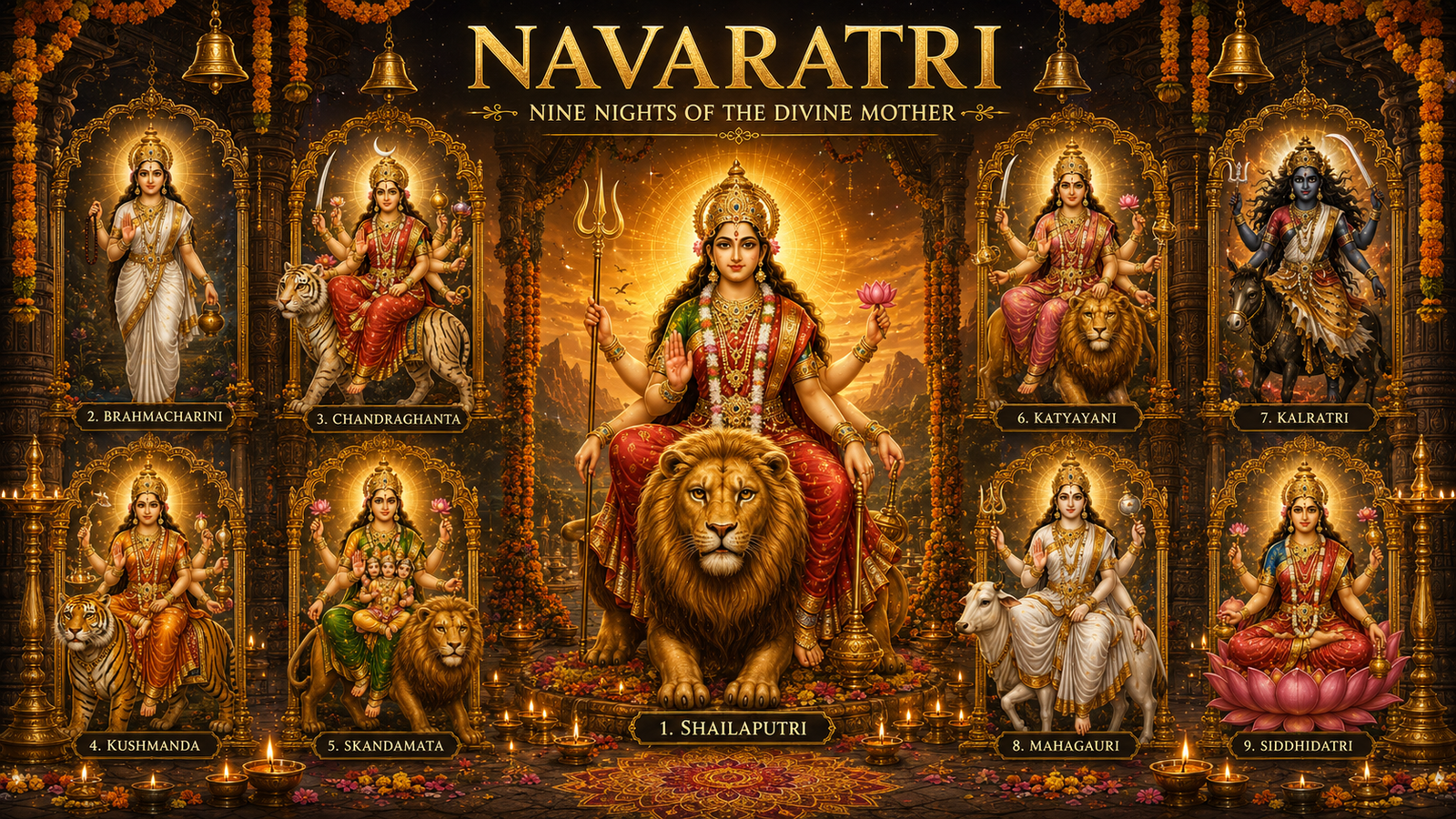
Everything about Navaratri — the nine forms of Durga (Navadurga), the mythology of Mahishasura Mardini, regional celebrations, and the spiritual significance of this nine-night festival.
Sage Jaimini is the founder of the Purva Mimamsa school, honoured for his rigorous inquiry into dharma and the right interpretation of the Vedas.
Bhrigu is a Prajapati and founder of one of the great rishi lineages, linked to Vedic hymns and to traditions of astrology and dharmic reflection.
Comments(0)
Loading comments…