The Essence of Veda-Vedanta: Sanathana Dharma and the Nature of Reality
Sanathana Dharma is not a religion but the eternal way of life guided by Dharma, Karma, Punarjanma and Moksha. Explore the 12 essence points of Vedanta, the wave-and-sea metaphor of individual and Universal Consciousness, and what it means to be ‘anchored in the Absolute Being.’
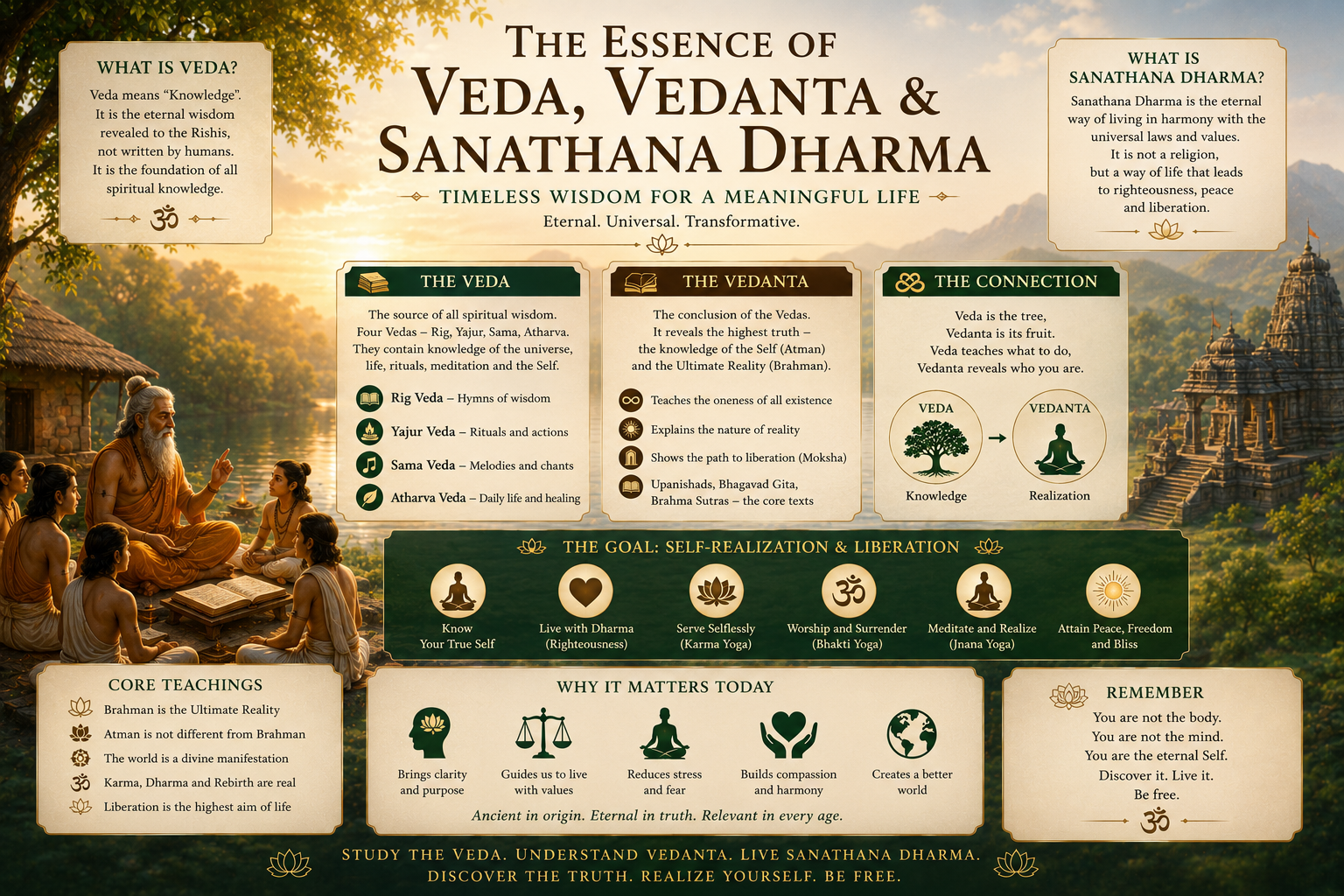
There is a question that has stirred the human heart across millennia: What am I? What is real? What lies beneath the surface of this world I experience every day? The ancient sages of India did not shy away from these questions. They pursued them with extraordinary rigour, and the body of wisdom they arrived at — refined over countless generations — is what we know today as Sanathana Dharma, the eternal way of life, and its philosophical spine, Veda-Vedanta. Together, they constitute one of humanity’s most complete and coherent frameworks for understanding existence, consciousness, and liberation.
This post is a deep dive into the core teachings of Veda-Vedanta as the philosophy behind Sanathana Dharma. We will explore its four foundational pillars, the distinction between the cosmic science of the Vedas and the liberating philosophy of Vedanta, and the twelve essence points that map the journey from individual ego-consciousness to union with the Universal Being. Whether you are new to Hindu philosophy or deepening an existing understanding, what follows is a complete guide to the metaphysical heart of Sanathana Dharma.
What Is Sanathana Dharma? — The Eternal Way of Life
The word Sanathana derives from Sanskrit and means eternal — that which has no beginning and no end, that which transcends the boundaries of time. Dharma is a word of extraordinary richness: it refers to the intrinsic nature of a thing, the right order of existence, the law that sustains the cosmos. Together, Sanathana Dharma means “the eternal way of life that guides the human being in the evolutionary direction — towards higher spiritual orders and ultimately towards salvation.”
It is critical to understand what Sanathana Dharma is not. It is not a religion in the conventional sense of the word. A religion, broadly understood, is a system of beliefs and practices founded by a specific individual at a specific historical moment, demanding faith and loyalty from its adherents and prescribing rewards and punishments accordingly. Sanathana Dharma has no founder, no fixed beginning, and no single human authority. It is not the spiritual vision of one man but the collective wisdom of an infinite lineage of enlightened sages, seers, saints and philosophers stretching back to the farthest reaches of Indian civilisation.
Because it is rooted not in human opinion but in the direct spiritual perception of countless rishis (seers), Sanathana Dharma is described as eternal and universal — as universal as the laws of nature themselves. Just as gravity operates regardless of whether one believes in it, the principles of Sanathana Dharma reflect cosmic realities that operate independently of any individual’s consent or awareness. This is precisely why it is also referred to as Hinduism — though that term, introduced by outsiders, captures only a fraction of the full depth of what Sanathana Dharma represents.
The genius of Sanathana Dharma lies in its inclusiveness. It does not demand a single path, a single form of God, or a single method of practice. It recognises that human beings are at vastly different stages of their spiritual evolution, and it provides teachings, practices and philosophies suited to every stage — from the most elementary acts of devotion to the most refined non-dual insight. It is, in the truest sense, a way of life: an all-encompassing orientation towards reality that permeates every dimension of human experience — ethical, social, intellectual, devotional and contemplative.
The Four Pillars of Sanathana Dharma — Dharma, Karma, Punarjanma, Moksha
Sanathana Dharma rests upon four foundational principles that together describe the entire arc of a human being’s journey through existence. These are not merely philosophical abstractions but practical realities that shape every life.
1. Dharma — Righteous Living
Dharma is the first and foundational pillar. It refers to the righteous way of living — aligning one’s thoughts, words and actions with the divine principles embedded in creation. Living by Dharma means embodying love, compassion, non-violence (except in necessary self-defence or to uphold righteousness), charity, honest fulfilment of one’s duties, service to others as a form of service to the Supreme Being, and the steady cultivation of devotion through prayer, meditation and worship. Dharma also involves the conscious avoidance of deceit, malice, jealousy and all forms of harm to oneself and others. The Four Vedas and the entire tradition of Hindu scripture exist, in large part, to illuminate what Dharma looks like across every dimension of life — from the cosmic to the personal.
2. Karma — The Law of Cause and Effect
Karma is the sum total of all actions — physical, verbal and mental — that bind an individual soul to the cycle of creation. Every action motivated by ego, desire, fear or ignorance generates a karmic impression that must eventually be experienced and resolved. The one who lives fully according to Dharma does not accumulate new karma, because their actions are not motivated by self-centred desire but by the natural movement of dharmic consciousness. Over time, such a person also gradually dissolves the accumulated karma of the past. This is not a mechanical process but a profound spiritual one, intimately connected with the purification of consciousness.
3. Punarjanma — Rebirth
Punarjanma, or rebirth, is the natural consequence of unresolved karma. When a being still carries the imprints of past actions at the time of death, those imprints necessitate a further birth — a further opportunity to work out what remains unresolved. This is not a punishment but a compassionate provision of the cosmic order: the soul is given whatever time and circumstances it requires to complete its evolution. Conversely, one who has lived entirely by Dharma and accumulated no new karma — and has dissolved past karma through spiritual practice — has no cause for further rebirth. The cycle of samsara simply ceases because its fuel, karma, has been exhausted. The concept of Punarjanma also underpins the Purushartha framework — the four goals of human life — which organises dharmic living across successive lifetimes.
4. Moksha — Liberation and Salvation
Moksha is the ultimate goal of Sanathana Dharma — the complete and final liberation of the individual soul from the cycle of birth, death and rebirth. When all karma is dissolved, the individual consciousness (jivatman) no longer has any cause to take birth. In this state, the separate sense of “I” — the ego that imagined itself to be an independent entity — dissolves into the Universal Consciousness (Paramatma). This is not annihilation but the grandest possible fulfilment: the wave returning to the sea, not losing itself but discovering that it was always the sea. This state of eternal rest, of being anchored in the Absolute, is Moksha — salvation.
Veda — The Cosmic Science of Divine Laws
The word Veda means knowledge — not the ordinary empirical knowledge of the senses, but the highest revealed knowledge, transmitted directly from the cosmic intelligence to the purified consciousness of the great seers. Veda is described as the cosmic science — a systematic body of understanding concerning the divine laws that operate throughout creation and the means by which human beings can align themselves with those laws for their own welfare and the welfare of the world.
The Vedic understanding of creation is richly polytheistic in its outer form, though it points towards a single Absolute in its deeper dimensions. The Vedas declare that there are innumerable divine laws — represented as Gods and Goddesses (Devas and Devis) — governing every aspect of creation: fire, wind, rain, abundance, wisdom, time, justice, love and countless others. Each of these can be identified in symbolic form, invoked through specific methods, worshipped and appeased. The Four Vedas — Rigveda, Yajurveda, Saamaveda and Atharvaveda — each represent a distinct branch of this cosmic knowledge:
- Rigveda: The oldest, containing hymns of praise (suktas) to the cosmic powers, composed in the form of magnificent sacred poetry.
- Yajurveda: Concerned primarily with the rituals of sacrifice (yagna) and the precise formulae (mantras) required for their correct performance.
- Saamaveda: The Veda of sacred chant — the hymns of the Rigveda set to elaborately structured musical forms (saamans) for liturgical use.
- Atharvaveda: A comprehensive body of knowledge including healing, protection, cosmology, and practical wisdom for human life.
Vedic practices — worship (puja), fire rituals (yagna and homa), chanting of mantras, and numerous technical disciplines — are understood as methods of aligning the human individual with the great cosmic forces that sustain creation. By propitiating these forces, a person ensures the welfare of their own life and contributes to the larger harmony of the world. The Vedic path is explicitly life-affirming: it does not ask the practitioner to renounce the world but to engage with it in a sacred, conscious and ordered way.
Vedanta — The Philosophy of the Absolute Being
If the Vedas are the outer garment of Sanathana Dharma — the cosmic science of the manifest world and its divine laws — then Vedanta is its innermost heart: the pure philosophy of the Unmanifest Absolute. The word itself means “the end of the Vedas” (Veda + anta = end), referring both to the Upanishads, which form the concluding portions of the Vedic texts, and to the ultimate conclusion that Vedic inquiry reaches. Vedanta is systematically expounded in three foundational texts: the Upanishads, the Bhagavad Gita, and the Brahma Sutras — together known as the Prasthanatrayi.
Vedanta deals not with the manifest laws of creation but with the Unmanifest Absolute Being that is the source, substance and ground of all creation. This Absolute — referred to as Brahma, Paramatma, the Universal Being, or simply THAT — is described as:
- All-pervading: present in every atom of creation without exception
- Omnipotent: the ultimate power from which all other powers derive
- Omniscient: the supreme awareness that knows all, sees all and is all
- The source of bliss, knowledge and peace: not as qualities it possesses but as what it intrinsically is
- The ground of all creation: that from which everything emerges, within which everything is sustained, and into which everything ultimately dissolves
Unlike the cosmic forces of the Vedas, this Absolute cannot be invoked, worshipped or propitiated as an external deity. It is not separate from the one who seeks it. The only way to “reach” it is to become it — or more precisely, to recognise that one was always, already it. This is the great insight of Advaita Vedanta: there is no fundamental separation between the individual soul (Atma) and the Universal Being (Brahma). The teaching, in its most compressed form, is the Mahavakya: Aham Brahmasmi — “I am Brahma.”
The Vedantic way of life is described as simple, natural and universally accessible. It does not require elaborate rituals, high caste status, scholarly credentials or years of ascetic practice (though all of these may have their value at certain stages). The ignorant and the learned, the so-called sinner and the saint — all can follow this path, because it is nothing other than the path of truthful self-inquiry and the gradual dissolution of the false sense of separateness.
The 12 Essence Points of Vedanta — From Creation to Liberation
The following twelve points represent the distilled essence of Vedantic philosophy as passed down through the tradition. Each is a concentrated teaching, carrying enormous depth. We present each point together with the commentary necessary to draw out its full meaning.
- Behind the ever-changing transient reality lies a never-changing eternal reality.
Creation — everything we experience through the senses and the mind — is in constant flux. Forms appear and dissolve; thoughts arise and pass; even the mountains are eroded by time. Yet beneath this river of change, Vedanta asserts, there is a bedrock of absolute stillness: an eternal reality that never changes because it is not subject to time. This is not merely a philosophical assertion but a direct experiential discovery made by those who have turned their awareness inward with sufficient depth and sincerity. - The ever-changing reality is confined by time and space; the never-changing eternal Reality is beyond time and space and unaffected by the changing realities.
Everything in creation — every object, event, experience — exists only within the coordinates of time and space. Remove time and space and creation, as we know it, cannot exist. But the Absolute Being is not located in time or space; it is that in which time and space themselves arise. It is the container, not the contained. It cannot be affected by anything within creation any more than a cinema screen is affected by the battles and romances projected upon it. - The goal of the ever-changing reality is THAT never-changing reality, for the never-changing reality alone is the Absolute truth.
All of creation — every life, every quest, every longing — is, at the deepest level, a movement towards the Absolute. Even when human beings seek happiness through objects, relationships or achievements, they are unknowingly seeking the absolute and unconditional joy that is the nature of Brahma. The finite always seeks the infinite; the transient always reaches for the eternal. This inner gravitational pull is not a design flaw in existence but its very purpose. - The ever-changing reality (transient truth) is called Creation, which includes the entire animate and inanimate creation.
Everything that has name, form and location in time and space — every atom, every galaxy, every thought, every living being — belongs to creation, the ever-changing field of manifestation. This includes the physical world of matter, the subtler world of energy, the still subtler worlds of mind, intellect and individual ego. All of this is creation. And all of it is transient — not ultimately real in the Vedantic sense, though it is real as Maya — the phenomenal appearance of the Absolute. - The never-changing Reality is the Absolute Being — Universal Consciousness that is all-pervading, omnipresent, omniscient and omnipotent.
This is not a personal God in the theistic sense but the very ground of being itself: pure, unlimited, self-luminous awareness. It is not a thing among other things but the very context in which all things appear. It is what is left when everything transient is stripped away — and it turns out to be not emptiness but the fullness of all fullnesses. - From this never-changing Reality, the ever-changing creation manifests like waves on the surface of the sea.
Creation is not something external to or separate from the Absolute. It is the Absolute expressing itself — manifesting as form within the coordinates of time and space, the way waves manifest on the surface of the sea without ever being anything other than sea-water. The source is always present within the manifestation. This is why the entire creation is, in essence, divine. - The waves have no independent existence; they depend on the sea, which is their only source. Similarly, the individual ego, when it dissolves into the Universal Being, ceases to exist as an individual but IS there as the Universal Being.
A wave is not something separate that was attached to the sea — it is the sea, momentarily shaped by wind and current into a particular form. When the wave recedes, it does not die; it simply ceases to be a wave and returns to being what it always was: the sea. So too, the individual ego or soul (jiva) is not a separate entity that must somehow travel to God. It is always already Brahma, momentarily shaped by Maya into an apparently separate form. Liberation is the recognition of this — not the creation of something new but the dissolution of a false appearance. - The ever-changing reality is Dynamic Divinity; the never-changing eternal Reality is Static Divinity.
Vedanta does not deny the reality of the world — it reframes it. The manifest creation is not mundane matter but Dynamic Divinity: energy and consciousness acting together, constantly moving, generating, sustaining and dissolving forms. The Unmanifest Absolute is Static Divinity: pure consciousness that is absolutely still, absolutely full and absolutely without movement — the ground from which all dynamism springs and into which it returns. This teaching prevents two errors: the error of thinking the world is meaningless (nihilism) and the error of thinking the world is ultimately real (materialism). - Your true nature is not the dynamic body, mind, intellect or ego, but that never-changing, static, eternal Reality. Therefore, the goal of the individual ego is to reach the Universal Being.
This point is the heart of the entire teaching. When we say “I,” we typically mean the body, the mind, the personality, the history — all of which are changing, limited and mortal. But Vedanta asks: who is it that observes all these changes? The body changes from childhood to old age — but who watches? The mind moves through countless moods and thoughts — but who is aware of them? That awareness itself — silent, still, unchanging — is your true nature. Not the instrument of perception but the ground of perception: the pure witness-consciousness that is always already present, always already free. - All that exists in reality is only the Universal Being, pervading both manifest and unmanifest fields. All that has manifested is nothing but the Universal Being itself. This alone is the Absolute truth.
This is the non-dual vision: there is only One Reality, appearing as the many. The diversity of creation — all its forms, names, distinctions and opposites — is real at the level of appearance but not at the level of essence. At the level of essence, the flower, the rock, the star, the human being and the enlightened sage are all the same Universal Being wearing different temporary forms. This is not a comforting metaphor but a precise ontological statement, supported by direct experiential verification in the tradition of Indian philosophy. - The Universal Being is eternally aware of itself and is the silent witness to all its manifestations, totally non-interfering, the finest existence, full of Bliss, Knowledge and Peace.
The Absolute does not get involved in the drama of creation the way a person gets emotionally entangled in a film they are watching. It is the screen itself — perfectly neutral, perfectly still, fully present for everything that appears, but touched by none of it. This is described as Satchidananda: Sat (pure being), Chit (pure consciousness) and Ananda (pure bliss) — not three qualities but one indivisible nature. This is the goal of Moksha: to realise and abide as this witness-consciousness. - The Universal Being can transcend itself to a state of ZERO (EVEN state) — beyond peace, bliss and knowledge — which is pure Awareness alone. This is Shuddha Jnana — beyond even Brahma Jnana.
This twelfth and most subtle point points beyond the traditional Vedantic goal. Even the state of abiding as Universal Being, full of bliss and knowledge, can be transcended to a condition the tradition calls Shuddha Jnana — Pure Knowledge or the Zero State. Here, all distinctions collapse entirely — even the distinction between “the one who knows” and “what is known.” This is described as the EVEN state: not bliss, not peace, not knowledge (as objects of experience), but the pure and undivided Awareness in which all these arise. It is the other side of the Universal Being — the “SHUDDHA ABSOLUTE” in which everything exists in its most unmanifest, undifferentiated potential.
The Wave and the Sea — Vedanta’s Most Profound Metaphor
Of all the metaphors in Vedantic philosophy, the image of the wave and the sea is perhaps the most beloved and most illuminating. It appears in many forms across the tradition, but in its most precise articulation it carries the complete non-dual teaching within itself.
Consider a wave on the surface of the ocean. It has a particular shape, a particular height and width, a particular direction of movement, a particular moment of arising and a particular moment of subsiding. In this sense, it appears to be a distinct individual entity — identifiable, nameable, different from other waves. But what is it made of? Sea-water. What sustains it? The sea. What will it return to? The sea. At no point is the wave anything other than the sea itself, temporarily shaped into a particular form by conditions of wind and current. There is, at the level of essence, no separation between wave and sea — only appearance of separation.
So long as the wave maintains its distinct form, it cannot “become” the sea — not because it is separate from the sea, but because the very form of the wave is a temporary shape taken by the sea. When the wave recedes, when the form dissolves, the sea-water that was momentarily a wave is once again simply sea. It has not gone anywhere. It has not been destroyed. It has simply ceased to maintain the form of separateness and returned to what it always was.
This is precisely the Vedantic teaching about the individual soul and Universal Being. The jiva — the individual ego, the sense of being a separate self — is like the wave. It appears distinct, with its own personality, history, desires and fears. But at the level of essence, it is nothing other than the Universal Being momentarily shaped by Maya into an apparent individual. When the ego dissolves — through sustained dharmic living, devotion, self-inquiry or meditation — the “wave” recedes. What remains is the Universal Being itself: unbounded, unmoving, eternally full. The individual has not been destroyed; the illusion of separation has been seen through.
Dynamic Divinity and Static Divinity — Understanding the Manifest and Unmanifest
Vedanta offers a uniquely sophisticated framework for understanding the relationship between the ever-moving world of creation and the absolutely still ground of Being that underlies it. This framework is captured in the distinction between Dynamic Divinity and Static Divinity.
Dynamic Divinity is the name given to the manifest creation: the entire world of energy and consciousness acting jointly or separately — all the forms, forces, cycles and processes that constitute the universe as we experience it. Dynamic Divinity is divine not in a figurative sense but in a literal one: every particle of creation is a direct expression of the Absolute Being, carrying its consciousness and energy within it. The trees, the stars, the rivers, the thunder, the human nervous system — all are manifestations of the same Divine intelligence, vibrating at different frequencies and playing different roles within the cosmic drama. To perceive the world through this lens is to move from ordinary perception to sacred perception — to see the face of the Divine in every face.
Static Divinity is the Unmanifest Absolute: pure consciousness that is absolutely still, absolutely self-sufficient and absolutely without internal or external movement. It is the ground from which all dynamic expression springs and the ocean into which all waves eventually return. It is not “static” in the sense of being dead or inert — on the contrary, it is the most alive of all realities, the source of all vitality. It is static in the sense of being unchanging, unaffected and always already complete. The Brahma Sutras and the great Upanishads repeatedly circle back to this understanding: that the Absolute is self-luminous, self-complete and requires nothing outside itself to exist or to know itself.
The relationship between these two dimensions of Divinity is not one of opposition or conflict. Dynamic Divinity is not separate from Static Divinity — it is Static Divinity in motion, the still ocean expressing itself as waves, the silence expressing itself as sound. The goal of Advaita Vedanta is to realise both dimensions simultaneously: to be fully engaged with the dynamism of life while remaining rooted, without effort, in the absolute stillness of the Unmanifest ground. This is the state the Bhagavad Gita describes as Sthitaprajna — the person of steady wisdom.
Shuddha Jnana — The Zero State Beyond Brahma Jnana
Most Vedantic teaching culminates in Brahma Jnana — the direct knowledge of Brahma, the Universal Being. This is the state in which the individual ego has dissolved and the practitioner abides in the non-dual recognition that “I am Brahma.” This is the state described as Satchidananda — pure being, pure consciousness, pure bliss — and it is the highest goal recognised in most classical Vedantic systems.
But the tradition of Sanathana Dharma points to a state even beyond this: Shuddha Jnana, the Zero State, the EVEN state. In Brahma Jnana, there is still, subtly, a recognition: “There is bliss,” “There is knowledge,” “There is peace.” Even in the most refined non-dual abiding, there remains the faintest trace of awareness recognising itself as awareness. Shuddha Jnana transcends even this. It is described as the state where the Universal Being transcends itself — where even the categories of bliss, knowledge and peace cease to function as objects of experience and there is only pure, undivided, undifferentiated Awareness.
This is called the ZERO state not because it is empty in the nihilistic sense, but because it is the perfect equilibrium — the EVEN state — in which all distinctions, including the distinction between “knower” and “known,” have been completely dissolved. Everything exists within this state in its most unmanifest potential: not as known things but as the pure possibility from which all knowing arises. The tradition describes this as SHUDDHA-ABSOLUTE: the highest state, beyond description, beyond experience in the ordinary sense, and yet the most intimate and fundamental reality of all.
This teaching is not presented as an intellectual concept to be analysed but as a pointer towards the most profound dimension of consciousness — the ultimate depth beneath even the experience of liberation. It is the final word of Sanathana Dharma: beyond all goals, all states and all descriptions, there is the Zero — the pure silent awareness that is the source and end of all.
Salvation — “Here or There It Does Not Matter”
One of the most beautiful and counterintuitive statements in the entire tradition of Vedanta is this: “Here or there, it does not matter — for IT (Universal Being) is everywhere and there is nowhere to go in the FULLNESS.” This single statement dissolves centuries of misunderstanding about what Moksha actually means.
Salvation in Sanathana Dharma is not a journey to a distant heaven, not an escape from the world, not a reward granted by a judging God at the moment of death. It is the complete and final dissolution of the false sense of separation — the dropping away of the ego’s insistence on being an independent entity separate from the rest of existence. When this drops away, what remains is the Universal Being: unbounded, timeless, present everywhere simultaneously. There is, quite literally, nowhere to go — because the Universal Being is already everywhere. The seeking ends not because the destination has been reached but because the seeker dissolves and it is seen that there was never anywhere to arrive at.
The liberated being — sometimes called a jivanmukta (one liberated while still in the body) — continues to function in the world. The body continues to breathe, speak and act. The mind continues to process information. But the identification with body and mind as “me” has dissolved. Actions arise spontaneously, in perfect alignment with Dharma, without the friction of ego-desire. The person is fully present in the world while simultaneously abiding in the Absolute. This state is described in the tradition as STHITHAHA — anchored in the Absolute Being, the stillness beneath all movement, the silence beneath all sound, the one truth beneath all appearances.
Once fully established in the Universal Being, the individual is “freed from all desires, sorrows, attachments, pains and pleasures that exist in the world.” This is not a description of numbness or indifference — the liberated being is often described as overflowing with compassion, love and joy. It is rather the freedom that comes when one’s happiness is no longer contingent on any particular external circumstance. The waves of the world rise and fall, but the one who is established in the sea is unmoved. This is the promise and the invitation of Veda-Vedanta: not a distant possibility for a select few, but the deepest truth of every human being’s nature — waiting to be discovered.
Related Articles
Further Reading
- The Reality of Creation: Maya and Existence
- Advaita Vedanta: The Complete Guide
- Maya — The Cosmic Illusion That Veils Reality
- Dharma — The Cosmic Law of Right Living
Frequently Asked Questions
1. What is the difference between Sanathana Dharma and Hinduism?
Sanathana Dharma is the original, self-given name for the eternal way of life followed by the people of India — it means “the way of life that is eternal and universal.” Hinduism is a later name introduced by outside cultures, derived from the geographical term for the people living beyond the Sindhu (Indus) River. While both terms refer to the same tradition, Sanathana Dharma is considered more precise and comprehensive, emphasising the timeless philosophical and spiritual principles rather than a geographically or ethnically defined group.
2. What is the relationship between Vedas and Vedanta?
The Vedas and Vedanta are complementary dimensions of a single great tradition. The Vedas, in their outer aspect, provide the framework of cosmic law, ritual, and right living — aligning human activity with the divine forces of creation. Vedanta, which literally means “the end of the Vedas,” is the philosophical conclusion that Vedic inquiry reaches: the direct knowledge of the Absolute Being (Brahma) as the only ultimate reality. The Vedas prepare the ground through right living and devotion; Vedanta consummates the journey through liberating self-knowledge.
3. Is Vedanta only for advanced spiritual practitioners?
According to the tradition itself, Vedanta is accessible to all — the ignorant and the learned, the so-called sinner and the saint. Its essential teaching — that your true nature is not the body, mind or ego but the universal, unchanging awareness — requires no special credentials. What it requires is sincerity, sustained reflection and the willingness to question one’s habitual assumptions about who one is. Different traditions within Vedanta offer different methods (devotion, self-inquiry, service, meditation) suited to different temperaments and stages of development.
4. How does Karma relate to the four pillars of Sanathana Dharma?
Karma is the pivotal link between Dharma and Moksha. When an individual lives by Dharma — righteous living guided by love, truth, non-violence and devoted service — they do not accumulate new karma, and their practice gradually dissolves accumulated karma from past lives. Without new karma being generated and old karma being resolved, there is no cause for further rebirth (Punarjanma). When karma is fully exhausted, the individual achieves liberation (Moksha). The four pillars are therefore not separate principles but a single continuous arc: Dharma leads to the dissolution of Karma, preventing further Punarjanma and culminating in Moksha.
5. What is Shuddha Jnana and how does it differ from ordinary enlightenment?
Brahma Jnana — the direct knowledge of Brahma — is the classical goal of Vedantic practice: the recognition that “I am the Universal Being, not the body or ego.” Shuddha Jnana (Pure Knowledge, or the Zero State) points to something even more subtle. In Brahma Jnana, there is still a residual experience of bliss, peace and knowledge as recognisable qualities. In Shuddha Jnana, even these qualities dissolve as objects of experience and what remains is pure, undivided Awareness alone — the EVEN state — in which all distinctions, including the distinction between knower and known, are completely transcended. The tradition describes this as the most profound dimension of the Absolute, beyond all description.
Related articles in Dharma & Philosophy
Sage Jaimini is the founder of the Purva Mimamsa school, honoured for his rigorous inquiry into dharma and the right interpretation of the Vedas.
Maitreyi, a brahmavadini and wife of the sage Yajnavalkya, is remembered for choosing the knowledge of the Self over wealth in one of the most moving Upanishadic dialogues.
Yajnavalkya is a towering sage of the Upanishads, whose dialogues with King Janaka, Gargi and Maitreyi gave the tradition some of its deepest teachings on the Self.
Comments(0)
Loading comments…