
Ganesh Chaturthi: The Complete Festival Guide — History, Rituals, and Significance
A comprehensive reference on Ganesh Chaturthi — covering the mythology of Ganesha’s birth, Tilak’s revolutionary transformation of the festival, the 10-day celebration, regional traditions from Maharashtra to Andhra Pradesh, Visarjan rituals, and the profound symbolism behind every aspect of the elephant-headed deity.
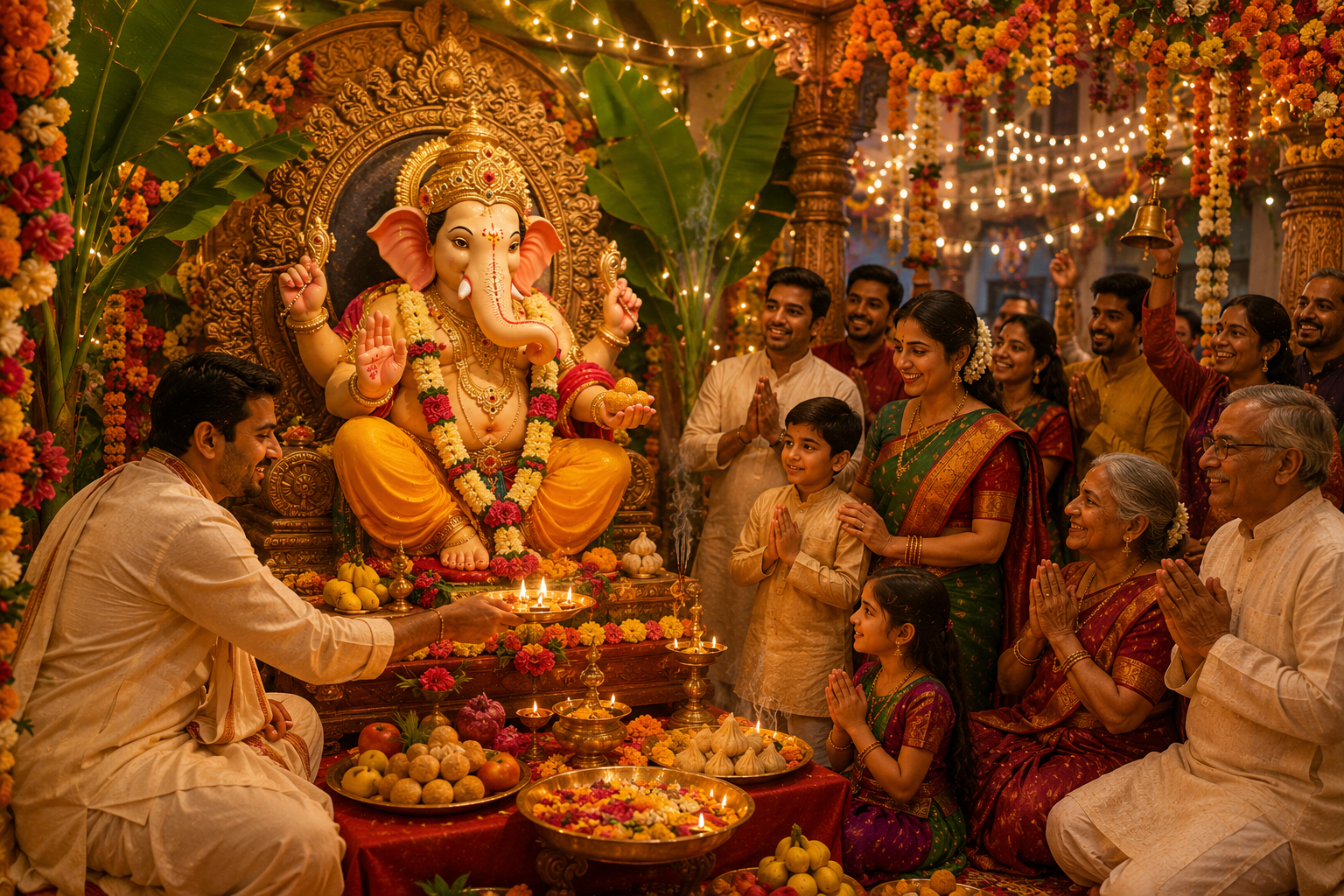
Ganesh Chaturthi — known in South India as Vinayaka Chaturthi — is among the most jubilant, theologically rich, and historically consequential festivals in the Hindu calendar. Observed on the fourth day (chaturthi) of the bright fortnight (shukla paksha) of the month of Bhadrapada (August–September), it celebrates the birthday of Lord Ganesha, the elephant-headed son of Shiva and Parvati, and one of the most beloved deities in the entire Hindu pantheon. From the narrow lanes of Pune where a neighbourhood potter crafts a ten-foot idol from river clay, to glittering pandals in Hyderabad that draw millions over eleven days, Ganesh Chaturthi is a living, breathing spectacle of devotion, community, art, and social cohesion. This guide traces the festival’s mythological roots, its extraordinary political reinvention in 1893, the precise choreography of its ten-day rituals, its regional flavours, and the dense symbolic vocabulary encoded in every curve of Ganesha’s iconography.
Who Is Ganesha? The First Among Gods
Ganesha — also spelled Ganesa, Ganapati, Vinayaka, Pillaiyar, or Ekadanta — is the lord of beginnings and the remover of obstacles (Vighnaharta). He is the first deity invoked in virtually every Hindu ritual, whether a wedding, a business launch, a journey, or the chanting of scriptures. His iconography is instantly recognisable: the rotund, saffron-smeared body of a man, the head of an elephant, a single intact tusk, large fan-like ears, a trunk that curves to the left or right, four arms holding a noose (pasha), a goad (ankusha), his broken tusk, and a modak (sweet dumpling); and beneath his enormous belly, a tiny mouse (mushika) serves as his vehicle. He is the patron of arts, sciences, wisdom, and intellect, the scribe who wrote down the Mahabharata as Vyasa dictated it, and the commander-in-chief (ganapati) of Shiva’s celestial army of attendants (ganas).
Ganesha’s worship cuts across sectarian lines. He is propitiated by Shaivites, Vaishnavites, Shaktas, and even Smartas — followers of Adi Shankaracharya’s tradition who include Ganesha among the five principal deities (panchayatana). Across the Hindu diaspora in Fiji, Mauritius, South Africa, the UK, and the United States, Ganesh Chaturthi has become a unifying cultural landmark. Understanding why requires reaching back into mythology.
Origins and Mythology: The Birth of Ganesha
Parvati’s Creation
The most widely recounted origin story comes from the Shiva Purana. The goddess Parvati, consort of Shiva, desired a loyal attendant who owed allegiance solely to her. One day, while Shiva was absent, she fashioned a boy from the turmeric paste (haridra ubtan) she had been rubbing from her own body — in some versions, from sandalwood paste — breathing life into him and appointing him as guardian of her doorway. When Shiva returned, the boy, faithful to his duty, barred his entry. Shiva, unaware of the boy’s identity, was infuriated. A battle ensued. Ultimately, Shiva beheaded the boy with his trident, sending his head beyond the cosmos.
Parvati was devastated and furious. To appease her, Shiva dispatched his attendants northward with instruction to return with the head of the first living being they encountered sleeping with its head pointing north — the direction considered inauspicious for sleeping, and thus inhabited by those with the least fear of death. They returned with the head of an elephant. Shiva attached the elephant head to the boy’s body, restored him to life, and declared him Ganapati — the lord of all the ganas — to be worshipped before all other deities in any ritual.
Why First? The Decree of Seniority
The Mudgala Purana, one of the minor Puranas dedicated entirely to Ganesha and regarded as the canonical scripture of the Ganapatya sect, provides a further explanation. When Shiva and Parvati asked their two sons — Ganesha and the war god Kartikeya (Murugan) — to circumambulate the universe, Kartikeya mounted his peacock and flew around the cosmos. Ganesha simply walked around his parents, declaring that for him, his parents were the entire universe. Shiva was so moved by this display of wisdom and filial devotion that he declared Ganesha the eldest in spiritual seniority, to be invoked before any deity or undertaking. This story encapsulates the Hindu philosophical insight that wisdom (jnana) transcends mere physical effort.
Ganesha as Vighneshvara: Lord of Obstacles
The Mudgala Purana elaborates Ganesha’s role as Vighneshvara — not merely remover of obstacles but also their creator for the unworthy or unprepared. The eight classical forms of Ganesha described in the Mudgala Purana each defeat a distinct asura (demon) embodying a human failing: Matsara (envy), Mada (pride), Lobha (greed), Krodha (anger), Kama (lust), Mamata (possessiveness), Abhimana (ego), and Moha (delusion). In propiciating Ganesha before any endeavour, the devotee invites his grace not just to clear external obstacles but to subdue these internal ones. This deep psychological architecture is why Ganesha’s relevance transcends agricultural seasons or dynastic patronage — his worship is perennial and personal.
Historical Roots: Peshwa Patronage and Maratha Celebration
While Ganesha worship is ancient — iconographic evidence dates to at least the second century CE, and the Ganapatya sect flourished by the seventh century — the specific festival format of Ganesh Chaturthi as a public, multi-day celebration has identifiable historical origins in the Deccan.
Chhatrapati Shivaji Maharaj (1630–1680), the founder of the Maratha Empire, reportedly encouraged public Ganesh Chaturthi celebrations as a means of fostering community solidarity among his troops and subjects. Shivaji understood that shared religious observance could transcend caste and regional divisions, binding his diverse army into a cohesive fighting force. Though documentary evidence from Shivaji’s own reign is limited, chronicles from his successors confirm the festival’s growing public character under Maratha rule.
It was under the Peshwas — the Brahmin prime ministers who effectively ruled the Maratha Confederacy from Pune (Poona) through the eighteenth century — that Ganesh Chaturthi became a grand state festival. Since Ganesha is the tutelary deity of the Chitpavan Brahmin community (the Peshwas’ own community), he was elevated to the status of the Peshwa dynasty’s presiding deity (kuladevata). Pune’s Dagdusheth Halwai Ganapati, though formally established later, traces its neighbourhood’s devotional tradition to this Peshwa legacy. Public celebrations, sponsored feasts, classical music, and distribution of prasad became hallmarks of the festival during this era. After the fall of the Peshwas in 1818 following the Third Anglo-Maratha War and British annexation of the region, the public festival shrank back into private household observance — until one man changed everything.
Bal Gangadhar Tilak, 1893: From Private Puja to Public Freedom Movement
No figure is more important to the modern history of Ganesh Chaturthi than Bal Gangadhar Tilak (1856–1920), the freedom fighter, journalist, and nationalist intellectual known as Lokmanya — “beloved of the people.” Tilak understood, with the instinct of a political genius, that India’s struggle against British colonial rule required a mass movement, and that mass movements require mass mobilisation. The challenge was immense: the Indian population was fragmented by caste, language, and region. The British policy of divide and rule deliberately exacerbated these divisions. Public assembly was restricted; political meetings were viewed with suspicion and often suppressed.
In 1893, Tilak recast Ganesh Chaturthi as a sarvajanik (public) festival in Pune. His insight was elegant: religious gatherings could not be prohibited by the colonial administration as easily as political meetings. By anchoring a freedom-movement message inside a devotional festival, Tilak created a venue for nationalist speeches, cultural performances, patriotic songs, the distribution of vernacular newspapers and pamphlets, and the forging of cross-caste Hindu solidarity — all under the protective canopy of religious observance.
Tilak’s sarvajanik model was deliberately egalitarian. He insisted that the festival pandals be open to all Hindus, regardless of caste. The communal sharing of food (prasad), the joint singing of devotional songs (bhajans), and the collective procession to the river for immersion (visarjan) created moments of unity that deliberately subverted the British narrative of Indian social incompatibility with self-governance. Over the following decade, the festival spread from Pune across Maharashtra, and by the early twentieth century it had become a pan-Indian phenomenon. Tilak’s newspaper Kesari covered each year’s celebrations as front-page news, amplifying the movement’s reach.
Historians of the Indian independence movement regard Tilak’s Ganesh Chaturthi as one of the earliest successful examples of what would later be called “soft power nationalism” — the weaponisation of culture and religious identity as instruments of political resistance. The slogan that emerged from these gatherings — “Swarajya is my birthright and I shall have it” — was first articulated by Tilak during a Ganesh Chaturthi address. The festival thus carries within it a double helix of devotion and democracy, of mythology and modernity.
The Ten-Day Celebration: A Day-by-Day Guide
Day 1 — Chaturthi: Pranapratishtha and Installation
The festival begins with the Pranapratishtha — literally “establishment of life-force” — the ritual consecration of the Ganesha idol. A trained priest chants Vedic mantras to invite the divine presence of Ganesha to inhabit the idol for the duration of the festival. The idol is bathed in panchamrita (five sacred liquids: milk, curd, ghee, honey, and sugar water), adorned with fresh flowers, sandalwood paste, kumkum (vermilion), and turmeric. Durva grass (a type of three-bladed grass sacred to Ganesha), red hibiscus flowers, and modaks are offered. The shodashopachara puja — sixteen-step worship — is performed with great solemnity. In household settings, families gather the idol from a local artisan or temple supplier; in public pandals, the idol has often been crafted over months and its installation is an event drawing thousands.
Days 2–9: Daily Worship Schedule
Each day of the festival follows a structured schedule of three principal worship sessions:
- Morning Puja (Pratah Puja): Performed at sunrise with offerings of fresh flowers, incense, camphor, and fresh modaks. The twenty-one-name Ganesha stotram is recited, and the Atharvashirsha — the Ganesha Upanishad, a sacred hymn from the Atharva Veda tradition — is chanted.
- Madhyanha Puja (Midday Worship): The most elaborate session, typically including Sahasra Namaarchana — the recitation of the thousand names of Ganesha, each name accompanied by a flower or leaf offering. This ritual can take two to three hours. Scholars of Sanskrit consider the Ganesha Sahasranama one of the most linguistically intricate hymns in the devotional canon.
- Sheja Aarti (Evening/Night Aarti): The day closes with the singing of the Sheja Aarti — “Sukhakarta Dukhaharata” — composed by the seventeenth-century Marathi saint-poet Samartha Ramdas. Camphor flames are waved before the idol in circular motions; conch shells are blown; drums (dhol) and cymbals (taal) create a soundscape of celebration. Devotees receive the flame’s warmth on their palms and pass it over their faces and hair — a gesture of receiving the deity’s blessings.
The Modak: Ganesha’s Favourite Food
No offering is more central to Ganesh Chaturthi than the modak — a steamed or fried dumpling made from rice flour (or wheat flour for the fried tukdi modak variety) stuffed with a mixture of fresh coconut, jaggery, cardamom, and saffron. The word modak is derived from Sanskrit moda (joy, bliss) + ka (that which causes). The modak thus literally means “that which causes bliss.” Ganesha is described in the scriptures as Modakapriya — lover of modaks — and 21 modaks constitute the canonical offering. Symbolically, the modak represents the sweetness of brahma (ultimate reality) — the spiritual truth that is hidden inside (like the sweet coconut filling) beneath the apparent world of forms (the rice-flour shell). To receive and eat a modak as prasad is to receive a taste of that inner sweetness.
Day 10 — Ananta Chaturdashi: Visarjan
The festival culminates on the fourteenth day of the bright fortnight — Ananta Chaturdashi — with the immersion of the idol in a body of water: the sea, a river, a lake, or a specially prepared tank. Some families observe a 1.5-day (dhakar), 5-day, or 7-day festival; the public pandals almost invariably run the full ten days.
The Visarjan: Procession, Chant, and Environmental Reckoning
The Procession
The immersion procession (mirchauti) is among the most emotionally charged spectacles in Indian public life. Idols — some of them twenty, thirty, even forty feet tall — are loaded onto elaborately decorated vehicles or carried on the shoulders of devotees. The procession winds through neighbourhoods, streets are lined with crowds, and the air fills with the hypnotic rhythm of dhol-tasha drum ensembles, the blare of brass bands playing devotional film songs, and the scattering of rose petals and gulal (coloured powder). People dance in the streets. The atmosphere oscillates between ecstatic joy and bittersweet farewell.
“Ganapati Bappa Morya, Pudchya Varshi Lavkar Ya”
The chant that reverberates through every Ganesh Chaturthi immersion procession is: “Ganapati Bappa Morya, Pudchya Varshi Lavkar Ya” — “O Father Ganapati of Morgaon, come back again soon next year.” The phrase Morya references either the town of Morgaon (home to one of the eight Ashtavinayak pilgrimage shrines) or the fifteenth-century saint-devotee Moraya Gosavi, a Brahmin devotee of Ganesha from Chinchwad near Pune whose family became hereditary priests at the Morgaon shrine. The chant is a lover’s goodbye — an expression of grief at the deity’s departure and an eager anticipation of his return, capturing in eleven Marathi syllables the entirety of the devotee’s relationship with the divine.
The Environmental Crisis and the Clay Idol Movement
For decades, a grave environmental problem has shadowed the festival’s jubilation. The shift from traditional unbaked river-clay idols to Plaster of Paris (PoP) idols — driven by cost, ease of moulding, and the ability to create larger and more detailed forms — has had devastating consequences for aquatic ecosystems. PoP does not dissolve; it accumulates on riverbeds and lake floors, releasing heavy metals (lead, mercury, cadmium from chemical paints) into the water. Studies of Mumbai’s Juhu Beach and Girgaon Chowpatty after Visarjan have recorded sharply elevated pollution levels. The Brihanmumbai Municipal Corporation has since 2015 instituted artificial immersion tanks in many areas, and the Maharashtra Pollution Control Board runs awareness campaigns. The eco-friendly Ganesha movement — championed by NGOs, environmental activists, and many swamis — promotes idols made from natural clay, plant-based colours, and biodegradable materials. Seeds embedded inside the idol allow the immersed idol to germinate as a sapling — a redemptive ecological metaphor of transformation rather than pollution. This movement has been slowly gaining mainstream acceptance, particularly among younger and urban devotees.
Regional Celebrations Across India
Maharashtra: The Epicentre
Maharashtra is the heartland of Ganesh Chaturthi. Mumbai alone hosts over 12,000 registered public pandals. Two stand above all others in fame and devotion:
Lalbaugcha Raja (King of Lalbaug) — installed since 1934 in the Lalbaug neighbourhood of Mumbai — is perhaps the most visited Ganesh pandal in the world. Queues for darshan (divine audience) routinely stretch for twelve to twenty-four hours, with an estimated seven to ten million devotees visiting over the ten days. The pandal is famed for wish-fulfillment; devotees tie ribbons and leave petitions, and testimonials of answered prayers fill a dedicated display wall. The Lalbaugcha Raja Trust contributes substantially to community welfare and medical facilities.
Dagdusheth Halwai Ganapati in Pune was established in 1893 — the same year as Tilak’s public festival revival — by a wealthy sweet-maker (halwai) named Dhonduseth Halwai to fulfil a vow made after the death of his son and daughter during a plague. The idol, adorned with gold and diamond jewellery worth hundreds of millions of rupees, is visited by heads of state, Bollywood stars, business tycoons, and millions of ordinary devotees. The trust is one of Maharashtra’s largest non-governmental welfare organisations, running schools, hospitals, and charitable activities year-round.
Beyond Mumbai and Pune, cities like Nashik, Nagpur, Kolhapur, and Aurangabad host spectacular celebrations. The Ashtavinayak pilgrimage circuit — eight ancient Ganesha temples in Maharashtra, each considered a swayambhu (self-manifested) idol — attracts millions of pilgrims during Bhadrapada.
Andhra Pradesh and Telangana: Hyderabad’s Eleven-Day Celebration
In Hyderabad, Ganesh Chaturthi is observed for eleven days rather than ten, making it the longest celebration in the country. The city transforms into a festival city; the Hussain Sagar lake becomes the focal point for the grand immersion of thousands of idols. The Khairatabad Ganesh — installed by the Khairatabad Sarvajanik Ganeshotsav Samithi — is traditionally one of the largest idols in India, often reaching fifty or sixty feet in height and requiring extensive scaffolding for construction. Andhra Pradesh and Telangana collectively see one of the highest concentrations of public pandals in India outside Maharashtra, and the Telugu celebration has its own distinctive musical traditions, including Harikatha (devotional storytelling through music).
Karnataka and Tamil Nadu
In Karnataka, particularly in Bangalore and the coastal districts of Dakshina Kannada, the festival is celebrated with great fervour. Bangalore’s Basavanagudi Dodda Ganapathi Temple — housing one of the largest Ganesha idols in Karnataka — becomes a centre of pilgrimage. In the coastal region, the festival coincides with the monsoon harvest thanksgiving tradition, blending agricultural and devotional observance.
In Tamil Nadu, the festival is known as Vinayaka Chaturthi (Vinayagar Chaturthi in Tamil). Kovil Pillaiyar (temple Ganesha) is central to Tamil religious life; virtually every Tamil Hindu temple has a Ganesha shrine, and the deity is known as Pillaiyar (“the noble child”). The celebration tends to be more domestic and temple-focused than the massive public spectacles of Maharashtra, emphasising the kozhukattai — the Tamil equivalent of the modak — as the sacred offering.
Goa: The Old Conquest Tradition
Goa’s celebration has a poignant historical dimension. During the Portuguese colonial period (1510–1961), the Inquisition banned Hindu festivals and destroyed temples. Goan Hindus maintained their traditions clandestinely, hiding idols in forests and private homes. After Goa’s liberation in 1961, Ganesh Chaturthi was revived publicly with a fervour shaped by centuries of suppressed devotion. Today, Goa’s celebration is intimate, family-centred, and culturally distinctive, blending Konkani customs with Maharashtrian influences.
Ganesha’s Attributes Decoded: The Symbolism of Each Element
The Elephant Head: Wisdom and Perception
The elephant — gaja in Sanskrit — is the most intelligent and perceptive of animals, renowned for memory, discrimination (viveka), and gentle power. The elephant head symbolises Ganesha’s supreme intelligence and his capacity to understand the difference between the real and the unreal. In Vedantic philosophy, the elephant also represents Atma (the individual self) in the act of recognising Brahma (universal consciousness) — the great, powerful form that perceives the unlimited.
The Large Ears: Listen More, Speak Less
Ganesha’s ears are immense — shaped like winnowing fans (supa). They sift the grain of wisdom from the chaff of noise. The teaching is explicit: the seeker must develop the capacity to hear the subtle (sukshma), to listen to the guru’s teaching, to the voice of conscience, and to the silence beneath sound. The small mouth paired with large ears encodes the ancient Upanishadic teaching: shrotriya (one established in hearing) is the first qualification of a student of wisdom.
The Trunk: Adaptability — Strength and Delicacy
An elephant’s trunk can uproot a tree or pick up a single needle from the ground. Ganesha’s trunk represents the quality of viveka-vairagya — discriminative detachment — the ability to engage powerfully with the gross world when needed, and to handle the most delicate spiritual realities with equal competence. A trunk curving to the left is considered vamamukhi and is the standard household form, easier to propitiate; one curving to the right (dakshinavarta) is rarer, reserved for specialised temple worship, and considered more demanding in its ritual requirements.
The Broken Tusk: Sacrifice for Knowledge
Ganesha holds his own broken tusk in one of his right hands. The most celebrated story explaining this comes from the Mahabharata: when the sage Vyasa wished to dictate the epic, he needed a scribe capable of writing as fast as he could compose. Ganesha volunteered, but his quill broke mid-dictation. Without missing a beat, he broke off his own tusk and continued writing, completing all 100,000 verses without pause. The broken tusk is therefore a symbol of total self-sacrifice for the preservation and transmission of knowledge — a reminder that the pursuit of wisdom sometimes demands giving up a part of oneself. It also symbolises that Ganesha holds his own broken part — he does not discard what is broken but uses it as a tool.
The Large Belly: Containing the Universe
Ganesha’s capacious belly (lambodara — “he who has a pot belly”) contains the entire universe. Nothing disturbs it; it digests all experience, pleasant and unpleasant, without agitation. There is also a story in which the serpent Vasuki, wound around Ganesha’s belly as a belt after a large feast of modaks, slipped; to prevent Ganesha’s belly from bursting, he caught Vasuki and retied him. The story is understood as depicting equanimity — the capacity to contain abundance without excess, to hold fullness with ease.
The Mouse Vehicle: Desire Under Control
The mouse (mushika) — Ganesha’s vehicle — represents desire (kama), the restless mind, and ego. A mouse gnaws at everything; the uncontrolled mind nibbles away at peace, at purpose, at dharmic living. The image of the enormous Ganesha seated calmly on a tiny mouse is a visual teaching: the vast wisdom of the self rides upon, tames, and directs desire without destroying it. Desire is not eliminated; it is yoked — made a vehicle of progress rather than an agent of destruction.
The Four Arms and Their Objects
Ganesha’s four arms represent the four inner faculties (antahkarana): mind (manas), intellect (buddhi), ego (ahamkara), and consciousness (chitta). The noose (pasha) represents the power to capture and hold the highest good; the goad (ankusha) drives away obstacles and the forces of ignorance. The modak in one hand represents the sweetness of liberation; the gesture of fearlessness and blessing (abhaya mudra and varada mudra) assures the devotee of protection and the fulfilment of worthy desires.
Ganesha Across Traditions and Cultures
The Ganapatya Sect
The Ganapatya sect — one of the six principal Hindu sects recognised by Adi Shankaracharya — regards Ganesha as the supreme deity, equivalent to Brahma itself. The Ganapati Atharvashirsha (Ganapati Upanishad), though a relatively late Upanishadic text, is the canonical scripture of the Ganapatyas. It identifies Ganesha with the formless Brahma: “Tvameva kevalam kartasi, Tvameva kevalam dhartasi, Tvameva kevalam hartasi” — “You alone are the creator, you alone are the sustainer, you alone are the destroyer.” The six sacred forms of Ganesha (Shodasha Ganapati), described in various Tantric and Agamic texts, represent different aspects of this supreme reality. The Ganapatya tradition, though numerically small today, has historically been the vehicle through which much of Ganesha’s deeper philosophical and Tantric worship has been preserved.
Ganesha in Buddhism and Jainism
Ganesha entered the Buddhist tradition during the first millennium CE, particularly in the Vajrayana (Tantric Buddhism) schools. In Nepal, Tibet, Japan, and China, a Buddhist form of Ganesha — often depicted as a dancing dual figure (Kangiten in Japan) representing a male-female pair locked in embrace — became an object of Tantric worship associated with prosperity and wish-fulfillment. Japanese Shingon Buddhist temples preserve Ganesha worship (Kangi-ten or Vinayaka) to this day, making it one of the most striking examples of Hindu-Buddhist syncretism.
In Jainism, Ganesha appears primarily as an auspicious figure on threshold sculptures of temples and in illustrated manuscripts. He is not worshipped as a deity in Jain theology but is honoured as a yaksha (auspicious attendant deity) associated with prosperity. Jain temples across Gujarat and Rajasthan regularly feature Ganesha images at entranceways.
Ganesha in Southeast Asia: Thailand, Indonesia, Cambodia
The spread of Hinduism through maritime Southeast Asia brought Ganesha to Thailand, Indonesia, Cambodia, and beyond. In Thailand, Ganesha is known as Phra Phikanet or Phra Phikahanet and is the patron deity of arts, commerce, and new beginnings. He is widely worshipped by Thai Buddhists alongside Buddhist deities — his image appears in shops, offices, and taxis throughout the country. The Ganesha Park in Chachoengsao hosts one of the largest Ganesha statues in the world, drawing pilgrims from across Asia. In Indonesia (particularly Hindu-majority Bali), Ganesha (Ganesa) is venerated as a deity of wisdom and is depicted in ancient stone reliefs across temple complexes, including at the great Prambanan temple. In Cambodia, Angkorian-era sculptures of Ganesha found at Angkor Wat and surrounding temple complexes demonstrate the deity’s centrality in the Khmer Hindu empire’s royal religious life.
Key Takeaways
Key Takeaways: Ganesh Chaturthi at a Glance
- Festival date: Fourth day of the bright fortnight of Bhadrapada (August–September); 10 days culminating on Ananta Chaturdashi.
- Core mythology: Ganesha was fashioned by Parvati, beheaded by Shiva, and restored with an elephant head — declared first among all deities to be worshipped.
- Political transformation: Bal Gangadhar Tilak in 1893 converted a private household puja into a mass public festival in Pune, using it as a vehicle for the Indian independence movement under the British.
- Ritual structure: Pranapratishtha (consecration) on Day 1; three daily aratis; Sahasra Namaarchana midday; modak as the primary offering; Visarjan (immersion) on Day 10 with the chant “Ganapati Bappa Morya.”
- Iconic pandals: Lalbaugcha Raja (Mumbai) and Dagdusheth Halwai Ganapati (Pune) are the two most visited Ganesh pandals in the world.
- Symbolism: Every aspect of Ganesha’s iconography — elephant head, broken tusk, mouse vehicle, modak, large belly, four arms — encodes a philosophical teaching about wisdom, desire, sacrifice, and self-realisation.
- Universal reach: Ganesha is venerated in Hindu, Buddhist (Japan, Tibet, Nepal), and Jain traditions, and worshipped across Southeast Asia from Thailand to Indonesia to Cambodia.
- Environmental responsibility: Plaster of Paris idols cause serious water pollution; the eco-friendly clay idol movement is growing as a sustainable alternative.
Frequently Asked Questions
Why is Ganesha worshipped before all other deities?
According to the Mudgala Purana and Shiva Purana, Shiva decreed that Ganesha would be worshipped first after the young deity demonstrated supreme wisdom — choosing to circumambulate his parents instead of flying around the cosmos, declaring them his entire universe. This act of filial wisdom was judged greater than his brother Kartikeya’s physical feat, and Ganesha was declared spiritually eldest and first in all ritual sequences. Philosophically, Ganesha as Vighneshvara (lord of obstacles) must be propitiated first so that all inner obstacles — pride, desire, anger, delusion — are cleared before any sacred or worldly undertaking begins.
What is the significance of the 10-day duration?
The 10-day format was formalised in its modern public form by Tilak in 1893, though longer celebrations have Peshwa-era precedents. The number ten corresponds to the ten days between the Chaturthi and the Ananta Chaturdashi (fourteenth day of the bright fortnight). Some families observe 1.5-day, 5-day, or 7-day festivals based on family tradition and practical circumstance. Spiritually, the ten days are understood as a sustained period of concentrated divine presence — the deity literally “comes home” to dwell with the family before returning to his cosmic abode.
Why is the modak specifically associated with Ganesha?
The modak’s association with Ganesha is ancient and multifaceted. Textually, the Ganesha Purana and various Agamic texts list the modak as Ganesha’s favourite food — he is called Modakapriya. The 21-modak offering is the canonical number. Symbolically, the modak represents the sweetness of brahmananda (the bliss of ultimate reality) hidden within the ordinary form of the world, a recurring Vedantic teaching about the hidden divinity within matter. Narratively, stories of Ganesha devouring modaks by the hundreds are beloved folk tales that also encode the teaching that the sage who has realised truth “consumes” all experience joyfully and without residue.
What does “Ganapati Bappa Morya” mean and where does it come from?
“Ganapati Bappa Morya, Pudchya Varshi Lavkar Ya” translates as “O Father Ganapati of Morgaon / Morya, come back again soon next year.” The word Morya has two equally valid etymologies: it refers either to the town of Morgaon (Moregaon) in Pune district, home to the Mayureshwar temple — the first and most important of the eight Ashtavinayak shrines — or to the fifteenth-century Ganesha saint Moraya Gosavi of Chinchwad, one of the most revered devotees in the Ganapatya tradition. The chant is simultaneously a farewell and an eager invitation for return — one of the most emotionally potent phrases in Marathi devotional culture.
How did Bal Gangadhar Tilak transform Ganesh Chaturthi politically?
Tilak recognised in 1893 that the British colonial administration restricted political assembly but could not easily prohibit religious gatherings. By reviving Ganesh Chaturthi as a sarvajanik (public, open-to-all) festival, Tilak created a legally protected space for nationalist speeches, distribution of patriotic literature, cross-caste social mixing, and the cultivation of collective Hindu identity as a political force. His newspaper Kesari amplified the festival’s reach. Over the following decade, the model spread across Maharashtra and eventually all of India, making Ganesh Chaturthi one of the most powerful instruments of the pre-independence mass-movement era. Historians consider it a foundational moment in the history of religious nationalism as anti-colonial strategy.
What are the environmental concerns with Ganesh Chaturthi, and what are the solutions?
The shift from traditional unbaked clay idols to Plaster of Paris (PoP) idols in the twentieth century created a serious pollution crisis. PoP does not dissolve in water; it settles on riverbeds and lake floors, releasing heavy metals (lead, cadmium, mercury) from synthetic chemical paints into aquatic ecosystems. Post-immersion pollution spikes in Mumbai’s beaches, Hyderabad’s Hussain Sagar, and rivers across Maharashtra and Andhra Pradesh have been extensively documented. Solutions include: (a) the eco-friendly clay idol movement — idols made from natural river clay that dissolve harmlessly; (b) seed-embedded idols that germinate as plants after immersion; (c) artificial immersion tanks set up by municipal bodies to avoid river immersion; (d) home immersion in buckets of water. Awareness campaigns by NGOs, temple trusts, and state governments have made progress, though large-scale change requires continued advocacy and infrastructure investment.
Related articles in Festivals & Rituals
Sage Jaimini is the founder of the Purva Mimamsa school, honoured for his rigorous inquiry into dharma and the right interpretation of the Vedas.
Madhvacharya is the great teacher of Dvaita Vedanta, who emphasised the eternal distinction between the individual soul and God and a path of wholehearted devotion.
Ramanujacharya is the great acharya of Vishishtadvaita Vedanta, who united loving devotion with rigorous philosophy and is honoured for his inclusive, compassionate vision.
Comments(0)
Loading comments…