
Goddess Annapurna: The Complete Guide to the Divine Mother of Food and Nourishment
A complete and in-depth guide to Goddess Annapurna — the Hindu goddess of food, nourishment, and sacred abundance. Covers the profound legend of Shiva’s hunger and Parvati’s lesson, Shankaracharya’s Annapurna Stotram, the Taittiriya Upanishad’s teaching that food is Brahma, Annadanam as the highest charity, the major Annapurna temples of Varanasi, Kerala, and Karnataka, and the deep theology of food as divine grace in Hindu tradition.
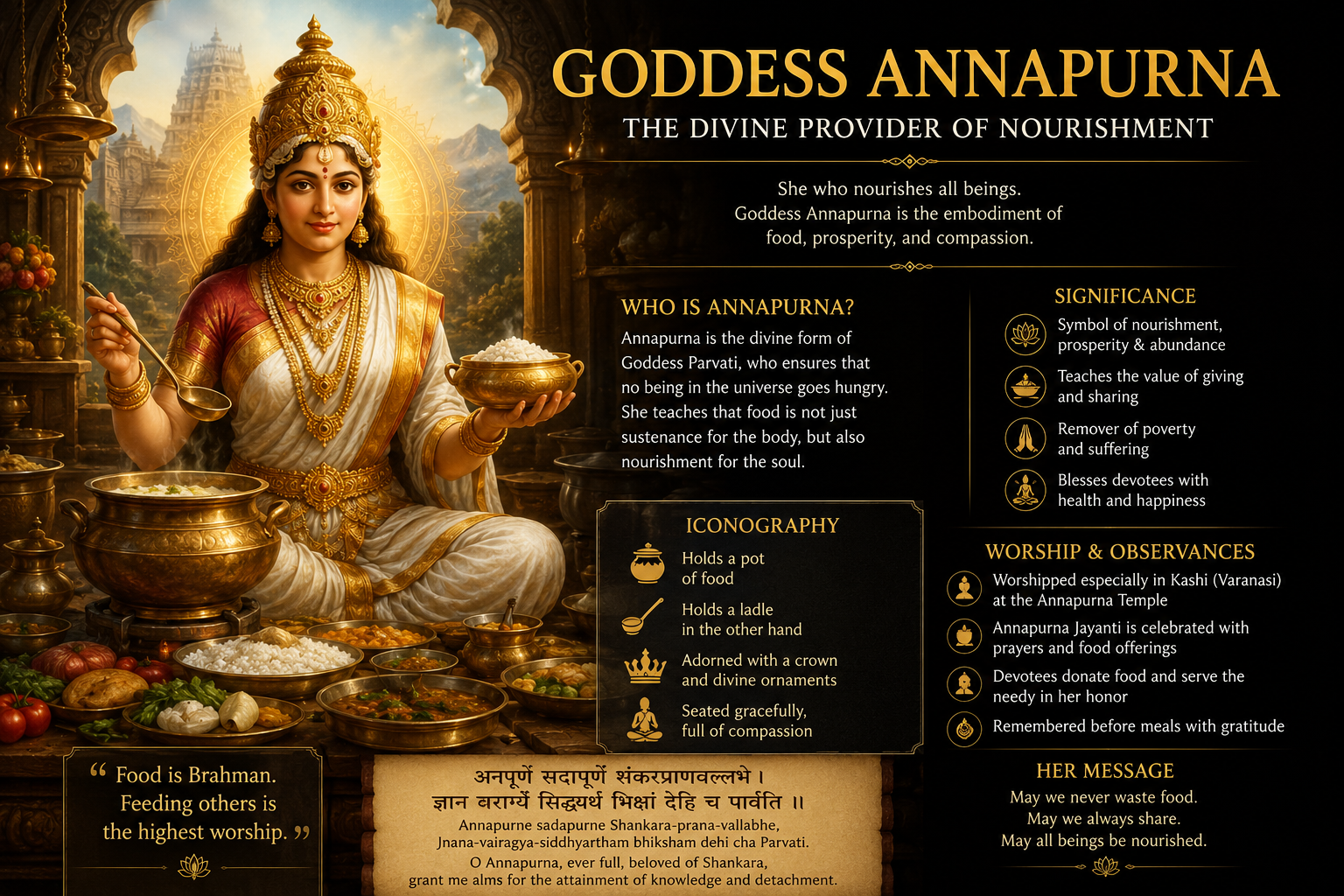
In the vast and luminous pantheon of Hindu goddesses, Annapurna occupies a place of profound intimacy and daily reverence. She is not a distant celestial power to be propitiated in times of crisis — she is the goddess who enters every kitchen, who blesses every hearth, who sanctifies every grain of rice and every drop of water that sustains life. She is the Divine Mother of food and nourishment, the living embodiment of abundance, and the sacred teacher who once humbled even Shiva himself.
The name Annapurna carries within it the entire theology of her being. “Anna” in Sanskrit means food or grain — not merely as physical matter, but as the primordial substance from which all life arises and into which all life returns. “Purna” means complete, full, perfect, entire. Together, Annapurna is “she who is completely full of food,” “she who gives food in abundance,” “she in whom all nourishment is complete and whole.” This is not merely a goddess of the kitchen; she is the expression of Brahma itself in the form of sustenance.
The Taittiriya Upanishad (2.2) makes the breathtaking declaration: “Annam Brahma” — food is Brahma. “From food all beings are born; by food, once born, they live; into food, at death, they return.” This is the theological foundation upon which all devotion to Annapurna rests. Food is not a mundane necessity to be hurried through before one gets to the “real” spiritual practice. Food is the very substance of the cosmos — the outermost expression of Brahma, the foundation of the Annamaya Kosha (the food-body), the most tangible form in which the divine touches every living being multiple times each day. To reverence food is to reverence God. To feed another is to serve God. To waste food is to insult the divine.
This complete and in-depth guide explores Goddess Annapurna from every dimension: her etymology and iconography, the great legend of Shiva’s hunger and its profound philosophical lesson, Shankaracharya’s celebrated Annapurna Stotram, the sacred Annapurna Temple of Varanasi, her presence in temples across India, the deep theology of Anna in Hindu scripture, and the living traditions of Annadanam and Prasadam that continue to express her grace in the modern world.
The Name and Iconography of Annapurna
Etymology: The Fullness of Nourishment
The etymology of “Annapurna” is itself a complete theological statement. The Sanskrit root anna derives from the verb ad (to eat) and refers broadly to food, grain, cooked rice, and all that sustains the body. In the Vedic understanding, anna is not merely biological fuel — it is the sacred substance through which the cosmos maintains itself. The Chandogya Upanishad teaches that food is the chief of all things, that all beings are made of food, and that food is the elixir of immortality when offered with right understanding.
Purna comes from the root pṛ (to fill, to satisfy) and means full, complete, perfect, lacking in nothing. The Upanishadic invocation “Purnam adah, purnam idam” — “That is complete, this is complete” — uses the same concept: Brahma is absolutely full; nothing can be added to it or subtracted from it. When applied to Annapurna, this fullness refers to her inexhaustible capacity to nourish. Her vessel of food never empties. Her grace never runs dry. She is the goddess who satisfies every form of hunger — physical, emotional, and spiritual.
The name can also be parsed as “Anna-apurna” — “she who fills with food,” meaning she who satisfies all who approach her with hunger. This reading emphasises her active, giving nature: she does not merely possess abundance; she distributes it, she pours it out, she fills the empty vessels of all who come to her.
Iconography: The Goddess with the Golden Ladle
The classical iconography of Annapurna is immediately recognisable and deeply meaningful. She is depicted as a golden-complexioned goddess, radiant with the warmth of a kitchen fire, seated or standing in regal composure. In her right hand she holds a jewelled ladle — the symbol of the one who serves, who dishes out grace with generosity and care. In her left hand she holds a vessel overflowing with kheer (rice porridge cooked in milk and sweetened), or sometimes a pot of cooked rice — the most basic and universal food of the Indian subcontinent.
She is adorned with all the markers of divine abundance: fine silks and ornaments, a serene and compassionate expression, a crown befitting a queen. Yet she is not distant. The ladle in her hand and the vessel of food mark her as the server, the feeder, the one who kneels to the hunger of her devotees. In many temples, the murti (sacred image) shows her about to ladle food into the bowl of Shiva himself — the ultimate subversion of the usual divine hierarchy, and a permanent reminder of the lesson she taught him.
In South Indian representations, particularly at the Horanadu Annapoorneshwari Temple in Karnataka, Annapurna takes on a more assertive, fierce form — the “Eshwari” suffix indicating sovereignty and power. Here she is a powerful ruler over the domain of food and nourishment, not merely a gentle mother but a governing deity whose authority in the material world is absolute.
The Great Legend: Shiva’s Hunger and Parvati’s Lesson
The Philosophical Dispute That Changed the Cosmos
The central legend of Annapurna is one of the most philosophically rich stories in the entire Hindu tradition. It begins with a dispute between Shiva and Parvati — not a petty quarrel, but a genuine theological disagreement that strikes at the heart of the relationship between spirit and matter, between Brahma and Maya.
Shiva, in his aspect as the great renunciant and master of Vedanta, makes the sweeping declaration that all material things — including food, the body, and the entire material world — are Maya, illusion, and therefore of no ultimate spiritual value. Only Brahma, the formless absolute, truly exists. Everything else is appearance. Why, then, should one be concerned about food, about the sustenance of the body, about material nourishment at all? The serious spiritual aspirant should look beyond such things.
Parvati, who is not merely Shiva’s consort but the very embodiment of Shakti — the primordial energy that is the material world itself — is deeply offended by this dismissal. She is the earth, the harvest, the cycle of seasons, the abundance of nature. To call her domain mere illusion is to misunderstand the nature of Brahma itself. For Parvati is not separate from Brahma — she IS Brahma expressed as the world. Her domain is not illusion; it is Brahma’s own creative, sustaining, nourishing face.
Rather than argue further, Parvati does something more eloquent than any philosophical rebuttal: she disappears from the cosmos entirely. She withdraws her presence — and with her withdrawal, all food, all nourishment, all abundance, all growth vanishes from existence. The earth stops producing. The rains fail. The crops die. The animals starve. Even the gods begin to grow weak. The cosmos, stripped of the goddess who sustains it, begins to collapse.
Shiva Arrives at the Kitchen with a Begging Bowl
Parvati, moved by compassion for the suffering of all beings, re-manifests — but she chooses her manifestation deliberately and pointedly. She appears not as a celestial queen in a heavenly realm, but as Annapurna, the goddess of food, in a kitchen in Kashi (Varanasi). She sets up a great kitchen and begins to cook and serve food to all who are hungry — the poor, the pilgrims, the sages, the suffering.
Word reaches Shiva that in Kashi, a goddess is feeding the hungry. Shiva himself, weakened by the absence of material nourishment that he had so airily dismissed, arrives at Annapurna’s kitchen. He comes not in the pride of the great Mahadeva, lord of destruction and liberation, but humbly — with a begging bowl in his hand, as a hungry sannyasi seeking food.
Annapurna receives him with a smile and fills his bowl. In the moment she places food in the bowl of Shiva, the entire theological lesson crystallises. Shiva accepts the food, eats, and is nourished. And in that act of receiving, he acknowledges what he had previously dismissed: the material world, food, the body, the act of eating and being sustained — these are not mere illusion. They are Shakti’s grace. They are Brahma’s own gift to the beings of the world. Spirit and matter are not opposed; they are inseparable. The goddess was right.
The Theological Depths of the Legend
This legend is not merely a charming story about a divine couple’s quarrel. It encodes one of the most important correctives in Hindu philosophical history — the pushback against extreme, otherworldly asceticism that dismisses the body and the material world as spiritually worthless.
The lesson is multilayered. First, it affirms the Shakta theological position that Shakti — the goddess, the material world, the power of manifestation — is not inferior to or separate from Brahma. The Devi Mahatmyam puts it plainly: “By you this universe is borne; by you this world is created.” To dismiss the material world as mere illusion is to misunderstand that the world is the goddess’s own body, her own expression. The Brahma that Shiva exalts so highly is itself inseparable from the Shakti that manifests the world.
Second, the story affirms the absolute necessity of the body for any spiritual pursuit. The Bhagavad Gita (6.16–17) teaches that yoga is not for one who eats too much or too little, who sleeps too much or too little. The yogi must maintain the body with appropriate food, rest, and care. “Sarira madhyam khalu dharma sadhanam” — the body is indeed the vehicle of all dharmic practice. Without a nourished body, there is no meditation, no study, no service, no spiritual aspiration. Annapurna’s lesson to Shiva is also the tradition’s lesson to extreme asceticism: you cannot abandon the material world entirely. The very practice of renunciation requires a body kept alive by food.
Third, the story establishes Kashi as the eternal city of Annapurna — a place where the goddess perpetually feeds the hungry, where the sacred act of feeding is the city’s most defining spiritual practice, and where even the greatest yogi must acknowledge his dependence on nourishment.
The Annapurna Stotram of Adi Shankaracharya
The Paradox of the Non-Dualist Hymn to Abundance
Among all the hymns composed to Annapurna, none is more celebrated, more philosophically layered, or more paradoxical than the Annapurna Stotram attributed to Adi Shankaracharya — the eighth-century sage who founded the Advaita Vedanta school and who spent his life arguing that all of apparent reality is ultimately one non-dual Brahma.
The paradox is immediately apparent. Shankaracharya, the philosopher most associated with the Mayavada (illusionism) position — the position that the material world is appearance, that only Brahma is real — is also the composer of the most luminous hymn to the goddess of food and material abundance. How can the great non-dualist pay homage to the goddess who represents the very material world his philosophy apparently dismisses?
The resolution of this paradox is also the resolution of the philosophical dispute between Shiva and Parvati in the legend above. At the level of ultimate reality (Paramarthika Satta), there is only Brahma — no distinctions, no names, no forms, no food, no hunger, no giver and receiver. But at the empirical level (Vyavaharika Satta) — the level at which human beings actually live, breathe, eat, practise, and aspire — food is divine, the body is sacred, and the goddess who nourishes that body deserves the highest reverence. The two levels do not contradict each other; they complement each other. Even the great renunciant must eat. Even the Advaita philosopher must acknowledge the sacred reality of the world as it appears.
The Central Verse and Its Meaning
The most famous verse of the Annapurna Stotram is:
Annapurne sadapurne Shankara pranavallahe,
Jnana vairagya siddhyartham bhiksham dehi cha Parvati.
“O Annapurna, ever full, the beloved life of Shankara (Shiva), give me alms of knowledge and renunciation, O Parvati.”
This verse is remarkable on multiple levels. The devotee — a sannyasi, a renunciant, one who has given up all worldly possessions — comes to the goddess with a begging bowl, exactly as Shiva did in the legend. But what does he beg for? Not wealth, not sensory pleasure, not material abundance. He begs for jnana (knowledge, wisdom) and vairagya (detachment, renunciation). The very goddess of food and material abundance is asked to grant the gift of non-attachment to the material world.
This is Shankaracharya’s brilliant synthesis: the approach itself is material (begging, receiving food, acknowledging physical need), but the aspiration is spiritual. The goddess of food is also the goddess who, having fed the body, enables the aspirant to turn toward the spirit. She is not an obstacle to liberation; she is its first condition. Without the nourishment she provides, there is no body, no mind, no consciousness available for the pursuit of knowledge and renunciation. She is the foundation upon which all spiritual practice rests.
The stotram continues with further invocations that describe Annapurna as the mother of the three worlds, the one who dissolves all sins, the goddess of Kashi, the one who gives final liberation (mukti) to those who dwell in her city and die there in her grace. The poem ends with the famous declaration: “Mata cha Parvati Devi, Pita Devo Maheshvarah, Bandhavah Shiva bhaktash cha, Svadesho Bhuvanatrayam” — “My mother is Goddess Parvati, my father is Lord Maheshvara (Shiva), my relatives are the devotees of Shiva, and my homeland is all three worlds.” The Annapurna Stotram thus moves from the immediate, bodily act of receiving food to the cosmic declaration of spiritual identity and belonging.
Annapurna in Kashi — The Sacred City of Feeding
The Annapurna Temple of Varanasi
Varanasi — the ancient city of Kashi, the city of light — is the earthly home of Annapurna. According to the legend of her manifestation, it was in Kashi that she set up her divine kitchen, and it is in Kashi that she permanently resides. The Annapurna Temple in Varanasi is one of the most visited and spiritually significant temples in the city, located just metres away from the great Kashi Vishwanath Temple — a proximity that is itself theologically significant: the goddess who nourishes the body dwells beside the lord who liberates the soul.
The presiding deity of the temple is the golden image of Annapurna — a murti of exceptional beauty and spiritual power, holding her jewelled ladle and her vessel of kheer, radiating the warm golden light of abundant grace. Devotees come from across India to receive her darshan, particularly during the month of Margashirsha (November–December), which is considered especially sacred to her, and during Annakuta — the day after Diwali.
The temple is a living centre of Annadanam — the sacred act of feeding. Each day, hundreds and sometimes thousands of pilgrims, the poor, and the hungry are fed at or near the temple complex. This is not merely a social welfare activity; it is an act of direct worship of Annapurna, a continuation of the divine kitchen she established when she taught Shiva that the act of feeding is sacred.
The Annakuta Festival: Mountains of Food
The Annakuta festival — literally “the mountain of food” — is celebrated on the day after Diwali, on Kartik Shukla Pratipada. It is one of the most visually spectacular expressions of Annapurna devotion. On this day, temples across India — and especially in Varanasi and Mathura-Vrindavan — prepare and display the Chhappan Bhog: 56 separate food items offered to the deity.
The 56 items of the Chhappan Bhog represent the fullness of culinary creation — sweet dishes, savoury dishes, fried items, steamed items, dairy preparations, fruits, and more. The items are arranged in elaborate formations before the deity, often literally creating a “mountain” of food that fills the entire inner sanctum. The sheer abundance is the point: the goddess delights in the fullness of the world she sustains, and the devotee delights in offering back to her, in concentrated and ceremonial form, the abundance she has given.
The origin of the 56-item offering is linked to Krishna — specifically to the Govardhan Puja that immediately follows Diwali. When Krishna lifted the Govardhan hill to protect the villagers of Vrindavan from Indra’s storms, the grateful villagers offered him food representing all categories of creation. In another reckoning, 56 represents the 8 meals Krishna had eaten each day multiplied by the 7 days he held up the mountain. In the Annapurna context, the 56 bhog represents the goddess’s total dominion over all forms of food — nothing that nourishes any being falls outside her grace.
The Theology of Anna: Food as Brahma
The Taittiriya Upanishad and the Five Sheaths
The philosophical grounding for all reverence toward food in the Hindu tradition comes primarily from the Taittiriya Upanishad, one of the principal Upanishads of the Krishna Yajurveda. The second chapter (Brahmananda Valli) contains the most concentrated and systematic theology of food found anywhere in Indian literature.
The Upanishad teaches the model of the Pancha Kosha — the five sheaths or layers of the self. The outermost sheath is the Annamaya Kosha — the food-body, the physical body made of food. “This indeed is the Self made of food,” the text declares. The deeper sheaths are the Pranamaya Kosha (the vital body), the Manomaya Kosha (the mental body), the Vijnanamaya Kosha (the wisdom body), and the Anandamaya Kosha (the bliss body). But the starting point, the most immediate and tangible expression of the Self, is the food-body.
The critical implication is that the physical body — precisely because it is made of food — is not the prison of the soul or the obstacle to liberation, as certain extreme ascetic traditions would have it. The physical body is the outermost layer of the Self. It is Brahma expressed as food. To nourish it is to nourish the Self. To feed another’s body is to nourish their Self. The act of eating, done with awareness and gratitude, is a form of recognition of Brahma’s presence in the most immediate and physical dimension.
The Taittiriya Upanishad (2.2) then makes its most radical statement: “Annaat bhavanti bhutani, annena jayanti jivanti, annayeva pralyante” — “From food, beings are born; by food, once born, they live; and into food they go at death.” Food is the alpha and the omega of physical existence. It is the medium through which the cosmos generates, sustains, and reabsorbs itself. To worship Annapurna is to worship this primordial cycle — the great round of matter that is simultaneously the great round of Brahma.
The Bhagavad Gita’s Cosmic Cycle of Food
The Bhagavad Gita (3.14–15) places food within a cosmic cycle of interdependence that links individual eating to cosmic sacrifice:
Annaat bhavanti bhutani, parjanyaat annasambhavah,
Yajnaad bhavati parjanyo, yajnah karma samudbhavah.
“From food, beings are born; food is produced from rain; rain arises from sacrifice; sacrifice is born from action (karma).”
This cycle — sacrifice → rain → food → life → sacrifice — shows that eating is never a private, isolated act. Every meal is a link in a cosmic chain of giving. The yagna (sacrifice) that produces rain is the act of offering to the divine. The rain that produces food is the divine’s gift in return. The food that produces life is the sustenance of beings who are themselves called to perform yagna, thus completing the cycle. Eating is participation in a cosmic act of mutual giving and receiving. Annapurna is the goddess who presides over the central node of this cycle — the point at which the divine gift of food becomes the life of the world.
Prasadam: Food as Divine Grace Made Tangible
One of the most theologically rich practices associated with Annapurna devotion is the concept of Prasadam. The word comes from the Sanskrit prasad — grace, clarity, serenity, divine favour. Prasadam is food that has been offered to the deity and received back as the deity’s grace.
The transformation is understood as real, not merely symbolic. When food is placed before the deity with devotion, offered with the Sanskrit formula “Brahmarpanam, Brahma havir, Brahmagnau Brahmanahutam” (from the Bhagavad Gita 4.24 — “The act of offering is Brahma, the offering is Brahma, offered by Brahma into the fire of Brahma”), the food itself becomes an expression of divine grace. When it is received back and eaten, the devotee is literally consuming the goddess’s love, her attention, her blessing. The transformation of ordinary food into Prasadam is the central sacramental act of Hindu temple worship.
In the Annapurna Temple of Varanasi, the Prasadam takes the form of cooked rice and kheer — the same foods the goddess holds in her divine image. To receive this Prasadam is to receive Annapurna’s personal gift — the same grace with which she filled Shiva’s begging bowl, extended now to every devotee who comes to her in hunger and humility.
Annadanam: The Highest Act of Charity
The tradition of Annadanam — the free giving of food to all who are hungry, without distinction of caste, class, religion, or status — is one of the most ancient and most honoured forms of Hindu religious practice. The Mahabharata’s Anushasana Parva declares: “Na daanam annadaanat param” — “There is no gift greater than the gift of food.”
This is not hyperbole. Every other gift — of gold, of land, of knowledge, of cows — assumes a recipient who is alive and capable of receiving it. Only the gift of food ensures that there IS a recipient. Food is the precondition of all other gifts. To feed the hungry is therefore to make possible all other forms of generosity, all other forms of spiritual practice, all other forms of dharmic life. Annadanam is thus the most foundational act of dharma.
In practical terms, the tradition of Annadanam has produced some of the most remarkable institutions of public feeding in the world. The great temples of South India — the Tirumala Tirupati Devasthanam, the Srirangam Temple, the Madurai Meenakshi Amman Temple — all maintain elaborate Annadanam programmes feeding tens of thousands daily. In the modern era, the Akshaya Patra Foundation, inspired directly by the Annadanam tradition and named after Draupadi’s inexhaustible vessel, provides free midday meals to over two million Indian schoolchildren every school day — making it one of the largest school meal programmes in the world. This is Annapurna’s grace operating at industrial scale, in the most mundane and practical form imaginable.
Major Annapurna Temples Across India
Cherukunnu Annapurneshwari Temple, Kerala
The Cherukunnu Annapurneshwari Temple in the Kannur district of Kerala is one of the most revered Annapurna temples in South India. Located in the lush green landscape of northern Kerala, the temple draws devotees from across the state and beyond, particularly for its extraordinary Annadanam programme.
The presiding deity here is Annapurneshwari — “the sovereign Annapurna” — depicted in the classical form with ladle and food vessel. The temple is famous for feeding thousands of visitors every single day without charge. The kitchen attached to the temple is considered sacred space, and the cooks who work there are understood to be performing priestly service. The food prepared and distributed here is Prasadam from the first ladle to the last — cooked with devotion, offered to the goddess, and distributed as her grace.
The annual festival of the temple draws hundreds of thousands of devotees, with the Annadanam during festival days feeding literally hundreds of thousands of people. This is not merely charitable hospitality; it is a direct theological statement that the goddess’s grace, like food itself, is inexhaustible and available to all without condition.
Horanadu Annapoorneshwari Temple, Karnataka
Deep in the Western Ghats of Karnataka, accessible through winding mountain roads flanked by forests, lies one of the most atmospheric and spiritually charged of all Annapurna temples — the Horanadu Annapoorneshwari Temple. Situated in the Chikkamagaluru district, on the banks of the Bhadra river, the temple is surrounded by the kind of primeval, forested landscape that itself feels like the body of the goddess.
The Annapoorneshwari of Horanadu is unique in her iconography compared to her northern counterpart. She is depicted as a somewhat fierce, sovereign deity — not the gentle feeder of Varanasi but the powerful mistress of the material world in her fullness. The “Eshwari” in her name is crucial: this is not merely a nourishing mother but a governing queen whose authority over the domain of food and life is absolute and non-negotiable.
The temple’s Annadanam is perhaps its most celebrated feature. The temple feeds every visitor, every pilgrim, every traveller who arrives — no one who comes to Horanadu leaves hungry. This unconditional feeding, in a remote mountain location that requires significant effort to reach, is experienced by devotees as a powerful confirmation of the goddess’s grace: wherever there is genuine need, she provides.
Kumbakonam and the Tamil Annapurna Tradition
In the Shaiva sacred geography of Tamil Nadu, Annapurna is venerated within the great temple complexes as a subsidiary but deeply beloved deity. In Kumbakonam — the temple city par excellence of the Tamil country — the Annapurneswari shrine within the Sarangapani Temple complex draws devotees who seek the goddess’s blessings for abundance, for the health of the household, and for the success of farming and trade.
The Tamil tradition has its own names and forms for the goddess: Annapurneswari, Annapoorna, Annamalai Amman. The theological grounding is the same as in the Sanskrit tradition — food is sacred, feeding is worship, the goddess who governs nourishment governs life itself — but expressed in the rich poetic vocabulary of Tamil Shaiva devotion.
Annapurna in the Domestic Altar
Beyond the great public temples, Annapurna is fundamentally a goddess of the home. Every Hindu kitchen is traditionally considered her domain. In many households, particularly in Maharashtra, Karnataka, and parts of North India, a small image or picture of Annapurna — or alternatively of Lakshmi, who shares the role of domestic abundance — is placed in or near the kitchen.
The cooking fire is sacred — identified with Agni, the god of fire, who is the cosmic priest transforming raw matter into nourishment. The first portion of every meal cooked is traditionally offered to the divine before the household eats — a practice called “Brahma Arpana” (offering to Brahma) rooted in the Bhagavad Gita (4.24). This transforms every meal into a form of Annapurna worship: the cook becomes a priest, the kitchen becomes a temple, and the family table becomes the altar of the goddess’s daily grace.
The Sattvik cooking tradition — preparing food with pure, fresh, seasonal ingredients, with mindfulness and devotion, without onion, garlic, or excessively stimulating spices — is understood as the highest expression of cooking as Annapurna’s service. Food prepared in this way is understood to carry the Sattvic qualities of clarity, lightness, and peace into the bodies and minds of those who eat it, making them more fit for spiritual practice. The cook in a temple or monastery who observes these principles is not merely a kitchen worker; they are a practitioner whose daily practice is the sacred act of feeding.
The Mountain Named for the Goddess
Annapurna Massif: The Goddess on the Roof of the World
The name Annapurna reaches its most dramatic geographical expression in the Annapurna Massif of Nepal — a section of the Himalayas that includes Annapurna I, at 8,091 metres the tenth highest mountain in the world. The Himalayan peaks have been named after deities for millennia, as an expression of the sacred character of these awe-inspiring natural phenomena. To name a mountain Annapurna is to see in its vast, permanent, and overwhelming presence the same inexhaustible fullness that the goddess represents.
Annapurna I entered world mountaineering history on 3 June 1950, when the French expedition led by Maurice Herzog and Louis Lachenal made the first successful ascent. This was a landmark moment in the history of Himalayan exploration: Annapurna was the first 8,000-metre peak ever climbed. The feat came at an extraordinary cost — both climbers suffered severe frostbite and lost fingers and toes — a reminder that the mountain, like the goddess, demands everything from those who approach her.
Today, the Annapurna Circuit and the Annapurna Base Camp trek are among the most popular trekking routes in the world, drawing hundreds of thousands of trekkers annually. The route passes through extraordinary diversity of landscape and culture — from subtropical lowlands through rhododendron forests to high alpine desert and the close presence of glaciers and peaks. The goddess whose name the massif bears is celebrated in the many Hindu and Buddhist shrines along the route, a reminder that for the Himalayan peoples, these mountains are not merely geological features but living divine presences.
The Sacred Economics of Food: Dana, Karma, and the Inexhaustible Vessel
Draupadi’s Akshayapatra: The Mythic Model of Annadanam
The Mahabharata gives the most vivid mythological expression of Annapurna’s principle in the story of Draupadi’s Akshayapatra — the inexhaustible vessel. During the Pandavas’ twelve-year exile in the forest, the sage Dhaumya expressed concern that the royal family would be unable to feed themselves and the multitudes of well-wishers and Brahmin scholars who accompanied them into the wilderness. The sun god Surya, moved by compassion, gifted Draupadi a divine vessel that would produce inexhaustible food — but with one condition: the vessel would continue to produce food until Draupadi herself had eaten for the day. Once she ate, the vessel was empty until the next day’s sunrise.
This condition encodes the dharmic principle: the server eats last. The hostess, the giver, the feeder — she serves everyone else first, and only when all are fed does she herself receive nourishment. Draupadi fed thousands from this vessel every day, eating only after all others were satisfied. This is the dharmic model of Annadanam: the one who gives food postpones their own satisfaction until the hungry are fed.
The Akshayapatra is the mythological version of Annapurna’s vessel — the container that never empties as long as it is used in the service of others. The durvasa episode (when the sage Durvasa arrived after Draupadi had already eaten, threatening to curse the Pandavas) was resolved by Krishna’s miraculous intervention, demonstrating that when the dharmic principle of service is whole-heartedly observed, divine protection is assured.
The Sattvik Kitchen as Sacred Space
The Hindu tradition has developed a sophisticated understanding of how food affects consciousness — a proto-science of nutrition that predates modern nutritional science by millennia. The Trigunas (three qualities) of Sattva (clarity, purity), Rajas (activity, passion), and Tamas (inertia, heaviness) are understood to be present not only in human psychology but in all of nature, including food.
Sattvik foods — fresh fruits, vegetables, dairy products, whole grains, legumes, honey, prepared with care and eaten in appropriate quantities — promote clarity, lightness, and equanimity. Rajasic foods — heavily spiced, stimulating, excessively flavourful — promote activity and passion. Tamasic foods — old, fermented, excessively heavy — promote dullness and inertia. The Bhagavad Gita (17.8–10) describes the foods preferred by each type of devotee.
The implications for Annapurna devotion are direct: to cook with Sattvik ingredients and with devotional intent is to serve Annapurna in her highest aspect. The cook who prepares food mindfully, with clean ingredients and a calm, generous spirit, is transmitting not merely nutrition but subtle spiritual quality to all who eat. This is why the tradition insists on the mental state of the cook: anger, grief, or selfish distraction in the kitchen contaminates the food; joy, devotion, and generosity purify and enhance it. The Annapurna tradition thus integrates physical, psychological, and spiritual dimensions into the simple, daily act of cooking and eating.
Annapurna in Daily Life: Living the Goddess’s Teaching
The deepest teaching of Annapurna is not located in any temple or text but in the daily rhythms of the Hindu household. It is present in the gesture of the mother who serves her children before herself. It is present in the temple priest who distributes Prasadam to the last devotee in line with the same care as to the first. It is present in the kitchen that keeps a portion aside for whoever might arrive unexpectedly — the tradition of atithi devo bhava (the guest is God), which demands that no one who arrives at a Hindu home hungry should be turned away without food.
Annapurna’s teaching is also present in the great contemporary movements of food justice and food access that draw, consciously or unconsciously, on the Annadanam tradition. The langar (community kitchen) of the Sikh Gurdwaras — which feeds millions of people daily, regardless of religion, caste, or status — shares deep structural roots with the Hindu Annadanam tradition. The Iskon (Hare Krishna) movement’s Food for Life programme, which has distributed over six billion meals worldwide, explicitly invokes the Prasadam theology: every meal is offered to Krishna before distribution, and every recipient receives not merely nutrition but divine grace.
To live Annapurna’s teaching is to approach every meal with gratitude — acknowledging the extraordinary chain of sun, rain, soil, seed, farmer, cook, and divine grace that brought food to the plate. It is to never waste food without recognition of its sacred character. It is to respond to the hunger of others as one responds to a call from the divine. It is to understand that the feeding of others is not merely kindness but worship — that in the face of every hungry person, Annapurna herself is looking out, waiting to see whether her devotees have understood her lesson.
Shiva came to Annapurna’s kitchen with a begging bowl, humbled by the recognition of his dependence on the goddess he had dismissively called Maya. Every hungry person who comes to a kitchen, every beggar who holds out a hand for food, every child who waits to be fed — each one is Shiva in his hungry form, testing whether the spirit of Annapurna lives in those who have been given the gift of abundance. The goddess who fed Shiva when he was hungry has never stopped asking her devotees to do the same.
Key Takeaways
- Annapurna means “she who is completely full of food” — from anna (food/grain) and purna (complete/full); she embodies the divine principle that food is sacred, inexhaustible, and a form of Brahma itself.
- The Great Legend: When Shiva dismissed the material world as Maya, Parvati disappeared and all food vanished from the cosmos. She re-manifested as Annapurna in Kashi and fed a hungry Shiva, teaching that the material world and spirit are inseparable — a foundational lesson against extreme asceticism.
- Shankaracharya’s Paradox: The greatest Advaita philosopher composed the most celebrated hymn to the goddess of abundance — demonstrating that even the highest non-dualist must acknowledge the sacred reality of the empirical world and the necessity of nourishment for spiritual practice.
- Taittiriya Upanishad: “Annam Brahma” — food is Brahma. The Annamaya Kosha (food-body) is the outermost sheath of the Self; nourishing the body is nourishing Brahma’s own expression in the world.
- Prasadam and Annadanam: Food offered to God and received back as divine grace is Prasadam; the gift of food to the hungry is the highest form of charity — “Na daanam annadaanat param” — with temples across India feeding millions daily as a living act of Annapurna worship.
- Annapurna temples across India — Varanasi, Kerala’s Cherukunnu, Karnataka’s Horanadu — are all characterised by their Annadanam programmes: the goddess’s grace is experienced most directly through the unconditional, inexhaustible giving of food.
- Annapurna Massif in Nepal, including the world’s 10th highest peak (8,091m), bears the goddess’s name — first climbed in 1950 by a French expedition; the first 8,000-metre summit in mountaineering history.
- The living tradition: Sattvik cooking, the domestic altar in the kitchen, the practice of offering food before eating, and the imperative of feeding guests — all are daily expressions of Annapurna’s theology in the Hindu household.
Frequently Asked Questions About Goddess Annapurna
Who is Goddess Annapurna and what does her name mean?
Goddess Annapurna is the Hindu goddess of food, nourishment, and abundance. She is considered a form of Parvati, the divine mother, and is one of the most beloved goddesses in both the Shaiva and Shakta traditions. Her name is composed of the Sanskrit words anna (food, grain, nourishment) and purna (complete, full, perfect). Together, the name means “she who is completely full of food” or “she who gives food in complete abundance.” She is depicted holding a jewelled ladle and a vessel of kheer (rice porridge), representing her eternal capacity to nourish all beings without limit.
What is the story behind Goddess Annapurna feeding Lord Shiva?
The legend begins with a philosophical dispute: Shiva declared to Parvati that all material things, including food, are Maya (illusion) and have no ultimate spiritual value. Parvati, as the goddess of the earth and material sustenance, was offended by this dismissal of her domain. She disappeared from the cosmos, causing all food and nourishment to vanish — the crops died, animals starved, and even the gods began to grow weak. Moved by compassion, Parvati re-manifested as Annapurna in Kashi (Varanasi), setting up a kitchen and feeding all who were hungry. Shiva himself arrived, humbled and hungry, with a begging bowl. She fed him, and in receiving her food, Shiva acknowledged that the material world and its nourishment are not mere illusion but the sacred expression of Shakti — inseparable from Brahma itself. The story teaches that no spiritual practice is possible without a nourished body, and that dismissing the material world is its own form of spiritual error.
Why did Adi Shankaracharya compose a hymn to Annapurna if he taught that the world is Maya?
This is one of the most interesting questions in Hindu philosophy. Shankaracharya’s Advaita Vedanta teaches that at the level of ultimate reality (Paramarthika Satta), only Brahma exists — all apparent distinctions, including the material world, are ultimately non-different from Brahma. However, at the empirical level (Vyavaharika Satta) — the level at which human beings actually live and practise — the world is real, the body requires nourishment, and the goddess who provides that nourishment deserves deep reverence. The Annapurna Stotram operates at this empirical level, acknowledging that even the greatest renunciant must eat, and that the act of receiving food from the goddess is itself a spiritual act. The famous verse asks Annapurna not for material wealth but for “jnana” (knowledge) and “vairagya” (renunciation) — the spiritual qualities that lead to liberation. Shankaracharya’s hymn is therefore not a contradiction of his non-dualism but its practical, grounded, and compassionate complement.
What is the significance of Annadanam in the Hindu tradition, and how does it relate to Annapurna?
Annadanam — the free giving of food to all who are hungry, without condition or discrimination — is considered in the Hindu tradition to be the highest form of charity. The Mahabharata declares “Na daanam annadaanat param” — there is no gift greater than the gift of food — because food is the precondition for all other gifts, all other spiritual practices, and all other forms of dharmic life. Annadanam is directly associated with Annapurna worship: to feed the hungry is to enact the goddess’s own divine function in the world. The great Annapurna temples — in Varanasi, at Cherukunnu in Kerala, at Horanadu in Karnataka — are all distinguished by their Annadanam programmes, feeding thousands to hundreds of thousands daily. Modern expressions of this tradition include the Akshaya Patra Foundation, which provides free meals to over two million schoolchildren in India every day.
What is the teaching of “Annam Brahma” from the Taittiriya Upanishad?
“Annam Brahma” — food is Brahma — is the central declaration of the Taittiriya Upanishad (2.2) regarding food. The full teaching states: “From food, all beings are born; by food, once born, they live; and into food they return at death.” This places food at the cosmic centre of existence — it is not merely biological fuel but the very medium through which Brahma sustains the universe. The Upanishad also teaches the model of the Pancha Kosha (five sheaths), in which the Annamaya Kosha (the food-body, the physical body) is the outermost expression of the Self. Because the physical body is made of food, and because the body is the outermost layer of the Self (which is ultimately Brahma), food itself is a form of Brahma. To reverence food — to eat with gratitude, to cook with devotion, to feed others generously — is therefore to acknowledge and honour Brahma’s presence in its most immediate and tangible form.
Why is the Annapurna Temple in Varanasi considered especially sacred?
The Annapurna Temple in Varanasi holds special sanctity for several interconnected reasons. First, according to the legend, it is in Kashi that Annapurna originally manifested her divine kitchen when she disappeared from the cosmos and re-appeared to feed the hungry — including Shiva himself. Kashi is therefore her earthly home, the city she has permanently claimed as her domain. Second, the temple is located adjacent to the Kashi Vishwanath Temple, one of the twelve Jyotirlingas and the most sacred Shiva temple in India — this proximity links the goddess of nourishment with the lord of liberation in a theologically profound pairing. Third, the Annadanam tradition at the Kashi Vishwanath complex — feeding thousands of pilgrims and the poor daily — makes the area around the temple a living expression of Annapurna’s grace. To visit the Annapurna Temple in Varanasi is to visit the original kitchen of the goddess and to experience, in the feeding of the pilgrims around you, her perennial, unconditional generosity.
Related articles in Gods & Deities
Sage Jaimini is the founder of the Purva Mimamsa school, honoured for his rigorous inquiry into dharma and the right interpretation of the Vedas.
Madhvacharya is the great teacher of Dvaita Vedanta, who emphasised the eternal distinction between the individual soul and God and a path of wholehearted devotion.
Ramanujacharya is the great acharya of Vishishtadvaita Vedanta, who united loving devotion with rigorous philosophy and is honoured for his inclusive, compassionate vision.
Comments(0)
Loading comments…