
Guru & Gurupoornima: The Eternal Principle of the Spiritual Guide
Discover the true meaning of Guru — the eternal principle that dispels darkness and guides consciousness towards the Supreme Being. Explore Gurupoornima, the tradition of Vyasa Poornima, and why Lord Veda Vyasa is the Jagad Guru of Kaliyuga.
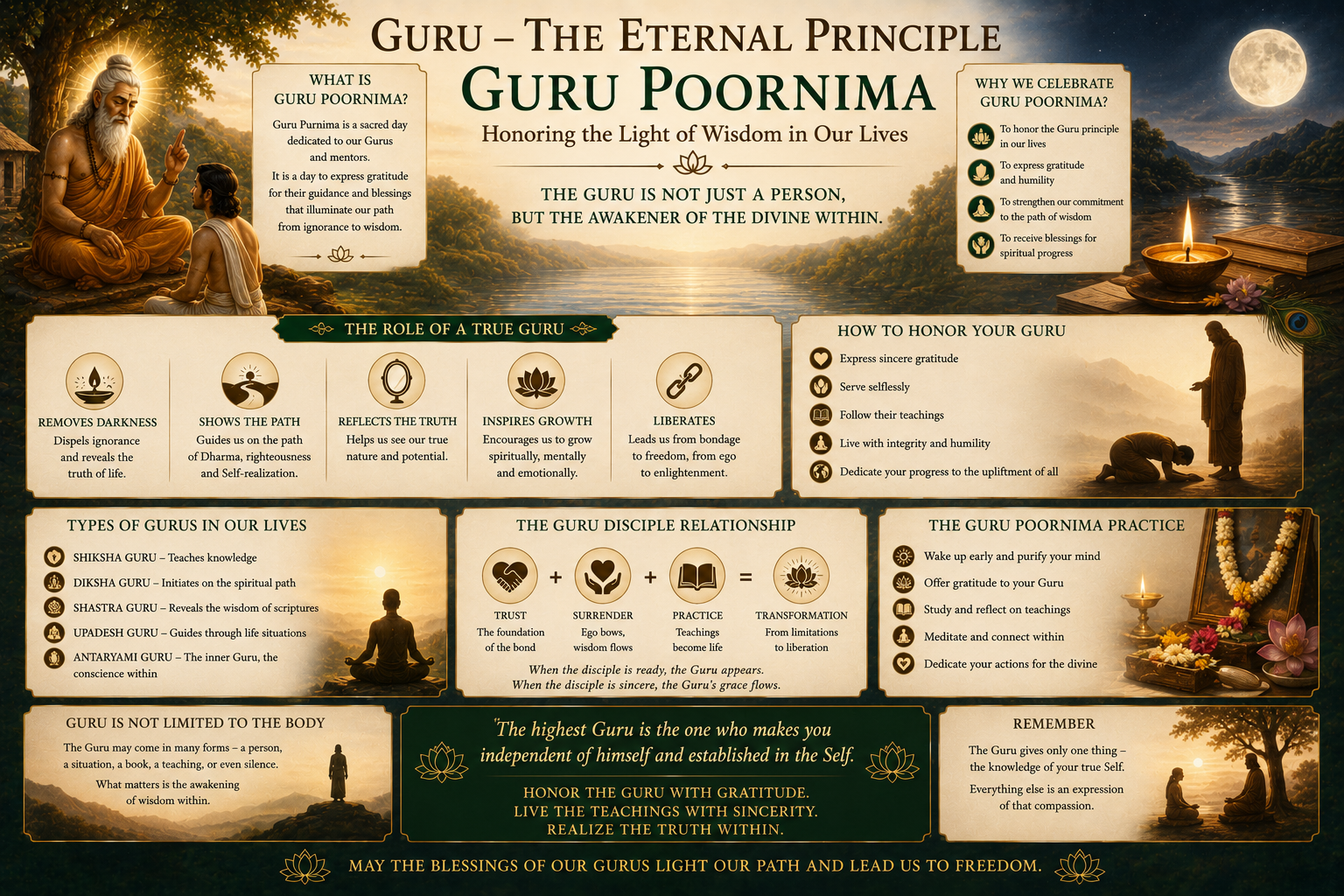
In the vast ocean of Sanathana Dharma, few principles carry as much transformative power as the concept of the Guru. Far more than a teacher or mentor in the conventional sense, the Guru represents a cosmic principle — a living force of illumination that dispels the darkness of ignorance and guides the seeker steadily towards the Supreme Being. Understanding this principle in its fullest depth is essential for anyone walking the path of spiritual evolution, for without the Guru, the journey inward can easily lose its way in the labyrinth of illusion, ego, and misdirection.
On the sacred occasion of Gurupoornima, also known as Vyasa Poornima, Hindus across the world pay homage to the greatest Guru of Kaliyuga — Lord Veda Vyasa — and to all those teachers who have selflessly transmitted the flame of spiritual wisdom across generations. This post explores the profound meaning of the word Guru, the three forms it takes, what distinguishes a true spiritual Guru from lesser guides, and why Lord Vedavyasa stands as the supreme Jagad Guru for humanity in this age.
The Etymology of Guru — GU and RU
The Sanskrit language, often called the language of the gods, encodes layers of meaning within every syllable. The word Guru is no exception. Its etymology reveals the entire philosophy of what a true Guru is:
- GU — refers to residues, the unwanted, the waste, the darkness. It represents all that which is impure, accumulated, and obscures the light of consciousness — the ignorance, the ego, the karmic residues of countless lifetimes.
- RU — refers to the splendour of light and fire, the brilliance of illumination. It is the radiance of true knowledge, the fire of awareness that burns and transforms.
- GURU — is therefore the brilliance of light and fire (the knowledge of the Supreme Being) that eliminates darkness (ignorance), burns down impurities to ashes, and illuminates the consciousness by aligning it with the Universal Consciousness — the Supreme Being.
This etymology is not merely linguistic poetry. It is a precise philosophical statement. The Guru does not simply add information to the mind; the Guru fundamentally transforms the seeker by removing what should not be there. Just as fire does not merely warm but purifies and consumes the gross to reveal the subtle, the Guru principle acts upon the seeker’s consciousness — burning away the accumulated ignorance, selfish desire, and karmic debris that veil the ever-present light of the Atma.
The Guru is thus a game changer of life. This is not hyperbole — it is a recognition that contact with genuine Guru energy restructures the very orientation of a human life, redirecting it from the pursuit of fleeting pleasures towards the realisation of eternal truth. The Guru does not merely teach; the Guru transforms.
The Three Forms of the Guru
One of the most profound and liberating aspects of the Guru principle in Sanathana Dharma is its recognition that the Guru need not always come in human form. The tradition identifies three distinct forms through which the Guru principle may manifest in a seeker’s life:
1. A Great Scripture
A great scripture, when approached with sincerity, humility, and the genuine desire for liberation, functions as a Guru. The Bhagavad Gita, the Upanishads, the Brahma Sutras — these texts are not merely repositories of information. They are living transmissions of wisdom from realised beings. When a seeker reads such texts with the right disposition, the words penetrate beyond the intellect and begin to reshape the very fabric of the inner life. The scripture illuminates, corrects, challenges, and ultimately points the seeker inward towards the truth that lies beyond all words.
2. An Enlightened Person
The second form of the Guru is the enlightened person — one who has themselves traversed the path of spiritual evolution and reached a level of realisation sufficient to give the seeker the true and correct spiritual path to tread towards the Supreme Consciousness. Such a Guru does not merely repeat scriptural knowledge but speaks from direct experience. Their presence itself is instructive; their words carry the vibration of truth; their guidance is tailored to the specific karmic condition and spiritual readiness of each seeker.
3. A Cosmically Vibrant Temple
The third form is a Temple that is cosmically vibrant enough to elevate consciousness towards a higher order. In the Sanathana tradition, a consecrated temple is far more than a building. When properly established and maintained through correct ritual, such a space becomes a field of elevated spiritual energy capable of transforming the consciousness of those who enter with the right intention. The Guru principle, in this form, acts through sacred space — through the geometry of the structure, the power of the installed deity, and the accumulated devotion of countless seekers across time.
All three — scripture, enlightened person, and sacred temple — can be Gurus. What unites them is the single function: the elevation of the seeker’s consciousness towards the Supreme Being. The form the Guru takes is secondary; the function is primary.
Who Is Not a True Spiritual Guru
Understanding what a true Guru is requires an equally clear understanding of what a true Guru is not. The tradition is unambiguous and, in the context of today’s spiritual marketplace, urgently relevant.
A Guru who fulfils worldly desires cannot be a spiritual Guru. If a teacher’s primary function is to grant boons, fulfil material wishes, heal physical ailments, or satisfy the ego’s demands for prosperity and comfort, that teacher is operating at the level of the world — not at the level of the spirit. Such teachers may be useful for navigating the challenges of worldly life, but they are not equipped to guide the soul towards liberation.
Similarly, siddhas, chaaranas (lower mystics), babas, and prophesying entities may possess genuine paranormal abilities. They may accurately predict the future, demonstrate extraordinary powers, or provide tangible relief from worldly problems. However, these abilities, impressive as they are, belong to the domain of the created world. They are not indicators of spiritual realisation in the deepest sense. Such beings are helpful for worldly life but are not true spiritual Gurus.
The tradition issues a serious warning here: those who adore and worship such figures as spiritual Gurus will be devoid of spiritual evolution and will instead descend to the darker realms of creation. This is not a judgement but an observation about the nature of spiritual energy. Alignment with lower-order energies — even if they appear impressive — draws the seeker towards those lower orders. This is the inevitable consequence of misaligned devotion.
A true spiritual Guru is one who gives the seeker the true spiritual path to work out their karma and Runa (emotional debt) in order to enable the seeker to reach the Supreme Being and attain salvation (moksha). The true Guru’s singular focus is the seeker’s liberation — nothing more, nothing less.
The Lineage of Spiritual Gurus in Sanathana Dharma
In the Indian spiritual tradition, the Guru-Shishya (teacher-disciple) lineage is considered sacred and unbroken across vast stretches of cosmic time. The origin of this lineage traces back to the highest possible sources:
Lord Brahma, Lord Vishnu, and Lord Shiva are revered as the first-line traditional spiritual Gurus in Sanathana Dharma. These are not merely mythological figures but represent the three primary cosmic functions — creation, sustenance, and dissolution — which together form the complete cycle of existence. The spiritual knowledge of universal evolution flows from these divine principles.
This knowledge was received and internalised by the great sages and saints who stood in the line of pure spirituality. These realised beings did not hoard the wisdom for themselves but ensured its transmission generation after generation, across all ages and for all time. The Guru-Shishya parampara (lineage of teacher to disciple) is the vehicle through which this eternal wisdom has been preserved and transmitted across millennia.
The importance of this unbroken chain cannot be overstated. Just as a lamp that has been lit from the original flame carries the same fire forward, each true Guru in this lineage carries the same essential transmission — the direct pointing towards the Supreme Being. The outer form of the teaching may vary across time and culture; the inner essence remains unchanged.
Lord Veda Vyasa — The Jagad Guru of Kaliyuga
Among the greatest sages of the Sanathana tradition, Lord Veda Vyasa occupies an unparalleled position. He is considered an incarnation of Lord Vishnu himself — the Preserver descending into the world of Kaliyuga (the current dark age) to ensure that the light of spiritual knowledge would not be extinguished by the thickening veils of ignorance.
The breadth of Lord Vedavyasa’s contribution to human spiritual knowledge is staggering. Among his greatest works:
- He divided and codified the Vedas into the four known collections: Rig-Veda, Yajur-Veda, Sama-Veda, and Atharva-Veda — making the vast ocean of Vedic knowledge accessible and transmissible.
- He authored the Mahabharata — the great epic that incorporates Lord Krishna’s immortal teachings of the Bhagavad Gita and the Anugita. This epic is considered the Fifth Veda (Panchamveda), a complete guide to dharma for humanity.
- He wrote the Uddhavagita, incorporating it into the Bhagavatha Purana — another expression of the highest devotional and philosophical wisdom.
- He authored all 108 Puranas — the vast narrative tradition that makes abstract philosophical and cosmological truths accessible through story, mythology, and devotional lore. (The Ramayana alone was authored by Maharshi Valmiki.)
- He composed numerous Upanishads — the philosophical pinnacles of Vedic wisdom that directly address the nature of Brahma, Atma, and the path to liberation.
- He authored the Brahma Sutras — the systematic philosophical treatise that synthesises the teachings of the Upanishads into a coherent framework, later becoming the foundational text for multiple schools of Vedanta.
- He composed the Shaanti mantras for appeasing the nine planets — a gift to humanity for harmonising the individual’s life with the cosmic rhythms.
The scale of this single sage’s contribution is almost incomprehensible. Whatever spiritual traditions the Hindus follow today have all, without exception, emanated from Sage Vedavyasa alone. He is therefore regarded as the true Guru for the people of Sanathana Dharma in Kaliyuga — the Jagad Guru, the Guru of the entire world.
Gurupoornima — Vyasa Poornima and Its Sacred Significance
Gurupoornima — also called Vyasa Poornima — is celebrated on the full moon day of the Hindu month of Ashadha. This sacred occasion has been observed for more than five thousand years, making it one of the oldest continuous spiritual observances in human history.
The day is fundamentally an occasion for paying humble respects to Lord Vedavyasa as the greatest Guru. But it also extends to all those who, in the spirit of Vedavyasa, are propagating the great spiritual knowledge in its pure form, selflessly, to genuine seekers of spiritual evolution. These living transmitters of dharmic wisdom — whether they are recognised sages, humble teachers, or sincere practitioners who share the light of authentic knowledge — are also revered on this day.
The tradition emphasises the word selflessly. The true Guru does not propagate spiritual knowledge for personal gain, recognition, or influence. The transmission is offered freely, without attachment to outcome, in the spirit of pure service to the seeker and to the Supreme Being.
There is also a serious caution attached to Gurupoornima: on this holy day, if Hindus worship lower Gurus — siddhas, chaaranas, babas, and other prophetic entities — as though they were true spiritual Gurus, they will descend spiritually into darker realms of creation. Moreover, the tradition warns that in future births such individuals may be gradually eased out of Sanathana Dharma by the Divinity itself. This is the inevitable consequence of misaligning one’s devotion on the most auspicious spiritual occasion of the year.
Gurupoornima is therefore not merely a celebration — it is an annual invitation to examine, clarify, and deepen one’s understanding of and commitment to genuine spiritual guidance. — Tat Sat.
How to Choose a Genuine Guru
Given the proliferation of spiritual teachers, self-proclaimed gurus, and charismatic figures in today’s world, the question of how to identify a true Guru is of great practical importance. The tradition offers clear criteria:
1. The Guru’s Singular Focus Must Be Your Liberation
A genuine spiritual Guru is focused exclusively on guiding the seeker towards the realisation of the Supreme Being and the attainment of moksha. If a teacher’s primary offerings revolve around material prosperity, physical healing, relationship success, or the satisfaction of worldly desires — however clothed in spiritual language — they are operating at a different level entirely.
2. The Guru Must Guide You Through Your Karma and Runa
A true spiritual Guru helps the seeker understand and work through their accumulated karma and Runa (emotional and relational debts from past lives). This is not a comfortable process — it involves confronting one’s patterns, attachments, and tendencies with unflinching honesty. A Guru who only offers comfort and validation without challenging the seeker’s deeper patterns is not providing the service that the tradition identifies as true Guru-seva.
3. The Guru Must Be Rooted in the Authentic Lineage
Genuine spiritual transmission flows through the Guru-Shishya lineage. A teacher who claims original revelation without roots in the established tradition of Sanathana Dharma, or who contradicts its core principles, should be approached with great discernment. The tradition is the tested, refined vehicle for this transmission — it is not a limitation but a protection.
4. The Teaching Must Point Inward
All genuine spiritual guidance, at its deepest level, points the seeker inward — towards the direct recognition of one’s own nature as consciousness, towards the Atma that is ultimately identical with the Supreme Brahma. Any teaching that consistently directs the seeker’s attention only outward — towards external rituals, external figures, or external experiences — without an equal emphasis on the inward journey should be examined carefully.
5. The Guru Must Embody What They Teach
Consistency between teaching and living is an essential mark of authenticity. A Guru whose personal life consistently contradicts the values they proclaim — particularly with respect to ego, attachment, greed, or the mistreatment of others — is not operating from the level of realisation that true spiritual guidance requires.
The choice of a Guru is one of the most consequential decisions in a spiritual life. The tradition urges seekers to approach this choice with prayer, patience, and sincere discernment — trusting that when the seeker is ready, the genuine Guru will appear.
Related Articles
- Guru Purnima: The Complete Guide
- Lord Veda Vyasa Munihi — Part 1
- The Path of Salvation: Mokshadharma Nirupanam
- Dharma — The Cosmic Law of Right Living
FAQs
What is the difference between a Guru and an ordinary teacher?
An ordinary teacher transmits information, skills, or knowledge within the domain of worldly learning. A true spiritual Guru, by contrast, transmits the light of consciousness itself — guiding the seeker not merely to know more but to be more, to dissolve the ignorance that veils the Atma and to move steadily towards the Supreme Being. The Guru’s function is transformative at the level of consciousness, not merely additive at the level of information.
Can a person have more than one Guru?
The tradition recognises that a seeker may receive guidance from multiple sources at different stages of the journey — a scripture may serve as Guru at one stage, an enlightened person at another, a sacred temple at another. However, for deep initiation into spiritual practice and the working out of karma, the tradition generally recommends establishing a sincere and exclusive relationship with one true spiritual Guru. Diffuse attention across multiple teachers often dilutes the depth of the transmission received.
Why is Lord Vedavyasa considered the Guru specifically for Kaliyuga?
Kaliyuga is characterised by a general decline in spiritual capacity, the shortening of human lifespans, and the thickening of ignorance across the world. In such an age, direct realisation through prolonged austerity or intense tapas becomes increasingly difficult. Lord Vedavyasa, recognising this, codified and organised the entire body of Vedic spiritual wisdom in written form — the Vedas, Puranas, Mahabharata, Brahma Sutras, and Upanishads — making it accessible to seekers of all levels. This extraordinary act of service ensures that the path to liberation remains available even in the darkest of ages, making him the Jagad Guru for humanity in Kaliyuga.
What is the significance of Gurupoornima being celebrated on a full moon day?
The full moon (Poornima) is traditionally associated with the fullness of light, the complete illumination of the night sky, and the heightened flow of cosmic energies. It is considered an especially auspicious time for spiritual practice, meditation, and the cultivation of awareness. Celebrating the Guru on the full moon day aligns the honouring of the illuminating principle (the Guru) with the cosmic symbol of complete illumination — a fitting and beautiful alignment of the inner and outer worlds.
Is it harmful to follow a worldly guru or a siddha as a spiritual Guru?
According to the tradition, yes — not because worldly gurus or siddhas are malicious, but because of the nature of spiritual energy alignment. Dedicating one’s deepest spiritual aspiration and devotion to a guide who operates primarily at the level of the material world or lower mystical powers orients the seeker’s consciousness towards those levels. The inevitable consequence, the tradition states, is spiritual stagnation or descent rather than evolution. Worldly teachers can be consulted for worldly guidance, but the deepest spiritual aspiration — the longing for moksha — should be entrusted only to a true spiritual Guru rooted in the authentic lineage of Sanathana Dharma.
Related articles in Dharma & Philosophy
Sage Jaimini is the founder of the Purva Mimamsa school, honoured for his rigorous inquiry into dharma and the right interpretation of the Vedas.
Markandeya is the immortal sage whose devotion, by tradition, conquered death itself. His name is linked to the Markandeya Purana and the celebrated Devi Mahatmya.
Narada is the celebrated devarshi who roams the worlds with his vina and the divine name, honoured for the Narada Bhakti Sutras and his role across the Puranas and epics.
Comments(0)
Loading comments…