
Jyotisha: The Sacred Science of Light — A Complete Guide to Vedic Astrology
Explore Jyotisha — Vedic Astrology — the ancient sacred science of light that maps the relationship between cosmic rhythms and the human soul’s journey through karma and dharma. Discover the Navagrahas, Nakshatras, birth chart, Dasha system, and the profound spiritual wisdom at the heart of this timeless Vedic tradition.
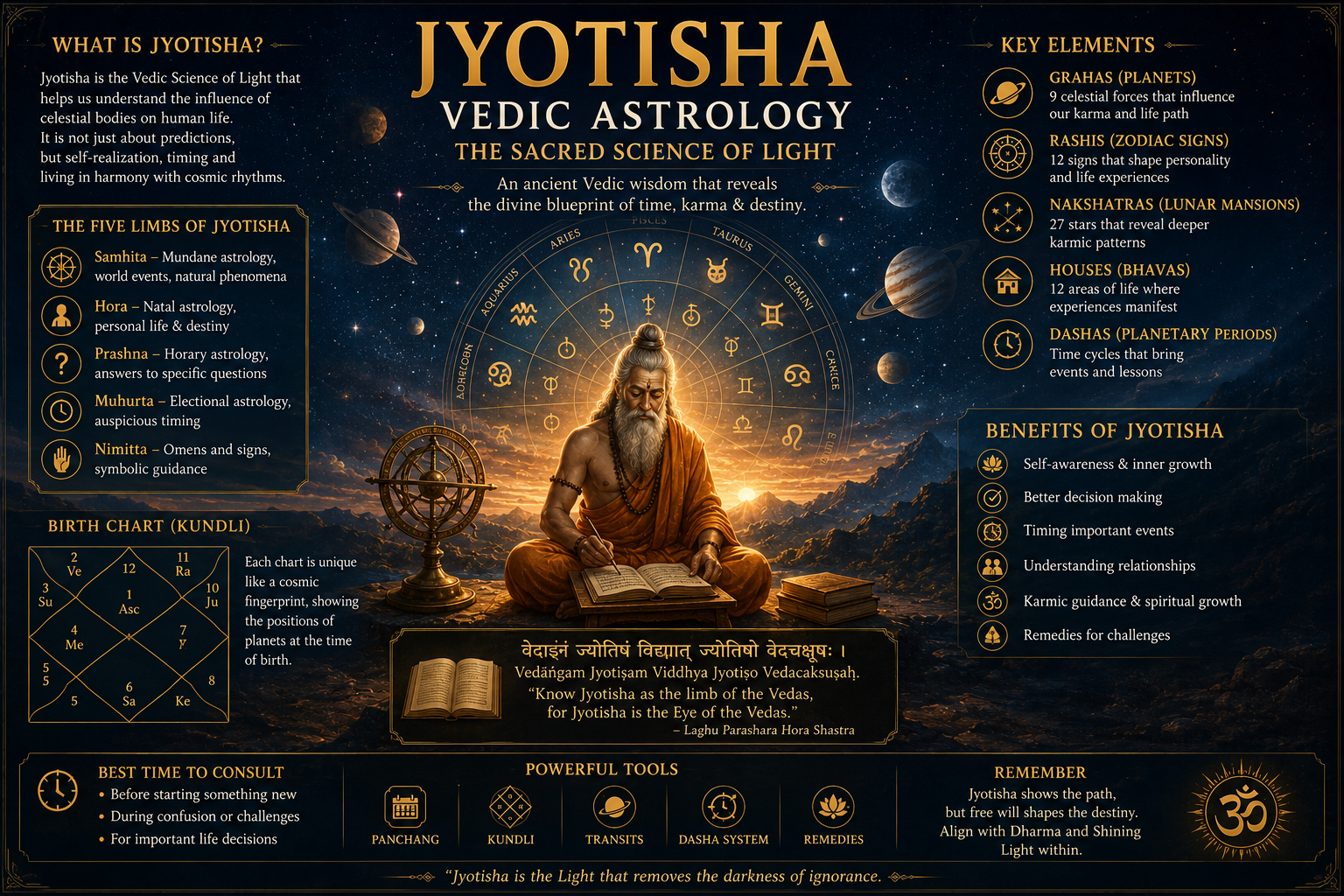
In the vast treasury of ancient Indian knowledge systems, Jyotisha — the science of light — stands as one of the most profound and enduring contributions to human civilisation. Known in the modern world as Vedic Astrology, Jyotisha is far more than a system for predicting future events. It is a sacred science that maps the relationship between cosmic rhythms and the unfolding of human consciousness, karma, and destiny. Rooted in the Vedas and refined over thousands of years by sages and scholars, Jyotisha offers a framework for understanding the soul’s journey through time, space, and incarnation.
The very word Jyotisha derives from the Sanskrit root jyoti, meaning “light” or “flame.” It is the science that illuminates — not merely the outer sky, but the inner landscape of human existence. Through the precise observation of celestial bodies, their positions, movements, and mutual relationships, Jyotisha reveals the karmic patterns that shape an individual’s life, character, relationships, health, and spiritual evolution. For the practitioner of Sanathana Dharma, Jyotisha is not superstition; it is a sophisticated system grounded in the understanding that the cosmos is a living, conscious whole, and that each human being is a microcosm reflecting the macrocosm of the universe.
This comprehensive exploration of Jyotisha will journey through its ancient origins, its position within the Vedic corpus, the celestial luminaries it studies, the intricate architecture of the birth chart, and the practical wisdom it offers to seekers of truth. Whether you are approaching Vedic Astrology for the first time or deepening an existing understanding, this article will illuminate the profound depth and timeless relevance of this sacred science.
Historical Origins of Jyotisha
The origins of Jyotisha are inseparable from the origins of the Vedas themselves. The Rigveda, humanity’s oldest surviving sacred text, contains numerous hymns and references that reflect a sophisticated awareness of celestial phenomena — the movements of the sun and moon, the marking of seasons, the rising of stars. The ancient Vedic seers (rishis) were not merely poets or priests; they were cosmic observers whose consciousness was attuned to the rhythms of the universe. They understood time as sacred, cyclical, and deeply purposeful.
The earliest systematic treatments of astronomical and astrological knowledge appear in the Vedanga Jyotisha, a text that scholars date to approximately 1200–1000 BCE, though the oral traditions it codifies are far older. This foundational text established the principles of tracking time through the movements of the sun, moon, and stars — knowledge essential for scheduling Vedic rituals (yajnas) at auspicious times. The Vedanga Jyotisha opens with the celebrated declaration: “As the crest of a peacock and as the gem on the head of a serpent, so stands the science of Jyotisha at the head of all the Vedangas.”
Over succeeding centuries, the science of Jyotisha underwent continuous refinement and expansion. The influence of Babylonian, Greek, and Persian astronomical traditions, absorbed during the period of cultural exchange from roughly 300 BCE onward, enriched Jyotisha without displacing its fundamentally Vedic character. The great sage Parashara, traditionally regarded as the father of Jyotisha, codified the classical system in the Brihat Parashara Hora Shastra, a monumental text that remains the foundational authority for Vedic Astrology to this day. Parashara’s system integrated planetary periods (dashas), the significations of houses (bhavas), the natures of planets (grahas), and the interpretation of birth charts (kundalis) into a comprehensive and consistent framework.
Other luminaries of the tradition include Varahamihira (6th century CE), whose Brihat Jataka and Brihat Samhita became standard reference works; Mantreshwara, author of the Phaladeepika; and the commentators and practitioners of the Kerala, Bengal, and South Indian schools, each of whom added layers of sophistication to the tradition. Jyotisha was never a static science; it grew and deepened through the dedicated inquiry of generations of scholars.
Jyotisha Among the Six Vedangas
To fully appreciate the status of Jyotisha within the Vedic tradition, it is essential to understand its place among the Shat Vedangas — the six limbs of the Vedas. The Vedangas are auxiliary sciences without which the Vedas themselves cannot be properly studied or applied. Each Vedanga serves a specific function in the preservation and transmission of Vedic knowledge:
- Shiksha (phonetics and pronunciation) — the nose of the Vedic body
- Kalpa (ritual procedure) — the hands
- Vyakarana (grammar) — the mouth
- Nirukta (etymology) — the ears
- Chandas (metre) — the feet
- Jyotisha (astronomy and astrology) — the eyes
The designation of Jyotisha as the “eyes” of the Veda is profoundly significant. Eyes are the organs of sight, of discernment, of perceiving both the immediate and the distant. Jyotisha gives the practitioner of Dharma the faculty to see through the veil of time — to perceive the deeper patterns beneath the surface of events, to understand the karmic forces at work in a life, and to navigate existence with wisdom rather than ignorance. Without Jyotisha, the ritual timing of Vedic ceremonies (muhurta), the determination of auspicious periods for important undertakings, and the understanding of an individual’s dharmic purpose would all be obscured.
The Vedangas collectively embody the understanding that sacred knowledge must be not only preserved but lived and applied. Jyotisha, as the eyes of this living body of wisdom, ensures that human action is aligned with cosmic order — with what the tradition calls Rta, the universal principle of harmony and right timing that underlies all existence.
The Navagrahas: The Nine Planetary Intelligences
At the heart of Jyotisha’s cosmological framework are the Navagrahas — the nine celestial bodies that Vedic Astrology regards as the primary cosmic influences on earthly life. The word graha derives from the Sanskrit root meaning “to grasp” or “to seize,” reflecting the ancient understanding that these celestial bodies have a tangible influence on the rhythms of nature and the patterns of human consciousness. The nine grahas are:
- Surya (Sun) — The soul (atma karaka), representing the individual self, vitality, authority, father, and government. Surya is the king among the grahas, the source of light and life. Its placement in the birth chart reveals the fundamental nature of the self, one’s dharmic path, and relationship with authority.
- Chandra (Moon) — The mind (manas), representing emotion, mother, home, the subconscious, and the fluctuating nature of experience. Chandra rules over the tides of feeling and the receptive, nurturing aspects of consciousness. The Moon’s placement is arguably the single most important factor in Vedic chart interpretation.
- Mangala (Mars) — Energy, courage, drive, ambition, siblings, land, and the capacity for action. Mangala is the general (senapati) among the grahas, endowing the native with the power to overcome obstacles and pursue goals with determination.
- Budha (Mercury) — Intelligence, communication, commerce, education, wit, and discrimination. Budha rules the analytical faculties and the capacity to process information, make connections, and express oneself clearly.
- Brihaspati (Jupiter) — Wisdom, dharma, progeny, wealth, teachers, and divine grace. Jupiter is the most benefic of all the grahas, the great guru who bestows learning, prosperity, and spiritual insight. Its presence in a chart indicates areas of grace and expansion.
- Shukra (Venus) — Beauty, love, pleasure, luxury, the arts, relationships, and material prosperity. Shukra governs the aesthetic and relational dimensions of life, as well as esoteric knowledge and occult practices.
- Shani (Saturn) — Discipline, karma, limitation, service, longevity, and renunciation. Shani is the great teacher who operates through constraint and challenge. Far from merely malefic, Saturn’s influence purifies and matures the soul through the encounters with reality, responsibility, and the consequences of past actions.
- Rahu (North Node of the Moon) — Ambition, obsession, worldly desire, unconventional paths, and foreign elements. Rahu is a shadow graha (chaya graha), representing the insatiable hunger for experience and the karmic pull toward the unfamiliar. It magnifies whatever it touches and drives the soul toward new frontiers of experience.
- Ketu (South Node of the Moon) — Spirituality, renunciation, past-life karma, intuition, and liberation. Ketu, as the complementary shadow graha to Rahu, represents what has already been mastered in past lives. It confers spiritual insight, detachment, and the capacity for moksha, but may also bring isolation and a sense of incompleteness in the areas of life it influences.
Each graha is understood to have its own nature (benefic or malefic), its own signs of rulership, exaltation, debilitation, and friendship or enmity with other grahas. In Vedic temple traditions, the Navagrahas occupy a prominent place in temple architecture and worship, with devotees offering specific prayers, colours, gemstones, and mantras to each graha as a means of harmonising their cosmic influences. The Navagraha shrine, typically positioned in the entrance hall or a dedicated sanctum, reminds every devotee that cosmic forces are real, active presences in the fabric of existence.
The 12 Rashis: The Vedic Zodiac
The Rashis are the twelve signs of the Vedic zodiac — divisions of the ecliptic (the apparent path of the sun through the sky as seen from earth) into twelve equal segments of 30 degrees each. Unlike the Western tropical zodiac, which is fixed to the seasons, Jyotisha uses the sidereal zodiac — the actual positions of the stars as observed in the sky. This distinction, known as the difference between the tropical and sidereal zodiacs (ayanamsha), means that Vedic birth charts typically differ from Western charts by approximately 23 degrees, reflecting the actual astronomical positions of the heavens rather than a symbolic seasonal framework.
The twelve rashis and their essential natures are:
- Mesha (Aries) — Fire, cardinal, ruled by Mars. Initiative, courage, independence, the pioneering spirit.
- Vrishabha (Taurus) — Earth, fixed, ruled by Venus. Stability, sensory appreciation, material comfort, persistence.
- Mithuna (Gemini) — Air, mutable, ruled by Mercury. Communication, adaptability, curiosity, duality.
- Karka (Cancer) — Water, cardinal, ruled by Moon. Nurturing, emotional depth, home, memory, the past.
- Simha (Leo) — Fire, fixed, ruled by Sun. Dignity, creativity, leadership, the royal nature of the self.
- Kanya (Virgo) — Earth, mutable, ruled by Mercury. Analysis, service, discrimination, the refinement of skill.
- Tula (Libra) — Air, cardinal, ruled by Venus. Balance, justice, partnership, aesthetic harmony.
- Vrishchika (Scorpio) — Water, fixed, ruled by Mars (and Ketu). Intensity, depth, transformation, the occult.
- Dhanus (Sagittarius) — Fire, mutable, ruled by Jupiter. Wisdom, idealism, philosophy, the quest for truth.
- Makara (Capricorn) — Earth, cardinal, ruled by Saturn. Ambition, discipline, worldly achievement, the structures of time.
- Kumbha (Aquarius) — Air, fixed, ruled by Saturn (and Rahu). Humanitarian vision, innovation, community, the unconventional.
- Meena (Pisces) — Water, mutable, ruled by Jupiter (and Ketu). Spirituality, compassion, imagination, dissolution of boundaries.
The rashi that occupies the first house (lagna or ascendant) of a birth chart — determined by the sign that was rising on the eastern horizon at the moment of birth — is of particular importance. The lagna sign colours the entire birth chart and represents the outermost expression of the individual’s personality, constitution, and approach to life. Understanding the interplay between the lagna, the moon sign (janam rashi), and the sun sign gives the Jyotisha practitioner a rich foundational picture of the native’s character and dharmic orientation.
The 27 Nakshatras: The Lunar Mansions
One of the most distinctive and sophisticated elements of Jyotisha — setting it clearly apart from all other astrological traditions — is its system of Nakshatras, the twenty-seven (sometimes twenty-eight) lunar mansions. The Nakshatras divide the ecliptic into twenty-seven equal segments of 13 degrees and 20 minutes each, corresponding to the approximate daily movement of the Moon through the sky. While the twelve rashis provide a solar framework, the Nakshatras provide a lunar framework of extraordinary depth and nuance.
Each Nakshatra has its own presiding deity (devata), symbol (symbol), ruling planet (adhipati), fundamental quality (guna), and detailed set of significations. The twenty-seven Nakshatras, from Ashwini to Revati, each tell a story drawn from the Puranas, the Vedas, and the living mythology of the tradition. They represent archetypal forces active in nature and in the human psyche, and their presence in a birth chart adds layers of meaning far beyond what the rashis alone can convey.
For example, the Nakshatra Rohini — beloved of the Moon and associated with the goddess of abundance — is considered one of the most auspicious of all the lunar mansions, associated with beauty, creativity, and material prosperity. The Nakshatra Ardra, governed by the storm god Rudra, represents the ferocious capacity for transformation — the lightning that clears the old to make way for the new. Pushya, ruled by Saturn and presided over by Brihaspati, is considered the most nourishing and dharmic of all Nakshatras, associated with abundance, spiritual merit, and the nurturing of others.
The Nakshatra occupied by the Moon at the time of birth (Janma Nakshatra) is of supreme importance in Jyotisha. It forms the basis of the Dasha system (the planetary period system), determines the individual’s root nature and life theme, and is used extensively in ritual, marriage compatibility (nakshatra matching), the selection of auspicious times (muhurta), and the naming of children (namakarana). The Nakshatras also play a central role in understanding an individual’s relationship with the cosmos — they are, in a sense, the soul’s address in the celestial map.
The Birth Chart (Kundali): The Map of a Soul
The Kundali (birth chart or natal chart) is the foundational document of Jyotisha practice. It is a precise astronomical snapshot of the sky at the exact moment, date, and location of an individual’s birth — a map of the cosmos as it appeared at the instant the soul took its first breath in this incarnation. The Kundali is understood not as a deterministic fate-map but as a karmic blueprint — a record of the tendencies, potentials, challenges, and gifts that the soul brings into this lifetime.
The Kundali is divided into twelve houses (bhavas), each governing a specific domain of life:
- First House (Lagna Bhava) — Self, body, personality, overall life direction
- Second House (Dhana Bhava) — Wealth, family, speech, accumulated resources
- Third House (Sahaja Bhava) — Siblings, courage, communication, short travels
- Fourth House (Sukha Bhava) — Home, mother, happiness, land, vehicles
- Fifth House (Putra Bhava) — Children, creativity, intelligence, past-life merit (poorvapunya)
- Sixth House (Shatru Bhava) — Enemies, debts, disease, service, daily routine
- Seventh House (Kalatra Bhava) — Marriage, partnerships, public dealings
- Eighth House (Ayu Bhava) — Longevity, transformation, the occult, inheritance, sudden changes
- Ninth House (Dharma Bhava) — Dharma, father, teachers, higher wisdom, fortune, pilgrimage
- Tenth House (Karma Bhava) — Career, profession, public reputation, social contribution
- Eleventh House (Labha Bhava) — Gains, aspirations, elder siblings, social networks
- Twelfth House (Vyaya Bhava) — Liberation, foreign travel, expenditure, isolation, the unconscious
The Lagna (Ascendant) — the sign rising on the eastern horizon at the moment of birth — is the single most important point in the Kundali. It determines the sign that rules the first house and thereby sets the entire framework of the chart. The lord of the Lagna sign (the Lagna lord) becomes a pivotal indicator of the native’s overall life journey, health, and primary identity.
Reading a Kundali involves understanding not only the individual positions of the planets but their complex web of relationships: aspects (drishti) — the ways in which planets cast their influence across the chart; conjunctions (yoga) — the merging of planetary energies in the same sign; and the various combinations (yogas) that indicate specific patterns of fortune, difficulty, or spiritual attainment. Classical Jyotisha texts enumerate hundreds of such yogas, each with precise conditions and effects, making the reading of a birth chart a rich act of interpretive scholarship.
Dashas and Planetary Periods: The Rhythm of Destiny
One of Jyotisha’s most brilliant and uniquely Indian contributions to world astrology is the system of Dashas — planetary periods that unfold sequentially through a person’s life, each activating the promise and challenge of a particular graha. The most widely used system, the Vimshottari Dasha, divides a human lifespan of 120 years into nine major periods, each ruled by one of the nine grahas. The sequence and duration of the dashas are determined by the Nakshatra occupied by the Moon at birth.
The Vimshottari Dasha sequence and durations are:
- Ketu — 7 years
- Venus (Shukra) — 20 years
- Sun (Surya) — 6 years
- Moon (Chandra) — 10 years
- Mars (Mangala) — 7 years
- Rahu — 18 years
- Jupiter (Brihaspati) — 16 years
- Saturn (Shani) — 19 years
- Mercury (Budha) — 17 years
Within each major dasha (maha dasha), there are sub-periods (antara dashas) ruled by each of the nine grahas in turn, and within those, further sub-sub-periods (pratyantar dashas). This creates a highly granular system for understanding the timing of events in a person’s life. The quality of a given dasha period is determined by the nature of the ruling planet, its placement and strength in the birth chart, its relationships with other planets, and the house or houses it rules.
For example, a person born with the Moon in Rohini Nakshatra begins life in a Venus dasha. A strong Venus well-placed in their chart might bring those years under a cloud of grace — creativity, abundance, artistic flourishing, and harmonious relationships. By contrast, an afflicted Venus might bring the pleasures of life tinged with difficulties in relationships or financial management. The Dasha system transforms astrology from a static description of character into a dynamic map of the unfolding of karma through time.
Beyond the Vimshottari system, Jyotisha employs numerous other Dasha systems — Ashtottari, Yogini, Kalachakra, Narayana, and many more — each offering a different lens for understanding the timing of events. The rich plurality of Dasha systems reflects the tradition’s recognition that reality is multidimensional and that no single framework can capture the full complexity of a human life.
Jyotisha and Karma: Reading the Cosmic Record
The philosophical underpinning of Jyotisha is inseparable from the Vedic understanding of karma — the law of cause and effect that operates across lifetimes. The Kundali, in this view, is not a random arrangement of cosmic elements but a precise record of the soul’s karmic inheritance — the accumulated consequences of actions, desires, and intentions from past lives, now crystallised into the conditions of the present birth.
Jyotisha recognises three categories of karma:
- Sanchita Karma — The total accumulated karma from all past lives. This is the vast reservoir from which each birth draws a portion to be experienced.
- Prarabdha Karma — The portion of sanchita karma that has been “activated” for the present life. This is what the birth chart primarily maps — the specific themes, challenges, gifts, and opportunities that constitute this incarnation’s spiritual curriculum.
- Agami Karma — The new karma being created through present thoughts, words, and actions. This is the domain of free will — the choices made within the framework of prarabdha that will shape future conditions.
From this perspective, Jyotisha is not fatalism. The birth chart reveals tendencies and potentials, not fixed outcomes. A skilled Jyotishi (astrologer) helps the native understand the nature of the karmic forces at work in their life, enabling them to navigate those forces with greater wisdom, intention, and spiritual awareness. The goal of Jyotisha, ultimately, is not merely to predict the future but to support the soul’s movement toward dharma and ultimately toward moksha — liberation from the cycle of karma and rebirth.
This integration of cosmic observation with spiritual philosophy is what elevates Jyotisha above mere fortune-telling. It is, at its deepest, a spiritual science — a means of understanding the conditions of one’s incarnation in order to live them more consciously, compassionately, and purposefully. The great Vedic astrologers of the tradition were themselves deeply realised spiritual practitioners, and they consistently taught that the highest use of Jyotisha is to support the aspirant’s journey toward self-knowledge and liberation.
Practical Applications of Jyotisha
In traditional Hindu society, Jyotisha was interwoven into the fabric of daily and ceremonial life. Its practical applications remain relevant and widely used in Indian communities worldwide:
Muhurta: Electional Astrology
Muhurta is the art of selecting auspicious times for important undertakings — marriages, business ventures, construction of homes, medical procedures, travel, educational beginnings, and religious ceremonies. The underlying principle is that timing matters — that actions undertaken in harmony with cosmic rhythms have a greater likelihood of success and flourishing. Muhurta practitioners analyse the day, the lunar phase (tithi), the Nakshatra of the day, the weekday (vara), the yoga, the karana, and planetary positions to identify windows of cosmic support for a given activity.
Vivaha Matching: Marriage Compatibility
The compatibility of prospective couples is assessed through a traditional system known as Ashtakoota Milan or Guna Milan — a comparison of the Moon Nakshatras and other chart factors of both individuals. The system evaluates eight different dimensions of compatibility, from basic nature (varna) and instinctive compatibility (vashya) to compatibility in physical health (tara), sexuality (yoni), emotional harmony (graha maitri), temperament (gana), generational compatibility (bhakoot), and child-bearing potential (nadi). The total score, out of 36 points, indicates the overall quality of the match.
Prashna: Horary Astrology
Prashna is the branch of Jyotisha that answers specific questions by casting a chart for the moment the question is asked. Rather than relying on the birth chart alone, the Prashna chart uses the positions of the planets at the time of the query to illuminate the likely outcome of a particular matter — a lost object, a business decision, the course of an illness, the prospects of a journey. Prashna is considered particularly useful when the birth data of the querent is unknown or uncertain.
Remedial Measures: Upaya
A crucial aspect of practical Jyotisha is the prescription of upayas — remedial measures designed to harmonise the influence of challenging planetary configurations. These may include the chanting of specific planetary mantras (such as the Navagraha Stotra or individual graha mantras), the wearing of gemstones corresponding to benefic planets, fasting on specific days of the week associated with particular grahas, charity to those associated with a planet’s significations, ritual worship (puja) of the presiding deity of a Nakshatra or graha, and pilgrimage to temples associated with specific planetary intelligences. The tradition of Navagraha temples — shrines specifically dedicated to the nine planetary deities — is found throughout India, particularly in South India, where circuits of nine Shiva temples in Tamil Nadu are associated with the nine grahas.
The Enduring Significance of Jyotisha
In the contemporary world, where science and technology have transformed our understanding of the physical universe, Jyotisha continues to hold profound relevance for millions of practitioners and seekers. Its significance operates on multiple levels simultaneously.
At the cultural level, Jyotisha is a living thread connecting modern Indians with their ancient heritage. The Panchanga (traditional almanac) that a Hindu family consults before any major undertaking, the Kundali prepared at the birth of a child, the Muhurta selected for a wedding — all of these are expressions of a living relationship with the cosmic order that has been maintained continuously for thousands of years. Jyotisha is not merely history; it is a present-day practice that shapes the rhythms of life for vast numbers of people.
At the psychological level, Jyotisha offers a sophisticated framework for self-understanding. The birth chart, interpreted by a skilled practitioner, can illuminate unconscious patterns, karmic tendencies, the timing of inner developmental phases, and the specific areas of life in which an individual is most challenged to grow. In this sense, Jyotisha functions as a form of sacred psychology — a means of understanding the self in its full cosmic context.
At the spiritual level, Jyotisha points beyond the individual self toward the vast, intelligent cosmos of which each soul is a part. It cultivates humility — the recognition that one’s life unfolds within a framework far larger than the ego’s plans and preferences — and at the same time empowers the practitioner with wisdom. By understanding the nature and timing of karmic influences, the spiritual aspirant can work with those influences rather than against them, moving toward dharma, artha, kama, and ultimately moksha with greater clarity and grace.
Modern scientific research, while not yet capable of fully explaining the mechanisms proposed by Jyotisha, has increasingly documented correlations between planetary movements and biological, psychological, and social phenomena — from the lunar cycle’s influence on human physiology to statistical studies of birth seasonality and personality traits. The tradition’s ancient recognition that the cosmos and the individual are not separate systems but deeply interconnected aspects of a single living whole continues to resonate with the frontier explorations of modern science.
Key Takeaways
- Jyotisha (Vedic Astrology) is one of the six Vedangas — the limbs of the Vedas — designated as the “eyes” of the sacred corpus, providing the faculty to discern cosmic patterns and navigate life in alignment with dharma.
- The Navagrahas (nine planetary intelligences) are understood not as material objects but as cosmic forces that shape the unfolding of karma through their positions in the birth chart and their sequential activation through the Dasha system.
- The Nakshatra system — twenty-seven lunar mansions — is Jyotisha’s most distinctive feature, offering a lunar framework of extraordinary depth that underpins the Dasha system, marriage compatibility, muhurta, and the soul’s fundamental karmic orientation.
- The Kundali (birth chart) maps prarabdha karma — the karmic inheritance from past lives — and serves not as a deterministic fate map but as a dynamic guide for conscious, purposeful living in alignment with the soul’s dharmic purpose.
- Jyotisha’s practical applications — muhurta (auspicious timing), vivaha matching (marriage compatibility), prashna (horary astrology), and upaya (remedial measures) — have kept it as a living, applied science in Hindu culture for thousands of years.
- At its deepest level, Jyotisha is a spiritual science pointing toward moksha — the understanding that by reading the cosmic record of one’s karma and living in harmony with cosmic rhythms, the soul advances toward ultimate liberation from the cycle of birth and death.
Frequently Asked Questions About Jyotisha
What is the difference between Vedic Astrology (Jyotisha) and Western Astrology?
The most fundamental difference is the zodiac used. Western Astrology uses the tropical zodiac, which is aligned with the seasons and the spring equinox. Jyotisha uses the sidereal zodiac, based on the actual positions of the constellations in the sky — accounting for the precession of the equinoxes through a calculation called the ayanamsha. This typically results in planetary positions in a Vedic chart being approximately 23 degrees earlier than in a Western chart. Beyond this technical difference, Jyotisha places particular emphasis on the Moon’s placement and Nakshatra, employs a unique system of planetary periods (Dashas) not found in Western Astrology, and is embedded within the larger philosophical framework of dharma, karma, and the soul’s journey toward liberation.
Is Jyotisha considered a science or a religion?
Jyotisha is best understood as a sacred science — a systematic body of knowledge that combines precise astronomical observation with a philosophical understanding of karma, consciousness, and the nature of time. It is not a religion in the sense of requiring specific beliefs or rituals for salvation, but it is deeply embedded within the Vedic worldview and the practice of Sanathana Dharma. Its foundational premise — that the cosmos is a unified, intelligent whole and that the positions of celestial bodies at the moment of birth reflect and influence the karma of the soul — is a metaphysical claim that science has not yet fully investigated but which practitioners have found deeply useful as a framework for understanding life.
How is the Dasha system used to predict events in Jyotisha?
The Dasha system works by activating the promise of a particular planet in the birth chart during its designated period. A skilled Jyotishi assesses the natural significations of the ruling planet, its placement by house and sign, its strength (through shadbala), its relationships with other planets, and the houses it rules in the chart. The events and themes that arise during a dasha period are consistent with the nature of that planet and the areas of life it governs. For greater precision, the Dasha is further subdivided into antara dashas (sub-periods) and pratyantar dashas (sub-sub-periods), and these are cross-referenced with the current transits (gocharas) of the planets through the sky. The convergence of supportive dasha periods with supportive transits typically indicates windows of significant opportunity or challenge.
What is the significance of the Nakshatra in Jyotisha?
The Nakshatra — particularly the Janma Nakshatra (the Nakshatra occupied by the Moon at birth) — is of central importance in Jyotisha for several reasons. It determines the starting point and sequence of the Vimshottari Dasha system, thereby governing the entire timeline of planetary periods in a person’s life. It reveals the soul’s deepest instinctual nature, fundamental emotional orientation, and karmic theme. It is used in the calculation of marriage compatibility (nakshatra matching), the selection of auspicious times (muhurta), and the naming of children according to the traditional syllables associated with each Nakshatra. The twenty-seven Nakshatras each have their own mythology, symbol, presiding deity, and ruling planet, offering a richly nuanced layer of interpretation that goes significantly beyond the twelve-sign zodiac alone.
Can Jyotisha be used for spiritual guidance rather than just prediction?
Absolutely — and the classical tradition explicitly positions this as Jyotisha’s highest use. The great Jyotisha masters of the tradition consistently taught that the birth chart is most valuable not as a fortune-telling device but as a mirror of the soul’s karmic constitution and dharmic purpose. A spiritually oriented reading of the Kundali can illuminate the nature of one’s dominant karmic patterns, the areas of life in which the soul is being called to grow, the timing of significant inner transformations, and the planetary combinations (yogas) that support or hinder spiritual practice and self-realisation. Many practitioners use Jyotisha alongside yoga, meditation, and other Vedic disciplines as part of an integrated approach to spiritual development — allowing the cosmic map of the birth chart to inform and deepen their practice of dharma.
What are upayas and how do they work in Jyotisha?
Upayas are remedial measures prescribed in Jyotisha to harmonise the influence of challenging planetary configurations in the birth chart. They are based on the understanding that karma, while real and powerful, is not absolutely fixed — that conscious action (including ritual action) can shift the quality and intensity of karmic influences. Upayas typically include the chanting of mantras associated with specific planets or deities (such as the Maha Mrityunjaya Mantra for Saturn-related challenges, or the Aditya Hridayam for Sun-related difficulties), the wearing of gemstones that strengthen the influence of benefic planets, fasting on days associated with particular grahas (Monday for Moon, Saturday for Saturn, and so on), charitable acts aligned with a planet’s significations (feeding the poor for Saturn, donating food and milk for Moon), and the performance of specific pujas and rituals at temples associated with the relevant planetary deities. The efficacy of upayas is understood within the broader framework of karma — they do not override the karmic record but work with it, gradually shifting the quality of one’s relationship to the forces at work in one’s life.
Related articles in Cosmic & Vedic Science
Madhvacharya is the great teacher of Dvaita Vedanta, who emphasised the eternal distinction between the individual soul and God and a path of wholehearted devotion.
Ramanujacharya is the great acharya of Vishishtadvaita Vedanta, who united loving devotion with rigorous philosophy and is honoured for his inclusive, compassionate vision.
Shuka, the son of Veda Vyasa, is the tradition's great image of innate liberation and detachment — the sage who narrated the Bhagavata Purana to King Parikshit.
Comments(0)
Loading comments…