
Lord Murugan: The Complete Guide to the Divine Warrior of Tamil Shaivism
A complete and in-depth guide to Lord Murugan (Kartikeya/Skanda/Subramanya) — the six-faced son of Shiva, commander of the divine army, and the most beloved deity of Tamil Nadu. Covers his extraordinary birth narrative, the symbolism of the Vel, his two consorts Valli and Devasena, the six sacred Arupadai Veedu temples, the Thaipusam festival and Kavadi tradition, his role in ancient Sangam literature, and his presence across Southeast Asia.
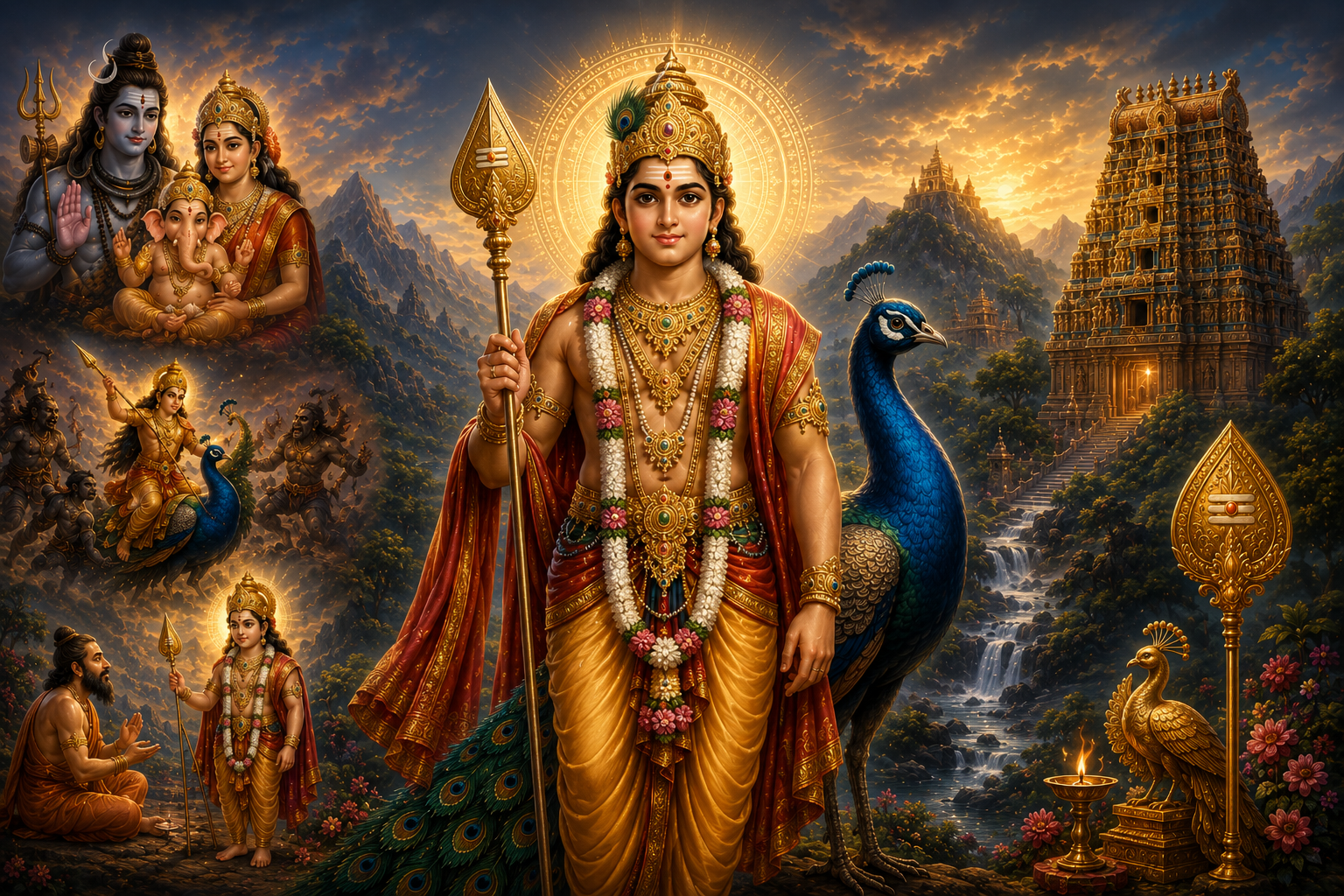
In the vast and luminous tapestry of Hindu Dharma, few deities inspire the kind of rapturous, all-consuming devotion that Lord Murugan commands. He is the eternal youth, the six-faced warrior, the commander of the celestial armies of the gods — and in the hearts of Tamil Shaivites, he is simply the highest truth made incarnate. Known by dozens of names across the Indian subcontinent and beyond — Kartikeya, Skanda, Subramanya, Shanmukha, Kumara — Murugan is the son of Lord Shiva and Goddess Parvati, and one of the most widely worshipped deities in South and Southeast Asia.
This complete guide to Lord Murugan explores every dimension of his sacred significance: the extraordinary circumstances of his birth, the rich symbolism of his iconography, the love stories of his two consorts Valli and Devasena, the six sacred Arupadai Veedu temples of Tamil Nadu, the electrifying Thaipusam festival, his deep roots in ancient Sangam literature, and his remarkable presence across the nations of Southeast Asia. Whether you are a devotee seeking deeper understanding or a student of Dharmic traditions, this is the definitive reference to the god who embodies beauty, power, wisdom, and unconditional love.
Names and Etymology: The Many Faces of One Truth
The multiplicity of Murugan’s names is itself a teaching. Each name illuminates a different facet of his infinite nature, and together they constitute a theology of the divine in miniature.
Murugan
The name Murugan is pure Tamil, one of the oldest names of the deity, and it carries the meaning of beauty, youth, and divine fragrance. The Tamil root muram suggests sweetness and loveliness; he is the eternally young god who radiates the beauty of creation itself. In ancient Tamil poetry, the word “murugan” was used as a common noun to denote a handsome young man — a testament to how deeply this god was woven into the cultural imagination of the Tamil people.
Kartikeya
Kartikeya derives from the Krittika — the six star-maidens of the Pleiades constellation — who nursed the god when he was born as six separate flame-children in the reed forest of Saravana. The Krittikas, moved by divine compassion, suckled the six infants simultaneously, and it is from their care that the god takes this name. Kartikeya is thus the foster-child of the cosmos, nurtured by the very stars of the sky.
Skanda
Skanda comes from the Sanskrit root skand, meaning to leap, to attack, or to pour forth with force. It evokes the god’s role as the supreme warrior who “leaps” into battle, as well as the manner of his birth — from Shiva’s fiery seed, which “leapt forth” and had to be contained by successive divine vessels before taking form in the reed forest. In North India and in Sanskrit literature — the Mahabharata, the Puranas — this is the dominant name for the deity.
Subramanya
Subramanya is a name of great theological depth. It is interpreted as meaning “excellent among Brahmins” (su = excellent, brahma = the priestly class or the ultimate reality, ya = endowed with). Another reading is “devoted to Brahmins” or “protector of sacred knowledge.” The name signals that Murugan is not merely a warrior deity but the guardian of dharma, wisdom, and sacred learning — a god who upholds the Vedic order even as he transcends it.
Shanmukha
Shanmukha means “six-faced” (Sanskrit: shan = six, mukha = face), referring directly to the god’s iconographic form. Each of his six faces presides over one of the six directions — north, south, east, west, zenith, and nadir — signifying that Murugan’s divine awareness encompasses all of space. The six faces also correspond to six divine functions: creation, preservation, destruction, concealment, grace, and liberation.
Kumara
Kumara means “the eternal youth” or “the prince.” It is one of the most ancient Vedic names for the god, appearing in the Atharva Veda and the Shatapatha Brahmana. The name evokes not just physical youth but the perpetual freshness of divine energy — the god who never ages, never wearies, and who stands at the threshold between the human and the divine with the eternal enthusiasm of a young warrior.
Senthil and Saravana
Senthil is a beloved Tamil name meaning “the beautiful, the charming one” — a term of endearment used especially by devotees of the Thiruchendur shrine. Saravana or Saravanabava recalls the place of his birth: the Saravana, the forest of reeds (Sara = reed, Vana = forest) on the banks of the celestial Ganga, where Shiva’s fire-seed took form. The name also encodes the six-syllable root mantra of Murugan — Sa-Ra-Va-Na-Ba-Va — which devotees chant in his worship.
The Birth Narrative: How the Divine Warrior Came Into Being
The story of Murugan’s birth is one of the most dramatic and theologically rich narratives in the entire corpus of Hindu Dharma. It begins with a cosmic crisis, passes through grief and penance, draws in the fire god, the river goddess, the stars of the Pleiades, and the reed beds of a heavenly forest, and culminates in the birth of a warrior so powerful that he slays the unconquerable demon on his very first day of battle.
The Demon Tarakasura and the Boon
The demon Tarakasura performed tremendous austerities and obtained a boon from Brahma, the creator: he could only be slain by a son of Shiva. This was Tarakasura’s masterstroke of cunning, for at the time the boon was granted, Shiva was in the deepest grief following the death of his first wife Sati — who had immolated herself in protest against her father Daksha’s insult to Shiva. In his inconsolable grief, Shiva had retired into deep, world-withdrawing meditation, and there was no possibility of him taking another wife, let alone fathering a child. The gods were terrorised, the three worlds fell under the shadow of demonic tyranny, and even Indra, king of the gods, was driven from his throne.
Parvati’s Penance
The gods, led by Indra and advised by Brahma, determined that the only solution was to awaken Shiva from his meditation and arrange his marriage to Parvati — the reincarnation of Sati, born as the daughter of the mountain-king Himavat. Parvati herself understood her cosmic purpose. To win Shiva’s heart, she undertook extraordinary tapas (austerities) — meditating for thousands of years in the forests near Kailasha, wearing rough bark garments, fasting, standing on one leg, enduring heat and cold, determined to match the great ascetic on his own terms. The love-god Kamadeva was sent by the gods to shoot Shiva with his flower-arrow and rouse the meditation — but Shiva, disturbed, opened his third eye and reduced Kamadeva to ash. Yet Parvati’s penance was not in vain. Her devotion and sincerity ultimately moved the great god, and Shiva took Parvati as his wife.
The Fire-Seed and Its Journey
From the union of Shiva and Parvati arose a seed of fire so extraordinarily powerful that it could not be contained by any ordinary womb — not even Parvati herself could bear it without the cosmos itself being threatened. The gods, in their anxiety, asked Agni (the fire god) to carry the seed. Agni accepted and bore the divine fire within himself, but even the god of fire found it unbearably intense. He passed it to the goddess of the river Ganga, whose cool, purifying waters could moderate the heat. Ganga carried the seed in her flow and, when the time came, deposited it in the banks of a great reed forest — the Saravana — where the divine fire settled among the reeds and gave birth to not one but six flame-children, glowing like tiny suns.
The Krittika Star-Maidens and the Six Faces
The six Krittika maidens — the divine personifications of the six stars of the Pleiades — came upon the six infants in the reed forest and were overwhelmed with maternal love. Each of the six took one infant and nursed it at her breast. When Parvati arrived, overcome with love for her children, she gathered all six to her breast in one embrace — and in that moment of divine motherly love, the six merged into one child with six faces and twelve arms. This is Shanmukha, the six-faced one, and this is the moment of Kartikeya’s true birth as the singular divine warrior.
The Slaying of Tarakasura
Murugan was made the commander-in-chief of the divine armies — the Devasena-pati, the lord of the army of the gods. The gods bestowed upon him divine weapons of every kind. Indra gave him the Vajra. Vishnu gave him the Sudarshana Chakra. Yama gave him his staff. Varuna gave his noose. And most significantly, Parvati herself gave him the Vel — the divine spear of knowledge — which became his supreme weapon and symbol. On the very first day of battle, the youthful warrior marched against Tarakasura and his demonic host and slew the demon with a single cast of the Vel, fulfilling the divine purpose for which he had been born.
Iconography: Reading the Language of Form
In the sacred iconography of Murugan, every detail carries meaning. His form is a visual scripture — a complete Dharmic teaching encoded in imagery.
Six Faces, Twelve Arms
As Shanmukha, Murugan has six faces, each oriented toward one of the six directions. The six faces are said to govern six divine functions: the creation and sustenance of the cosmos; the bestowing of knowledge; the destruction of evil; the nurturing of devotees; the granting of liberation; and the grace that operates beyond all categories. His twelve arms carry an array of weapons and divine emblems — the Vel, the bow, the arrow, the sword, the shield, the Vajra, the conch, and others — symbolising that his divine power operates in all the spheres of creation simultaneously.
The Vel — The Sacred Spear
Of all his weapons, the Vel (Tamil: வேல்) is primary. It is not merely a weapon of war but a symbol of divine knowledge — the discriminating wisdom (viveka) that cuts through the illusion of maya as a spear cuts through a shield. The Vel was given to Murugan by Parvati herself — and in this gesture, the mother-goddess, the embodiment of Shakti, empowers her son with the instrument of spiritual liberation. Its sharp, pointed blade represents the focused intensity of jnana (true knowledge) that pierces the veil of ignorance; its gleaming shaft represents the clarity and purity of divine awareness. Devotees hold vel-shaped objects in their hands as they circumambulate temples, and the vel-kavadi — a structure adorned with the spear motif — is carried during festivals as an act of surrender to this divine weapon of wisdom.
The Peacock Vahana (Paravani)
Murugan’s divine vehicle is the peacock, called Paravani. In the mythology, the peacock was originally the demon Soorapadman — the great asura who was ultimately defeated by Murugan in an epic cosmic battle. In his death, Soorapadman pleaded for mercy, and in a characteristic gesture of divine compassion, Murugan transformed the demon’s body: one part became his peacock vehicle, the other became the rooster on his battle-flag. The peacock, with its magnificent spread of eyes on its tail-feathers, symbolises the all-seeing awareness of the divine; it also represents the ego that has been tamed and transformed — placed beneath the feet of the guru — rather than destroyed. The rooster on the flag crows at dawn, symbolising the awakening of spiritual knowledge that dispels the darkness of ignorance.
The Snake, the Consorts, the Golden Form
A serpent is sometimes shown beneath Murugan’s feet — representing the kundalini energy, the primal spiritual power of consciousness that the yogi master has awakened and brought under divine control. Murugan is universally depicted as a radiantly handsome young man with golden skin — the colour of the sun, of divine fire, of enlightened awareness. He stands between his two consorts, Valli (on his left) and Devasena (on his right), who together represent the two poles of his devotees: the earthly human soul seeking the divine, and the divine celestial grace reaching down to the devotee.
The Two Consorts: Valli and Devasena
The story of Murugan’s two marriages is among the most theologically rich and humanly moving narratives in Tamil Shaivism. The two consorts — one celestial, one earthly — represent the complete spectrum of Murugan’s relationship with his devotees: the divine dispensation that comes from above, and the humble human longing that reaches upward from below.
Devasena: The Celestial Bride
Devasena is the daughter of Indra, the king of the gods. Her name means literally “army of the gods” (Deva = gods, Sena = army), and in one reading her very being is the divine army that Murugan commands. She represents the celestial, orthodox, Vedic tradition — the marriage that was arranged by the gods, sanctioned by heavenly protocol, blessed by the divine hierarchy. Murugan married Devasena at Thiruparankundram near Madurai — one of the six sacred Arupadai Veedu temples — in a ceremony presided over by Indra himself. This marriage symbolises the relationship between the divine warrior-god and the established order of cosmic dharma.
Valli: The Tribal Beloved
The story of Valli is perhaps the most beloved narrative in all of Tamil devotional literature. Valli was a young woman of the Vedda people — the aboriginal hunters and forest-gatherers of Tamil Nadu — who worked guarding millet fields from birds. She had a pure heart, simple devotion, and a natural love for the divine. Murugan, in his infinite love for the humble devotee, fell passionately in love with Valli and determined to win her heart.
He came to her field disguised as a handsome young hunter — but Valli, while charmed, was cautious and sent him away. He returned disguised as an old man selling honey, and again she was friendly but unresponsive. In his playful determination, Murugan enlisted the help of his brother Ganesha, asking him to create an obstacle. Ganesha took the form of a terrifying wild elephant and charged at Valli, who, in her terror, ran straight into the arms of the “old man” for protection. In that moment of surrender — the soul fleeing into divine refuge — love was born. Murugan revealed his true form, and Valli agreed to marry him, though she first returned to her people to seek their blessing.
The theological meaning of this story is profound. Valli represents the jiva — the individual human soul. She is not a princess, not a goddess, not of the Vedic priestly hierarchy; she is an ordinary person of the forest, living close to the earth. Murugan crossing social and cosmic boundaries to love her, disguising himself, playing games, seeking her out — all of this enacts the teaching that the divine love does not wait for the soul to become perfect before it comes; it pursues the soul wherever it is, in whatever condition, and uses every means — beauty, disguise, even a frightening elephant — to bring the soul into divine embrace. Valli is the supreme symbol of bhakti — the love of the divine for the devotee is as passionate and relentless as a lover seeking the beloved.
The Six Abodes — Arupadai Veedu: The Sacred Geography of Murugan
The six sacred temples of Murugan in Tamil Nadu are collectively known as the Arupadai Veedu — literally “six battle camps” or “six abodes.” They are considered the six places where Murugan rested or was worshipped after significant events in his divine mission. Together, they form a sacred geography — a map of the god’s presence across the Tamil land — and a pilgrimage circuit that has been walked by millions of devotees for over two millennia.
1. Thiruthani — The Abode of Contemplation
Located about 84 km from Chennai, Thiruthani (also spelled Tiruttani) is the temple where Murugan is said to have rested and meditated after slaying Tarakasura and completing his divine mission. Here, the warrior-god becomes the contemplative sage — his work done, he turns inward. The presiding deity, Thandayuthapani, appears in a peaceful, meditative form, holding the vel. The temple sits atop a hill of 365 steps — one for each day of the year — which pilgrims climb as an act of devotion.
2. Swamimalai — Where the Student Became the Teacher
Swamimalai, near Kumbakonam in the Cauvery delta, is one of the most theologically significant of the six temples. Here, the child Murugan taught the meaning of the Pranava mantra (Om/AUM) to Brahma (and according to some versions, even to his own father Shiva), after Brahma was found ignorant of its meaning and was imprisoned by Murugan as a consequence. The deity here is called Swaminathaswamy — “the lord who is the teacher of the Lord” — a paradox that speaks volumes about the nature of divine knowledge: even the oldest gods can learn from the newest.
3. Thiruparankundram — The Site of the Divine Wedding
Thiruparankundram, located about 8 km from Madurai, is one of the oldest rock-cut temples in South India, carved into a hillside. This is the site where Murugan married Devasena — with Indra giving his daughter away and the whole celestial host attending. The temple, which dates in its present form to at least the Pandya period, is a stunning example of Dravidian rock-cut architecture. The deity here appears in a nuptial form, with Devasena at his side.
4. Palani — The Mountain of Renunciation
Palani (also Palani or Pazhani) is perhaps the most famous of the six temples, and its origin story is one of the most touching in all of Hindu mythology. The sage Narada brought a rare and precious fruit — described variously as a mango or a jackfruit — to Shiva and Parvati, saying it was a fruit of supreme knowledge and spiritual perfection, and that it could go only to the worthiest of their two sons. Shiva proposed a competition: whoever circumambulates the entire universe first would receive the fruit. Skanda immediately mounted his peacock and set off at full speed around the three worlds. Ganesha, the round-bellied son with the elephant head, calmly walked in a circle around his parents — for to him, his parents were the entire universe. When Skanda returned after his vast circuit and found that Ganesha had already been given the fruit for his wisdom, he was furious. In his righteous anger at what he felt was an injustice, he renounced all his divine ornaments and weapons, stripped himself to the bare minimum, and retired to the hill of Palani as a renunciant, a lone ascetic clothed in nothing but a loincloth.
When his parents arrived to console him, Murugan said, in what became one of the most quoted lines of Tamil devotion: “I myself am the fruit” — meaning he himself is the embodiment of divine knowledge, and he needs no external prize to complete him. The deity at Palani, called Dhandayuthapani, stands alone on the hilltop — young, lean, renunciant, holding only a staff and a small water-vessel — the most ascetic form of the divine warrior. Millions of pilgrims climb the 693 steps to his shrine every year, and the Palani deity is considered one of the most powerful forms of Murugan in the Tamil world.
5. Thiruchendur — The Coastal Victory
Thiruchendur is the only one of the six temples located on the sea coast — it stands at the edge of the Bay of Bengal in the far south of Tamil Nadu. This is the site of Murugan’s great battle against the demon Soorapadman, the most terrible of all the asuras who tormented the gods, and whom Tarakasura’s brother and co-conspirator. Murugan set up his war camp on the beach at Thiruchendur and, after the great battle in which he used the Vel to split the demonic Soorapadman (who took the form of a mango tree) into two, transformed the halves into his peacock and his rooster-flag. The temple here, one of the most visited shrines in India, has the sound of the ocean as its permanent background music — a fitting setting for the place where the decisive cosmic battle was won.
6. Pazhamudircholai — The Forest Shrine
Pazhamudircholai is a forest temple located on a hill about 25 km from Madurai, surrounded by lush greenery and natural beauty. Unlike the other five temples, this shrine has no elaborate battle-story as its origin — it is simply a place where Murugan is said to eternally delight, a place of natural beauty that the god himself loves. The name means “the grove of ever-ripening fruit,” and the temple evokes the pastoral, gentle aspect of the deity — the mountain-god of ancient Tamil poetry, dwelling in the kurinji (mountain/forest landscape) beloved by young lovers. Valli is particularly associated with this temple.
Thaipusam: The Festival of the Vel
Thaipusam is the most spectacular and emotionally charged festival in the Murugan devotional calendar. It falls on the full moon day of the Tamil month of Thai (January–February), on the day when the star Pushyam (Poosam) is in the ascendant — and it commemorates the day when Parvati gave Murugan the sacred Vel to defeat the demon Soorapadman.
The Kavadi Tradition
The central feature of Thaipusam is the kavadi — an elaborately decorated arched frame, often several feet tall, adorned with peacock feathers, flowers, images of the deity, and miniature vels — which devotees carry on their shoulders as an act of penance, thanksgiving, or fulfillment of a vow to the god. The word kavadi originally referred to a simple carrying pole, but over centuries the tradition evolved into an art form of devotion. Kavadis can weigh many kilograms and are carried for distances of several kilometres — sometimes the entire length of the pilgrimage route from one temple to another.
The most extreme and visually dramatic form of kavadi devotion involves the piercing of the skin. Vel-shaped skewers — long, silver spears — are pushed through the cheeks, the tongue, and the body of the devotee, who enters a deep trance state of divine possession (arul) and feels no pain, bleeds little, and receives the piercing as a direct gift of the god’s grace. This practice, deeply misunderstood by outside observers, is not masochism but an ancient tradition of extreme devotion — the body becoming a living altar, the vel piercing the devotee as Murugan’s knowledge pierces through the illusion of the self. Devotees often fast for 48 days before Thaipusam to prepare spiritually, and are in a state of profound spiritual preparation before the event.
Thaipusam Across the World
In Malaysia, Thaipusam is one of the most magnificent religious spectacles on earth. The celebration at Batu Caves near Kuala Lumpur — where a 42.7-metre golden statue of Lord Murugan stands at the foot of 272 steps leading up to a vast limestone cave temple — draws over 1.5 million devotees and pilgrims annually, making it one of the largest Hindu religious gatherings anywhere in the world outside India. The procession begins in the night with the chariot of the deity being drawn through the streets of Kuala Lumpur to Batu Caves, a journey that takes many hours, accompanied by drums, chanting, and the ecstatic movement of hundreds of kavadi-bearers.
In Singapore, Thaipusam is a public holiday, and the procession from the Sri Srinivasa Perumal Temple to the Sri Thendayuthapani Temple on Tank Road draws hundreds of thousands of participants and spectators. In Sri Lanka, particularly at the Kataragama temple in the south — considered a sacred site by Hindus, Buddhists, and Muslims alike — Thaipusam is a multi-religious celebration. In Mauritius, where Tamil Hindus form a significant part of the population, it is one of the most important annual events.
Panguni Uttaram: The Festival of the Divine Marriages
Panguni Uttaram falls on the full moon of the Tamil month of Panguni (March–April), when the moon is in the nakshatra Uttara Phalguni. This festival commemorates Murugan’s marriages — to Devasena at Thiruparankundram and, by extension, to Valli as well. The divine wedding is celebrated at all six Arupadai Veedu temples and at Murugan shrines across the Tamil world, with elaborate wedding rituals (kalyanam) performed for the deity. Panguni Uttaram is considered an auspicious day for human marriages as well — couples who marry on this day are said to receive the blessing of the divine couple’s eternal union. The festival also celebrates other divine marriages — including that of Shiva and Parvati — and the full moon of Panguni is considered one of the holiest days in the Tamil calendar.
Murugan in the Sangam Literature: Ancient Roots of Tamil Devotion
The worship of Murugan as a specifically Tamil deity has roots that precede the great Sanskrit Puranas. In the Sangam literature — the classical Tamil poetry composed roughly between the 3rd century BCE and the 3rd century CE, representing the earliest surviving corpus of Tamil literature — Murugan appears as one of the foundational deities of the Tamil people.
Seyon — The Lord of the Mountains
In the Sangam literary system, the Tamil landscape was divided into five tinai (ecological zones), each associated with a particular mood of love and a presiding deity. The mountain landscape — the kurinji tinai, with its cold peaks and dense forests — was presided over by a deity called Seyon (literally “the Red One” — perhaps referring to his golden-red complexion or to the red hill on which he dwells). Seyon was identified with the young hunter-god of the mountains, associated with the emotion of union — the first coming-together of lovers — and with the forests, the wild animals, and the raw vitality of nature. This ancient Seyon is widely understood by scholars to be the proto-Murugan — the Tamil deity who was later integrated with the Sanskritic Skanda-Kartikeya to produce the rich composite divinity we know today.
The Tirumurugattrupadai
The Tirumurugattrupadai (“Guide to the Sacred Murugan”) by the poet Nakkirar, composed approximately in the 2nd century CE, is the oldest sustained literary text entirely devoted to Murugan and his worship. It is one of the Pattupattu (Ten Idylls), a collection of classical Tamil poems, and it is structured as an atrupadai — a poem in which one person guides another to a generous patron, in this case the divine patron Murugan himself. Nakkirar describes in vivid detail the six holy places of Murugan’s worship, his celestial form, his peacock, his two wives, his Vel, his battle against the demons, and the ecstatic state of the devotees who worship him. The poem is a living bridge between the ancient Tamil hill-cult of Seyon and the developed Shaiva theology of Murugan as Shanmukha Kartikeya.
The Tirumurugattrupadai stands as evidence that Murugan worship was already highly developed, theologically sophisticated, and deeply embedded in Tamil cultural life nearly two thousand years ago — long before many of the North Indian Sanskrit texts about Skanda were composed in their present form. The Tamil tradition of Murugan worship is not a derivative of the Sanskrit Skanda-tradition but an independent and ancient stream that merged with the Sanskritic river to produce a uniquely rich confluence.
Murugan as Jnanaskanda — The Supreme Guru
One of the most paradoxical and theologically profound aspects of Murugan’s nature is his role as the divine teacher — the guru who knows more than his own elders, who imprisons Brahma for ignorance, who teaches Om to his own father Shiva, and who is thus called Swaminatha (teacher of Shiva, “Swami” being a title for Shiva) and Jnanaskanda (Skanda of divine knowledge).
The Imprisonment of Brahma
The story goes that one day, the child Murugan asked Brahma — the creator of the universe — what the meaning of the Pranava mantra, the sacred syllable Om (AUM), was. Brahma, unable to answer fully, was found ignorant of the highest mystery. Murugan, as the embodiment of divine knowledge, imprisoned Brahma to signal that creation itself cannot proceed from mere mechanical power without true wisdom. The gods appealed to Shiva to intervene, and Shiva himself went to Murugan — whereupon the divine son agreed to release Brahma only on condition that he teach Shiva himself the meaning of Om. Shiva, in an act of profound humility, sat at the feet of his own son as a student — and Murugan whispered the meaning of Om into his ear, in the posture of a guru imparting secret knowledge into the ear of a disciple.
This episode — in which the son teaches the father, the young teaches the ancient, the warrior-god is revealed as the greatest sage — encapsulates one of the deepest truths of the Dharmic tradition: that divine knowledge transcends all hierarchies of age, status, and position. It is also a statement about the relationship between Shakti (divine power) and Jnana (divine knowledge): Murugan, born of Shiva and empowered by Parvati’s Vel, integrates both in himself, and in that integration becomes the supreme teacher. The Swamimalai temple, where this episode is said to have occurred, commemorates this paradoxical reversal in its very name: Swami-malai means “the hill of the teacher of Swami.”
Dakshinamurti and Murugan
In the broader Shaiva tradition, the divine teacher is most often represented by Dakshinamurti — Shiva as the silent, southward-facing guru who teaches by silence, sitting under a banyan tree, with ancient sages at his feet learning simply by being in his presence. Murugan as Jnanaskanda is the complement of Dakshinamurti: where Dakshinamurti teaches in silence, Murugan teaches through dynamic engagement, through battle, through love, through the vel, through his relationship with his two consorts, his quarrel with his parents, his renunciation at Palani. Both are faces of the divine guru — the still and the dynamic, the silent and the narrative, the ancient and the eternally youthful.
Murugan Across Southeast Asia: The God Who Crossed the Seas
The worship of Murugan did not stay within the boundaries of South India. Carried by Tamil merchants, sailors, settlers, and scholars across the ancient maritime trade routes of the Indian Ocean world, and later by the movement of indentured labourers and free migrants under colonial-era arrangements, Murugan became one of the most widely worshipped Hindu deities in Southeast Asia.
Sri Lanka — Kataragama
In Sri Lanka, the Kataragama temple complex in the deep south is among the most important pilgrimage sites in the entire country — and uniquely, it is revered by Hindus, Buddhists, and Muslims alike, who know the presiding deity by different names but understand him as the same powerful, grace-giving divine presence. For the Tamil Hindu community of Sri Lanka, Murugan at Kataragama is second in importance only to the major temples of Tamil Nadu. The Kataragama festival, held during the month of Esala (July-August), draws hundreds of thousands of pilgrims and features fire-walking as well as kavadi-carrying.
Malaysia — The Tamil Diaspora’s Beloved God
In Malaysia, where Tamil Hindus make up the majority of the Hindu community (approximately 1.8 million people, or about 6% of the national population), Murugan is unquestionably the most beloved deity. The Tamil community, brought to Malaya as plantation workers under British colonial administration from the mid-19th century onwards, carried their deep devotion to Murugan with them and established hundreds of temples across the country. The Batu Caves temple complex near Kuala Lumpur — with its iconic golden statue of Murugan, the largest in the world — has become not just a religious site but a national landmark, visited by millions of tourists of all backgrounds every year. Thaipusam at Batu Caves is a national event in Malaysia.
Singapore, Indonesia, Thailand, and Cambodia
In Singapore, the Sri Thendayuthapani Temple on Tank Road (also known as the Chettiars’ Temple) is the focal point of Thaipusam celebrations and one of the most important Hindu temples in the city-state. In Indonesia, especially in Bali where Hinduism survived the region’s conversion to Islam, the deity known as Kartikeya or Skanda is part of the sacred Hindu-Buddhist pantheon. In ancient Cambodia, the Angkor civilisation at its height was deeply influenced by South Indian Shaivism, and images of Skanda-Murugan have been found in Angkorian temple complexes. In Thailand, the royal and Brahminical traditions of Bangkok and Ayutthaya maintained Hindu ritual practices in which Skanda (known as Karthikeya or Kumara) played a significant role in court ceremonies and protective rites.
What this remarkable geographic spread illustrates is that Murugan’s appeal transcends the specific cultural context of Tamil Nadu — though Tamil Nadu remains his heartland. As the deity who crosses boundaries to love the humble forest girl Valli, as the warrior who transforms enemies into his vehicle and flag, as the teacher who teaches the cosmic creator and his own divine father, Murugan embodies a universality that speaks to the human condition across cultures and centuries.
The Vel as the Symbol of Divine Knowledge
In the Shaiva tradition, each great deity has a primary symbolic weapon that encapsulates his essential nature: Vishnu has the Sudarshana Chakra (the discus of the all-seeing mind), Shiva has the Trishula (the trident of the three aspects of consciousness — creation, preservation, dissolution). Murugan’s supreme symbol is the Vel.
The Vel is first and foremost a weapon of knowledge, not of war. In the iconographic and philosophical tradition, the long shaft of the vel represents the infinite expanse of divine consciousness — the pure awareness that underlies all phenomena. The sharp, blade-like point represents viveka (discrimination) — the capacity of awakened intelligence to distinguish the real from the unreal, the eternal from the transient, the self from the not-self. Just as a spear pierces a target with unerring precision, the vel of Murugan pierces through the veil of maya (illusion) that ordinarily prevents the soul from recognising its true divine nature.
The fact that the Vel was given to Murugan by Parvati — by the mother-goddess, the embodiment of Shakti (divine power) — is theologically significant. It says that the power to overcome illusion and realise the truth is not something the seeker generates independently; it is a gift of grace from the divine mother. Shakti empowers the warrior of truth. The mother gives the son the tool with which he will liberate all beings. In this gesture, Parvati’s gift of the Vel to Murugan enacts the central teaching of Shakta-Shaiva philosophy: that divine consciousness (Shiva) and divine energy (Shakti) work inseparably together, and that the path to liberation requires both the warrior’s courage and the mother’s grace.
For the devotee who carries the vel-kavadi at Thaipusam, or who holds a small vel in their hands at the temple, this symbol is not an abstraction. It is a living connection to the divine presence of Murugan — a reminder that they, too, carry within themselves the vel of knowledge, and that Murugan’s grace is always available to sharpen it and set it to work on the demons of their own ignorance, fear, and ego.
Key Takeaways
Key Takeaways
- Lord Murugan (also Kartikeya, Skanda, Subramanya, Shanmukha, Kumara) is the six-faced son of Shiva and Parvati, born to defeat the demon Tarakasura, and one of the most widely worshipped deities in South and Southeast Asia.
- His birth involved Shiva’s fire-seed passing through Agni and Ganga before settling in a reed forest, where the six Krittika star-maidens nursed six flame-babies that merged into one child with six faces upon Parvati’s embrace.
- The Vel (sacred spear) — given by Parvati herself — is Murugan’s primary symbol and weapon, representing not a tool of war but the divine knowledge (jnana) that pierces through illusion (maya) and leads the soul to liberation.
- His two consorts — Devasena (the celestial, divine bride) and Valli (the tribal, earthly beloved) — together represent the complete spectrum of divine-human relationship: the grace that descends from above and the devotion that rises from below.
- The six Arupadai Veedu temples of Tamil Nadu — Thiruthani, Swamimalai, Thiruparankundram, Palani, Thiruchendur, and Pazhamudircholai — form a sacred pilgrimage circuit across Tamil Nadu, each associated with a key episode in Murugan’s divine biography.
- Thaipusam is the major festival of Murugan, commemorating Parvati giving him the Vel; the kavadi tradition — including the extreme devotion of vel-piercing — represents the soul’s complete surrender to the divine; Batu Caves in Malaysia hosts the world’s largest Thaipusam celebration with 1.5 million devotees.
- Murugan in Tamil Sangam literature (as “Seyon”) predates the Sanskrit Puranic tradition — the Tirumurugattrupadai (c. 2nd century CE) by Nakkirar is the oldest detailed text on Murugan, showing the deep, independent roots of Tamil Murugan worship.
- As Jnanaskanda, Murugan is the supreme guru — the child who imprisoned Brahma for ignorance and taught the meaning of Om to his own father Shiva, earning the title Swaminatha (teacher of the Lord).
- Murugan’s influence extends across Southeast Asia — Kataragama in Sri Lanka, Batu Caves in Malaysia, Singapore, ancient Cambodia, Bali — carried by the Tamil diaspora and ancient maritime trade, making him one of the most geographically widespread of all Hindu deities.
Frequently Asked Questions About Lord Murugan
Why does Lord Murugan have six faces?
Lord Murugan has six faces (making him Shanmukha, “six-faced”) because he was originally born as six separate flame-babies in the Saravana reed forest, one for each of the six Krittika star-maidens who nursed him. When Parvati embraced all six at once, they merged into a single child with six faces. Theologically, the six faces represent the six directions of space (north, south, east, west, zenith, and nadir), signifying that Murugan’s divine awareness and protection extend in all directions simultaneously. The six faces are also associated with six divine functions: creation, preservation, dissolution, concealment, grace, and liberation.
What is the significance of the Vel (spear) of Lord Murugan?
The Vel is Murugan’s primary weapon and sacred symbol, given to him by his mother Parvati (the goddess Shakti) for the defeat of the demon Soorapadman. In its deeper meaning, the Vel is not a weapon of war but a symbol of divine knowledge (jnana) — the penetrating spiritual discrimination (viveka) that cuts through the illusion of maya (the appearance of the world as real and separate from the divine). The sharp blade represents the focused clarity of awakened consciousness, the long shaft represents divine grace extending from the heavens. When Parvati gives the Vel to Murugan, this represents the divine mother empowering her son — and by extension, all devotees — with the gift of liberating wisdom. At Thaipusam, devotees carry vel-shaped structures (kavadi) and some allow vel-skewers to pierce their skin as an act of total devotion and surrender to this divine knowledge.
Who are Valli and Devasena, and what do they symbolise?
Valli and Devasena are the two wives of Lord Murugan. Devasena is the daughter of Indra, the king of the gods, and she represents the celestial, Vedic, divinely ordained tradition — the grace that comes to the devotee through the established sacred order. Valli is a tribal girl of the Vedda people of Tamil Nadu — simple, earthly, deeply devoted — and she represents the human soul in its most natural, humble state. Murugan pursued Valli with great love, crossing all social and divine boundaries, even enlisting his brother Ganesha to help. Together, Valli and Devasena symbolise the completeness of Murugan’s love: he loves the celestial and the earthly equally, the divine hierarchy and the humble devotee, the institutionally sacred and the naturally devout. The story of Valli is the most beloved love story in Tamil devotional literature.
What are the six Arupadai Veedu temples of Murugan?
The six Arupadai Veedu (“six battle-camps” or “six abodes”) are the most sacred temples of Lord Murugan in Tamil Nadu, India. They are: Thiruthani (where Murugan meditated after slaying Tarakasura); Swamimalai (where he taught the meaning of Om to Brahma and to Shiva); Thiruparankundram near Madurai (where he married Devasena); Palani (where he stands as the lone renunciant after refusing the fruit of knowledge); Thiruchendur on the sea coast (where he defeated the demon Soorapadman); and Pazhamudircholai (the forest shrine near Madurai associated with Valli). These six temples together form one of the most important pilgrimage circuits in South India, and visiting all six is considered an act of great spiritual merit.
Why did Murugan become a renunciant at Palani?
The story of Murugan’s renunciation at Palani is one of the most poignant in Hindu mythology. The sage Narada brought a precious fruit of knowledge to Shiva and Parvati, declaring it could go only to the worthiest of their two sons. Shiva proposed a race: whoever circumambulated the entire universe first would receive the fruit. Murugan leapt onto his peacock and flew around the three worlds at great speed. His brother Ganesha, however, simply walked around his parents — for his parents were, to him, the entire universe — and this act of wisdom won him the fruit. When Murugan returned to find Ganesha had been awarded the prize, he was overcome with righteous indignation at what he felt was unfair, and in his fury he renounced all his divine ornaments and weapons, stripped himself to a simple loincloth, and retired to the hill of Palani as a renunciant. His response to his parents — “I myself am the fruit” — became one of the most celebrated statements of spiritual realisation in Tamil devotional literature: the god declaring that he is himself the embodiment of divine knowledge, needing nothing external to complete him.
How is Lord Murugan worshipped outside India?
Lord Murugan is one of the most globally worshipped Hindu deities, carried across the Indian Ocean world by Tamil merchants, scholars, and later by the Tamil diaspora. In Sri Lanka, the Kataragama shrine in the south is sacred to Hindus, Buddhists, and Muslims alike and draws hundreds of thousands of pilgrims. In Malaysia, the Tamil Hindu community of approximately 1.8 million people maintains hundreds of Murugan temples; the Batu Caves complex near Kuala Lumpur — with the world’s largest statue of Murugan — hosts Thaipusam celebrations drawing 1.5 million devotees annually. In Singapore, Thaipusam is a public holiday celebrated with a major procession between two temples. In Indonesia (especially Bali), Thailand, and Cambodia, the ancient Hindu traditions that arrived via Tamil maritime trade left lasting traces of Skanda-Murugan worship in temples and royal court traditions. The god’s global presence reflects both the ancient reach of Tamil civilisation and the depth of the devotion he inspires.
Related articles in Gods & Deities
Sage Jaimini is the founder of the Purva Mimamsa school, honoured for his rigorous inquiry into dharma and the right interpretation of the Vedas.
Madhvacharya is the great teacher of Dvaita Vedanta, who emphasised the eternal distinction between the individual soul and God and a path of wholehearted devotion.
Ramanujacharya is the great acharya of Vishishtadvaita Vedanta, who united loving devotion with rigorous philosophy and is honoured for his inclusive, compassionate vision.
Comments(0)
Loading comments…