
The Trimurti: Brahma, Vishnu, and Shiva — The Cosmic Trinity
Understand how the Hindu cosmic trinity of Brahma the Creator, Vishnu the Preserver, and Shiva the Destroyer together govern the eternal cycle of creation, sustenance, and dissolution.
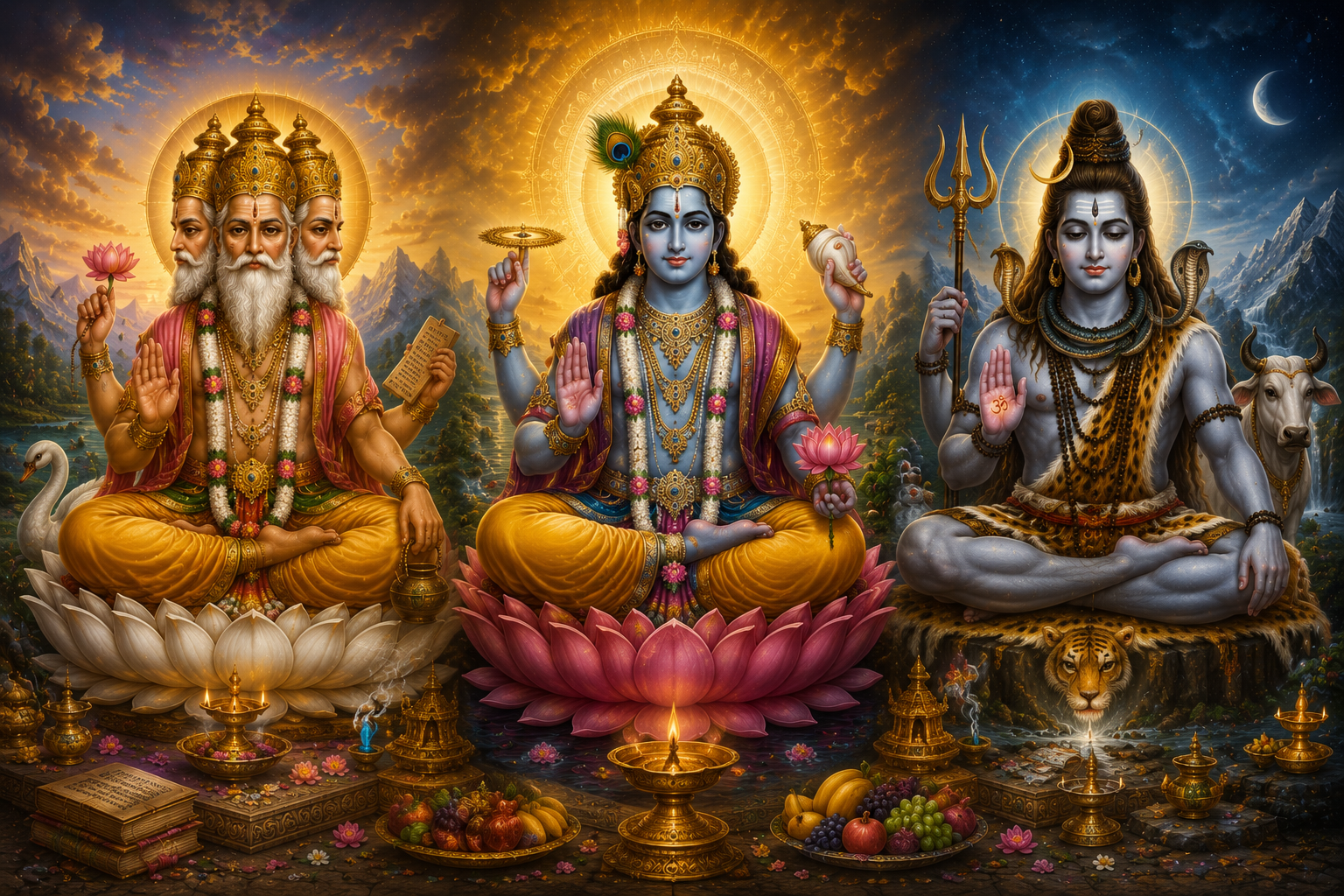
Three Faces of the One Reality
The word Trimurti comes from Sanskrit: tri (three) + murti (form). It refers to the three principal manifestations of Brahman — the ultimate, formless reality — each governing a fundamental cosmic function.
| Deity | Function | Consort | Vehicle |
|---|---|---|---|
| Brahma | Creation (Srishti) | Saraswati | Hamsa (swan) |
| Vishnu | Preservation (Sthiti) | Lakshmi | Garuda |
| Shiva | Dissolution (Samhara) | Parvati | Nandi (bull) |
These three are not separate gods competing with one another — they are three expressions of the one cosmic process that sustains existence.
Brahma — The Creator
Brahma is depicted with four heads, representing the four Vedas and the four directions, signifying the all-encompassing nature of creation. He holds the Vedas, a water pot, a rosary, and a lotus. Despite being the creator, Brahma is rarely worshipped directly; only two significant temples to Brahma exist in India (the most famous at Pushkar, Rajasthan).
The Puranas explain that Brahma''s role — though essential — is transient. Once creation is set in motion, his immediate function recedes. He represents the creative impulse, the initial sankalpa (intention) that brings the universe into being.
Vishnu — The Preserver
Vishnu is the sustainer who maintains the cosmic order (rita) and dharma. He is depicted as a serene, blue-skinned deity reclining on the cosmic serpent Ananta-Shesha on the ocean of consciousness (Kshirasagara). He holds four divine attributes:
- Shankha (conch) — the primordial sound of creation
- Chakra (discus, Sudarshana) — the wheel of time and divine will
- Gada (mace) — the power of knowledge and strength
- Padma (lotus) — purity and liberation
Whenever dharma declines, Vishnu descends as an avatar to restore balance — hence the Dashavatara tradition.
Shiva — The Destroyer and Transformer
Shiva''s role is often misunderstood. He does not destroy out of malice but dissolves the old to make way for renewal — just as a forest fire enables new growth. Shiva is simultaneously the most ascetic and the most fierce, the destroyer of ego and the bestower of liberation (moksha).
He is depicted meditating on Mount Kailash, adorned with the crescent moon, the Ganga flowing from His matted locks, the third eye of wisdom on His forehead, and the serpent Vasuki around His neck. His dance as Nataraja symbolises the cosmic cycle: the drumbeat of creation, the flame of destruction, and the lifted foot of grace.
Unity in the Trinity
Many philosophical traditions within Hinduism teach that Brahma, Vishnu, and Shiva are ultimately one. The Puranas frequently depict them honouring one another. The Dattatreya form — with three heads — embodies this unity directly.
In the Shaiva tradition, Shiva encompasses all three functions. In the Vaishnava tradition, Vishnu is the supreme from whom Brahma and Shiva emerge. The non-dual Advaita view holds that all three are manifestations of the one formless Brahman.
Significance for Daily Life
Understanding the Trimurti teaches us that creation, preservation, and dissolution are not events that only happen cosmically — they happen within us every moment. Every thought arises (Brahma), is held for a time (Vishnu), and passes away (Shiva). To live in harmony with this cycle is the essence of dharmic living.
Shiva and the Cosmic Dance
Shiva's dissolution is not destruction but renewal. His dance, the Tandava, is the rhythm of cosmic time itself — every ending becomes the seed of a new beginning.
"Where there is creation, there is preservation; where there is preservation, there is dissolution. The three are one."
Related articles in Gods & Deities
Lord Ganesha — the elephant-headed son of Shiva and Parvati — is the most universally worshipped deity in Hinduism. Before any journey, any enterprise, any prayer, any sacred text is opened, Ganesha is invoked first. This encyclopaedic guide covers every dimension of Ganesha: the competing origin myths, the deep symbolism of every element of his form, his role in all Hindu traditions, the Ganesh Chaturthi festival, the eight Ashtavinayaka shrines, his 108 names, key mantras, his philosophical significance, and his living presence in the world today.
Krishna — Yadava prince, cowherd of Vrindavan, king of Dwarka, charioteer of Arjuna, and giver of the Bhagavad Gita. A complete encyclopedic profile of his birth, exploits, teachings, philosophy, iconography, and lasting cultural legacy across India and beyond.
Why Varanasi is considered the oldest continuously inhabited spiritual capital of the world.
Comments(0)
Loading comments…