
Chidambaram Nataraja Temple: The Cosmic Dance at the Centre of the Universe
The Thillai Nataraja Temple at Chidambaram is one of Hinduism's most sacred and philosophically profound sites — housing the Akasha Lingam and the cosmic dance of Shiva. Discover its architecture, legends, and hidden mysteries.
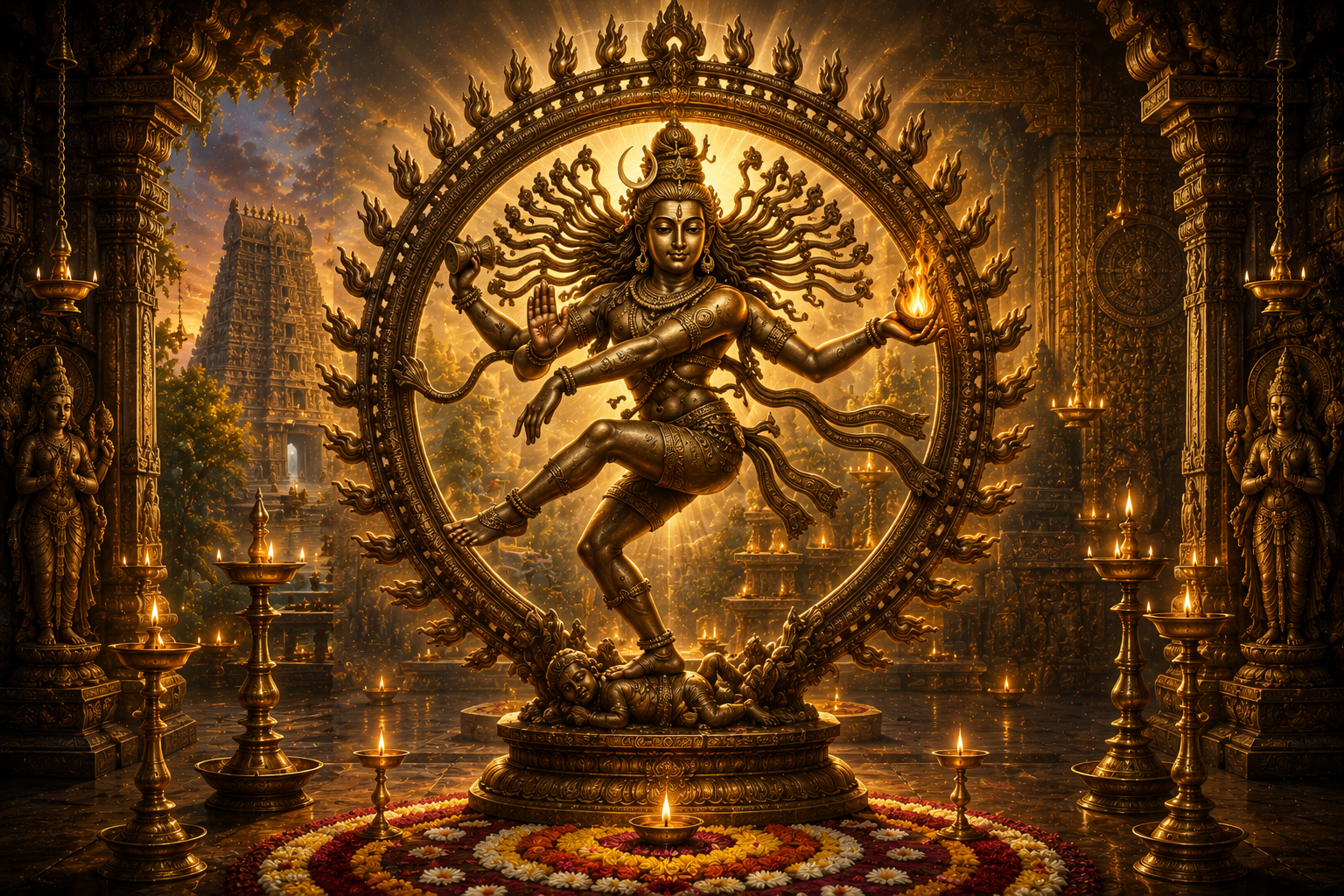
The Centre of the Cosmos
In the Tamil Nadu town of Chidambaram stands a temple that is arguably the most philosophically rich in all of Hinduism — the Thillai Nataraja Temple, dedicated to Lord Shiva as Nataraja, the Lord of the Cosmic Dance.
The very name Chidambaram encodes its essence: Chit (pure consciousness) + Ambaram (sky/space). This is the temple of the sky of consciousness — where the infinite meets the finite.
One of the Pancha Bhuta Stalas
Hinduism recognises five Pancha Bhuta Stalas — temples where Shiva is worshipped as each of the five elements:
| Temple | Element | Location |
|---|---|---|
| Chidambaram | Akasha (Space/Ether) | Tamil Nadu |
| Tiruvannamalai | Fire (Agni) | Tamil Nadu |
| Kanchipuram (Ekambareswarar) | Earth (Prithvi) | Tamil Nadu |
| Thiruvanaikaval | Water (Jala) | Tamil Nadu |
| Kalahasti | Air (Vayu) | Andhra Pradesh |
Chidambaram represents Akasha — space, the subtlest element, the substratum of all existence. The Shivalinga here is Akasha Lingam — the formless, invisible presence, worshipped as space itself.
Nataraja: The Cosmic Dance
The presiding icon of Chidambaram is the Nataraja — Shiva''s form as the Lord of Dance. The bronze image, one of the finest examples of Chola craftsmanship, is rich with symbolism:
- Upper right hand (Damaru): The drum whose beat creates the universe — the first vibration of Nada Brahma (cosmic sound)
- Upper left hand (Agni): The flame of dissolution — creation and destruction held in the same pair of arms
- Lower right hand (Abhaya mudra): Protection — "fear not"
- Lower left hand (Gaja hasta): Points to the lifted left foot — the foot of liberation and grace
- Right foot: Stamps upon Apasmara Purusha (the demon of forgetfulness/ignorance)
- Lifted left foot: Ananda Tandava — the dance of bliss; liberation offered to all who behold it
- Ring of fire (Prabhamandala): The boundary of the cosmos — the cycle of creation and dissolution
The Nataraja image, declared by art historians as one of humanity''s greatest artistic and philosophical achievements, is the cosmic process expressed in bronze.
The Chidambara Rahasyam — The Secret of Chidambaram
Behind the golden roof of the Kanaka Sabha (golden hall), behind a curtain of golden vilva leaves, lies the Chidambara Rahasyam — the "secret of Chidambaram."
When the curtain is drawn aside during ritual, what is revealed? Nothing — empty space. Or rather: a string of golden vilva leaves, and the space between them.
This is the most profound teaching of the entire temple: the ultimate reality is not an object you can see, grasp, or worship with form. It is the spacious awareness itself — the Akasha — that underlies everything. The Rahasyam is not a hidden treasure; it is the recognition that you are the space in which all experience arises.
The Temple''s Architecture
The temple complex covers 49 acres and features four massive gopurams (gateway towers), each covered with sculptures depicting 108 karanas (dance poses from the Natya Shastra) — the entire repertoire of Bharatanatyam frozen in stone.
The Kanaka Sabha (golden-roofed hall) houses the Nataraja, and the Chit Sabha houses the Akasha Lingam. The roof of the Chit Sabha is covered with 21,600 golden tiles — representing the 21,600 breaths a human takes in one day — fixed with 72,000 golden nails, representing the 72,000 nadis (subtle energy channels) of the human body. The temple is literally built as a map of the human body and cosmic breath.
The Dikshitar Community
The Chidambaram temple has been managed for over a thousand years by the Thillai Vaazh Andhanar — the Dikshitars — a community of some 300 priests who claim descent from the original 3,000 sages (the Tillai three thousand) who witnessed Shiva''s dance. They follow an ancient tradition of Vedic and Agamic ritual unique to this temple.
Pilgrimage and Significance
Chidambaram holds a unique place in Tamil Shaivism. All six Tevaram hymn-composers (Nayanmars) — Appar, Thirugnana Sambandar, Sundarar, and others — have sung of Nataraja. The temple is the spiritual heart of Bharatanatyam — the classical dance form is considered an offering of devotion to Nataraja himself.
To visit Chidambaram is not simply to see a temple — it is to stand at the threshold of the cosmos, and to recognise that the dance of consciousness never began and will never end.
Related articles in History & Sacred Places
The twelve Jyotirlingas — the sacred light-pillars of Lord Shiva — are among the holiest sites in all of Hinduism. Each represents a spontaneous self-manifestation of Shiva as an infinite column of light, at twelve sacred locations spanning the length and breadth of India. This encyclopaedic guide covers the origin myth, the philosophical meaning of the Jyotirlinga, and a complete guide to each of the twelve shrines — their location, mythology, architecture, significance, and practical pilgrimage information.
Mahashivaratri — the Great Night of Shiva — is the supreme festival of Shaivism and one of the most significant nights in the Hindu calendar. Observed on the fourteenth day of the dark fortnight in Phalguna (February–March), it is a night of vigil, fasting, prayer, and deep meditation. This comprehensive guide covers all the mythologies of Mahashivaratri, the spiritual science behind night vigil, complete puja rituals, the four pahars (watches) of the night, celebrations at the twelve Jyotirlingas, and the profound inner significance of this most sacred of all nights.
Why Varanasi is considered the oldest continuously inhabited spiritual capital of the world.
Comments(0)
Loading comments…