
The Twelve Jyotirlingas: The Sacred Light-Shrines of Lord Shiva
The twelve Jyotirlingas — the sacred light-pillars of Lord Shiva — are among the holiest sites in all of Hinduism. Each represents a spontaneous self-manifestation of Shiva as an infinite column of light, at twelve sacred locations spanning the length and breadth of India. This encyclopaedic guide covers the origin myth, the philosophical meaning of the Jyotirlinga, and a complete guide to each of the twelve shrines — their location, mythology, architecture, significance, and practical pilgrimage information.
The Infinite Column of Light
The word Jyotirlinga (jyoti = light, radiance, consciousness; linga = mark, symbol, form) means "the mark/form of divine light." Each of the twelve Jyotirlingas is not a stone image installed by human hands — each is a svayambhu (self-manifested) shrine where Shiva is said to have appeared spontaneously as a column (stambha) of infinite light, without beginning or end.
The Origin Myth — The Contest of Brahma and Vishnu
The foundational narrative of the Jyotirlinga comes from the Shiva Purana (Koti Rudra Samhita): At the dawn of a new creation, Brahma and Vishnu fell into dispute about which of them was the supreme being. To settle the argument, a towering, blazing pillar of fire (jyotirlinga) appeared before them — infinite in height, infinite in depth, blazing with the light of a thousand suns.
Brahma took the form of a swan and flew upward to find the top. Vishnu became the cosmic boar Varaha and dug downward to find the root. Neither could find the end. For thousands of divine years they searched — and neither succeeded.
Then Shiva himself emerged from the pillar as the Sadashiva (eternal Shiva) and revealed himself as the supreme — the ground from which both Brahma's creative power and Vishnu's preserving power emerge. Both Brahma and Vishnu, humbled, offered their worship. The Jyotirlinga is Shiva's permanent cosmic signature — the mark of the infinite in the finite world.
The philosophical meaning: The infinite pillar of light that neither Brahma (creation) nor Vishnu (preservation) can measure is a precise statement of the Upanishadic teaching about Brahman: consciousness (chit) is the ground of all that exists — it cannot be found at the end of any search because it is not an object but the very searcher. The Jyotirlinga is Shiva as pure consciousness — Chidambara (the sky of consciousness), exactly as enshrined at Chidambaram.
The Twelve Jyotirlingas — Complete Guide
1. Somnath — Gujarat (Lord of the Moon)
Location: Prabhas Patan, Saurashtra, Gujarat — on the Arabian Sea shore Deity name: Somnath (soma = moon, nath = lord) Mythology: The moon god Chandra (Soma) married all 27 daughters of the sage Daksha (the 27 Nakshatras — see Vedic astronomy), but showed preferential love only for Rohini. The other 26 complained to Daksha, who cursed Chandra to wane and eventually disappear. Chandra prayed to Shiva at Prabhasa Kshetra (present Somnath). Shiva, moved, modified the curse — Chandra would wax and wane in a perpetual cycle. From that point, the moon could never be permanently destroyed. Shiva became known as Somnath — the protector of Soma/Chandra.
Historical significance: Somnath is the most historically dramatic of all the Jyotirlinga temples. It was destroyed and rebuilt seventeen times — by Mahmud of Ghazni (1025 CE), by subsequent invaders, and each time rebuilt by devoted kings. The current temple was rebuilt after Indian independence in 1951, with Sardar Vallabhbhai Patel presiding over the reconstruction — an act of national religious and cultural restoration. The rebuilt temple stands directly on the Prabhasa shore, the same spot where the original is said to have been.
Architecture: The current temple is in Chalukya style — a soaring shikhara (spire) rising above the coastal town, visible far out to sea. The sanctuary faces west, with the open sea directly in front — an endless expanse of ocean horizon visible through the shikharardha window.
Pilgrimage: Somnath is year-round accessible. The sound-and-light show at Somnath tells the temple's turbulent history each evening at the shore. Mahashivaratri at Somnath draws enormous crowds.
2. Mallikarjuna — Andhra Pradesh (Jasmine Shiva)
Location: Srisailam, Nandyal district, Andhra Pradesh — on the banks of the Krishna river, in the Nallamala Hills Deity name: Mallikarjuna (mallika = jasmine, arjuna = Shiva; together: "Shiva white as jasmine") Co-deity: Bhramaramba Devi (a form of Parvati) is also enshrined — this is both a Jyotirlinga and a Shakti Pitha (sacred site of the Goddess), making it uniquely doubly significant Mythology: When Ganesha and Kartikeya (Murugan) competed to circle the universe first, Kartikeya left on his peacock. Ganesha circumambulated his parents Shiva and Parvati — declaring that one's parents are the universe. Kartikeya, on returning and finding Ganesha had already received the prize, left in anger to Krauncha mountain (identified with the Mallikarjuna hill). Shiva and Parvati followed their son and established themselves nearby. Shiva as Mallikarjuna and Parvati as Bhramaramba embody divine parental love pursuing the wayward child.
Significance: Mallikarjuna is connected to the Navaratri tradition through Bhramaramba Devi — one of the 18 Maha Shakti Pithas. The combination makes Srisailam one of the most powerful pilgrimage sites in South India.
3. Mahakaleshwar — Ujjain, Madhya Pradesh (Lord of Time)
Location: Ujjain (ancient Avantika), Madhya Pradesh — on the banks of the Shipra river Deity name: Mahakaleshwar (Mahakala = the great time / the great destroyer of time; Ishvara = lord) Mythology: The demon Dushan terrorised the devotees of Shiva at Avantika. Shiva appeared from the earth as Mahakaleshwar and destroyed him, answering the prayers of his devotee Vriksha. He then established himself permanently as Mahakaleshwar to protect his devotees forever.
Unique feature: Mahakaleshwar is a dakshina-mukha lingam — facing south, the direction of death and yama (the god of death). This makes it uniquely powerful for liberation from the cycle of death and rebirth. It is said that Mahakaleshwar, as Lord of Time, destroys the fear of death itself.
The Bhasma Aarti: The most famous ritual at Mahakaleshwar is the pre-dawn Bhasma Aarti — the sacred ash (bhasma, the ash of cremation) is applied to the Mahakaleshwar lingam at approximately 4 AM daily. This ritual enacts Shiva's nature as the one who is smeared with cremation ash — representing the truth that all creation returns to ash, and that Shiva presides over this cosmic reality. Attendance at the Bhasma Aarti requires advance booking and draws devotees from across India.
Kumbh Mela: Ujjain is one of the four sites of the Kumbh Mela — the world's largest religious gathering (see Char Dham pilgrimage for context). The Simhastha Kumbh at Ujjain occurs every 12 years when Jupiter enters Leo (Simha).
4. Omkareshwar — Madhya Pradesh (Lord of Om)
Location: Mandhata island (where the Narmada and Kaveri rivers meet), Khandwa district, Madhya Pradesh Deity names: Omkareshwar on the island + Mamleshwar (or Amareshwar) on the south bank — together counting as one Jyotirlinga Mythology: The sages of Vindhya mountain performed tapas to Shiva, who appeared in the form of a Jyotirlinga. The Jyotirlinga then divided itself into two — Omkareshwar and Mamleshwar — honouring both the island and the mainland devotees.
Significance: Mandhata island is naturally shaped like the sacred syllable OM (Omkar) when viewed from above — a formation that the tradition regards as Shiva's own signature in the landscape. The Narmada Parikrama (circumambulation of the entire Narmada river — approximately 3,600 km) passes through Omkareshwar, making it a pilgrimage site of extraordinary breadth.
Adi Shankaracharya connection: According to tradition, Adi Shankaracharya met his primary teacher Govinda Bhagavatpada at Omkareshwar and received initiation into Advaita Vedanta here — making this site pivotal in the history of Indian philosophy.
5. Kedarnath — Uttarakhand (Lord of the Field)
Location: Rudraprayag district, Uttarakhand — at 3,583 metres in the Garhwal Himalayas, on the Mandakini river Deity name: Kedarnath (kedar = field/meadow; nath = lord — "lord of the Himalayan meadows") Mythology: The Pandavas, after the Kurukshetra war, sought Shiva's blessing for absolution of the sin of killing kinsmen. Shiva, not wishing to be easily found, hid from them, taking the form of a buffalo (nandi) among a herd. Bhima, however, recognised the divine buffalo and tried to hold it. The buffalo dove into the earth — and its hump remained above ground. This hump (prista bhaga) became the Kedarnath lingam. The remaining parts of the same divine buffalo appeared at four other sites in the Kedar Panch — together forming the Panch Kedar pilgrimage:
| Part | Location |
|---|---|
| Hump | Kedarnath |
| Arms | Tungnath |
| Face | Rudranath |
| Navel | Madmaheshwar |
| Hair/Locks | Kalpeshwar |
Practical significance: Kedarnath is accessible only from May to November. The 16-km trek from Gaurikund to the temple (or helicopter service) is one of India's most spiritually charged pilgrimages. The 2013 Kedarnath floods caused catastrophic damage; the temple itself miraculously survived due to a large boulder that shielded the sanctum. Reconstruction and infrastructure development continues.
Combined with Badrinath: Kedarnath and Badrinath are always visited together in the Chota Char Dham circuit of Uttarakhand — Shiva and Vishnu, the two principal deities of the Hindu world, enshrined 40 km apart in the same Himalayan massif.
6. Bhimashankar — Maharashtra (Shiva of Bhima)
Location: Bhimashankar, Pune district, Maharashtra — in the Sahyadri (Western Ghats) mountains Mythology: The demon Bhima (Kumbhakarna's son, not the Pandava) had obtained a boon and began oppressing the gods and the devotees of Shiva. When Bhima attacked the king Kamrupeshwar for his Shiva devotion, Shiva appeared and destroyed the demon. At the gods' request, he remained at the site permanently as Bhimashankar.
Wildlife: The Bhimashankar Wildlife Sanctuary surrounding the temple is the habitat of the Indian Giant Squirrel (Shekru) — the state animal of Maharashtra — making this pilgrimage site unique for its ecological setting.
7. Kashi Vishwanath — Varanasi, Uttar Pradesh (Lord of the Universe)
Location: Kashi (Varanasi, Benares), Uttar Pradesh — on the western bank of the Ganga Deity name: Vishwanath (vishva = universe, nath = lord — "Lord of the Universe") Mythology: Varanasi is Shiva's own city (Shiva Nagari) — the oldest continuously inhabited city in the world and the holiest site in Hinduism. The Skanda Purana declares that Shiva himself presides over every death in Kashi, whispering the Taraka Mantra (the liberation mantra — "Rama") into the right ear of every dying person, ensuring their liberation regardless of their life's karma. This is why dying at Kashi is considered the supreme good fortune — not because of any physical property of the city but because of Shiva's perpetual presence there.
History: The Kashi Vishwanath Temple has been destroyed twice by Mughal rulers (Qutb ud-Din Aibak in 1194 CE and Aurangzeb in 1669 CE) and rebuilt both times. The current temple was built in 1780 CE by Ahilyabai Holkar — the legendary Maratha queen of Indore, one of the greatest temple-builders in Indian history. The Kashi Vishwanath Corridor (inaugurated 2022) has created a direct ceremonial pathway from the temple to the Ganga, restoring the ancient sacred connection.
The Panchatirthi: Varanasi's five sacred ghats (Pancha Tirtha) are circled on specific auspicious occasions, connecting the Ganga's physical presence to Vishwanath's cosmic presence.
Our site has a dedicated article on Kashi — the Eternal City with full detail on the sacred ghats, the Ganga Aarti, and pilgrimage logistics.
8. Tryambakeshwar — Nashik, Maharashtra (Three-Eyed Lord)
Location: Tryambak town, Nashik district, Maharashtra — near the source of the Godavari river Deity name: Tryambakeshwar (tryambaka = three-eyed, the three-eyed Shiva — a classical Vedic epithet for Rudra) Mythology: The sage Gautama (of the Saptarishis) prayed to Shiva to bring the Ganga to the south. Shiva, pleased with Gautama's tapas, brought the Brahmaganga (Godavari) — the southern Ganga — through Tryambak, and established himself here as Tryambakeshwar.
Significance: The Godavari river — the longest river in peninsular India and the most sacred river of the Deccan — originates at the Brahmagiri mountain beside the Tryambakeshwar temple. The source of a sacred river's birth and the presence of a Jyotirlinga together create extraordinary spiritual potency.
Nashik Kumbh: Nashik (along with Trimbak) is one of the four Kumbh Mela sites. The Nashik Kumbh is held on the Godavari, with the main bathing ghat at Trimbak. The twelve-year astronomical cycle that triggers the Kumbh is based on Vedic astronomical calculations.
9. Vaidyanath — Deoghar, Jharkhand (Lord of Physicians)
Location: Deoghar, Jharkhand (also called Baidyanath Dham or Baba Dham) Deity name: Vaidyanath (vaidya = physician — "the divine physician") Mythology: The demon king Ravana — the same Ravana of the Ramayana — performed extreme tapas for Shiva at Deoghar, offering his ten heads one by one to the sacred fire. Shiva, pleased, appeared and agreed to grant a boon. Ravana requested the Jyotirlinga itself — the actual Shivalingam — to take to Lanka and install there, making Lanka invincible.
Shiva agreed, on one condition: Ravana must carry the lingam to Lanka without setting it down. If it touched the earth, it would remain there permanently. Vishnu (and in some versions, Ganesha) arranged for Ravana to be tricked into setting the lingam down at Deoghar — where it remains to this day.
The Shravan Mela: Every year during the month of Shravan (July–August), an extraordinary pilgrimage unfolds: millions of devotees (called Kanwariyas) walk hundreds of kilometres barefoot from the Ganga at Sultanganj to Deoghar, carrying holy Ganga water in decorated bamboo yokes (kanwar) to pour on the Vaidyanath lingam. This Shravan Mela is one of the largest annual pilgrimages in the world, drawing 20–25 million pilgrims.
10. Nageshwar — Gujarat (Lord of Serpents)
Location: Darukavana, between Dwarka and Bet Dwarka, Gujarat — on the Saurashtra coast Deity name: Nageshwar (naga = serpent; ishvara = lord — "lord of serpents") Mythology: The merchant Supriya, an ardent devotee of Shiva, was captured by the demon Daruka and imprisoned. From prison, he continued his Shiva devotion without cease. Shiva appeared, destroyed Daruka, and then remained at the site as Nageshwar to protect his devotees perpetually.
Proximity to Dwarka: Nageshwar is located on the road between mainland Dwarka and Bet Dwarka island — making it a natural stop on the Char Dham pilgrimage circuit through Gujarat.
11. Rameshwaram / Ramanathaswamy — Tamil Nadu
Location: Rameswaram island, Tamil Nadu — in the Palk Strait Deity name: Ramanathaswamy (Rama-natha = Lord worshipped by Rama)
The full mythology and pilgrimage guide is covered in our dedicated Char Dham Yatra article. In brief: Rama established this Jyotirlinga before crossing to Lanka, as expiation for brahmahatya (the sin of killing the Brahmin Ravana). The sand lingam made by Sita's own hands is the primary lingam; Hanuman's lingam from Kailash receives the first abhisheka by Rama's decree.
The 1,212-metre corridor (longest in any Hindu temple), the 22 sacred theerthams, and the proximity of the Rama Setu shoals make this the most mythologically rich of all twelve Jyotirlingas.
12. Grishneshwar — Aurangabad, Maharashtra (Lord of Compassion)
Location: Verul (Ellora), near Aurangabad, Maharashtra — 1 km from the Ellora Caves Deity name: Grishneshwar (grishna = compassion/love; ishvara = lord — "the compassionate Lord") Mythology: A devoted wife named Kusuma (or Ghushma in some versions) made 101 Shiva lingams every day, worshipped them, and immersed them in a nearby lake. Through her devotion, her barren sister-in-law had a son. Jealousy led the sister-in-law to kill the child and immerse his body in the same lake. When Kusuma continued her daily worship the next morning without complaint, Shiva appeared and restored the child to life — and remained at that spot as Grishneshwar in recognition of her compassionate, unperturbed devotion.
Ellora connection: Grishneshwar's proximity to the Ellora Caves (a UNESCO World Heritage Site containing the largest rock-cut Hindu, Buddhist, and Jain monuments in the world) makes this pilgrimage site uniquely paired with one of India's greatest archaeological treasures. Cave 16 at Ellora — the Kailash Temple — is a single monolithic rock-cut temple to Shiva carved entirely from the top down, considered the greatest achievement of ancient Indian architecture.
The Complete Jyotirlinga Circuit — Pilgrimage Overview
| # | Jyotirlinga | State | Best Season |
|---|---|---|---|
| 1 | Somnath | Gujarat | Oct–Mar |
| 2 | Mallikarjuna | Andhra Pradesh | Year-round |
| 3 | Mahakaleshwar | Madhya Pradesh | Year-round |
| 4 | Omkareshwar | Madhya Pradesh | Year-round |
| 5 | Kedarnath | Uttarakhand | May–Nov |
| 6 | Bhimashankar | Maharashtra | Year-round |
| 7 | Kashi Vishwanath | Uttar Pradesh | Year-round |
| 8 | Tryambakeshwar | Maharashtra | Year-round |
| 9 | Vaidyanath | Jharkhand | Year-round; Jul–Aug Shravan |
| 10 | Nageshwar | Gujarat | Oct–Mar |
| 11 | Rameshwaram | Tamil Nadu | Year-round |
| 12 | Grishneshwar | Maharashtra | Year-round |
The Dwadasha Jyotirlinga Shloka: Reciting the following verse — which names all twelve Jyotirlingas — is said to bestow the merit of visiting all twelve: "Saurashtre Somanatham cha Srishaile Mallikarjunam | Ujjayinyam Mahakalm Omkaramm Amaleshvaram | Paralyam Vaidyanatham cha Dakinyam Bheema Shankaram | Setur Nandhesham cha Nageshm Dadijam Tatha | Varanasyam tu Vishwesham Tryambakam Gautameethate | Himalayetu Kedaram Ghrushneshwam cha Shivaalaye | Etaani Jyotirlingani Saayam Praatah Pathennarah | Saptajanmakrutam Paapam Smaranena Vinashyati"
The Philosophical Meaning of the Jyotirlinga
In the deeper teaching, each Jyotirlinga is not merely a physical pilgrimage site but a point where the infinite light of consciousness has pierced through the material world like a needle through cloth — creating a permanent opening between the finite and the infinite.
The tradition of the Pancha Bhuta Stalas (five elemental temples of Shiva, including Chidambaram) represents Shiva as the five elements. The twelve Jyotirlingas represent Shiva as consciousness itself — jyoti (light/consciousness) — the ground from which even the five elements arise.
Together, the Pancha Bhuta Stalas and the twelve Jyotirlingas constitute a complete map of Shiva's presence in the sacred geography of India.
Related Reading
- The Trimurti — Shiva's nature as the cosmic dissolver; the philosophical context for the Jyotirlinga tradition
- The Chidambaram Nataraja Temple — the Akasha Lingam as the ultimate Jyotirlinga; the invisible light of consciousness
- The Char Dham Yatra — Kedarnath (Chota Char Dham) and Rameshwaram (Char Dham) are also Jyotirlingas
- Navaratri — Mahashivaratri and Navaratri as the two supreme Shaiva-Shakta festivals
- The Saptarishis — Gautama Rishi's tapas brought the Godavari to Tryambakeshwar; Ravana's tapas at Vaidyanath
- Vedic Cosmology — the Jyotirlinga as Shiva's cosmic column penetrating all lokas
Related articles in History & Sacred Places
Why Varanasi is considered the oldest continuously inhabited spiritual capital of the world.
Mahashivaratri — the Great Night of Shiva — is the supreme festival of Shaivism and one of the most significant nights in the Hindu calendar. Observed on the fourteenth day of the dark fortnight in Phalguna (February–March), it is a night of vigil, fasting, prayer, and deep meditation. This comprehensive guide covers all the mythologies of Mahashivaratri, the spiritual science behind night vigil, complete puja rituals, the four pahars (watches) of the night, celebrations at the twelve Jyotirlingas, and the profound inner significance of this most sacred of all nights.
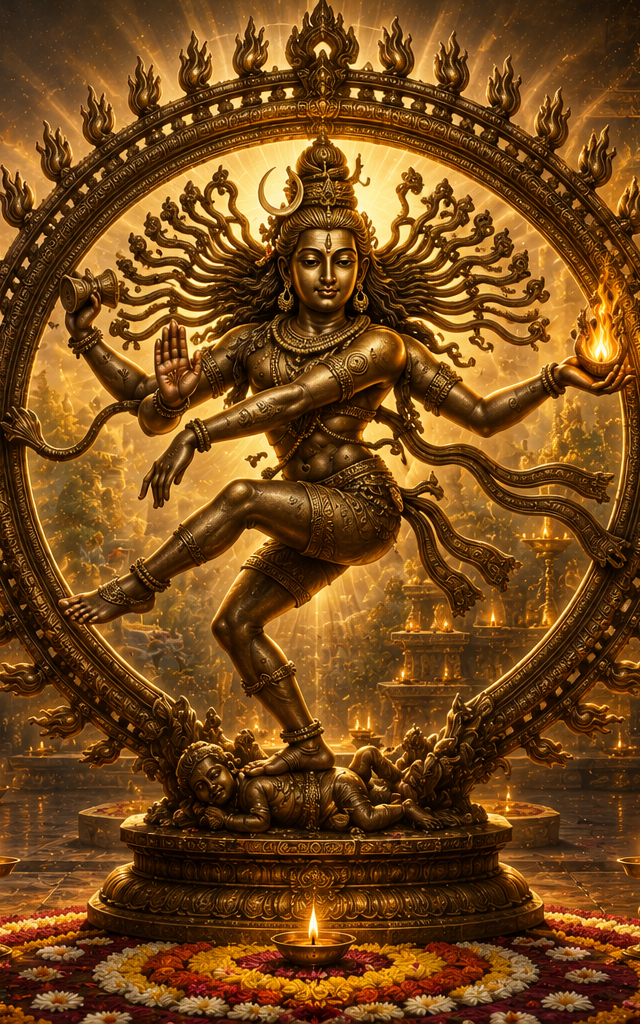
The Thillai Nataraja Temple at Chidambaram is one of Hinduism's most sacred and philosophically profound sites — housing the Akasha Lingam and the cosmic dance of Shiva. Discover its architecture, legends, and hidden mysteries.
Comments(0)
Loading comments…