
The Saptarishis: Seven Great Seers of the Vedic Tradition
The Saptarishis — the seven great seers of the Vedic tradition — are among the most revered figures in all of Sanatana Dharma. As the original receivers of Vedic knowledge, progenitors of the great gotra lineages, and the seven stars of the constellation Ursa Major, they bridge the cosmic and the human. This encyclopaedic guide covers each of the seven Rishis in full depth — their complete biographies, Vedic hymns, philosophical teachings, family lineages, and enduring legacy across the Puranas, the night sky, and living Hindu practice today.
The Seers Who Heard the Universe
In the Vedic understanding, the universe itself is composed of sound — Nada Brahma, the cosmos as vibration. The sacred mantras of the four Vedas are eternal patterns of cosmic sound (shruti — "that which is heard"). They were not invented; they were perceived — by extraordinary beings whose minds had become so still, so transparent, that the eternal could speak through them.
These perceivers are the Rishis (rishi from drish = to see; a Rishi is "one who sees"). Among all the rishis, seven stand apart: the Saptarishis (sapta = seven, rishi = seer) — simultaneously cosmic archetypes, historical sages, progenitors of human lineages, and the seven stars of the constellation we call the Great Bear.
Bhagavata Purana (12.11.22): "The seven rishis are the seven breaths of Brahma — through them the living wisdom of the cosmos enters the world of time."
The Saptarishis appear throughout the Rig Veda, the Upanishads, the Mahabharata, the Ramayana, and all eighteen major Puranas. They are not merely historical figures — they are the living connective tissue between the divine (brahma-vidya) and the human, between the eternal Vedic wisdom and its transmission through time.
Who Are the Saptarishis? Sources and Variations
Different texts give slightly different lists of the seven:
Brihadaranyaka Upanishad (2.2.4) and Mahabharata (Shanti Parva 208.17): Gautama, Bharadvaja, Vishvamitra, Jamadagni, Vasishtha, Kashyapa, Atri
Gotra Pravara tradition (most widely observed): Kashyapa, Atri, Vasishtha, Vishvamitra, Gautama, Jamadagni, Bharadvaja — the seven root gotras from which all Brahmin lineages descend
Puranic variation: Some texts substitute Agastya for Vishvamitra; others include Kratu, Pulaha, or Marichi (mind-born sons of Brahma).
This guide follows the Gotra Pravara and Mahabharata consensus: Kashyapa, Atri, Vasishtha, Vishvamitra, Gautama, Jamadagni, and Bharadvaja.
The Saptarishis in the Night Sky
The seven Rishis are identified with the seven principal stars of Ursa Major (the Great Bear / the Plough / the Big Dipper):
| Star (Western) | Indian Name | Associated Rishi |
|---|---|---|
| Dubhe (α UMa) | Kratu | Kratu |
| Merak (β UMa) | Pulaha | Pulaha |
| Phecda (γ UMa) | Pulastya | Pulastya |
| Megrez (δ UMa) | Atri | Atri |
| Alioth (ε UMa) | Angiras | Angiras |
| Mizar (ζ UMa) | Vasishtha | Vasishtha |
| Alkaid (η UMa) | Marichi | Marichi |
The Vedic astronomical tradition holds that the Saptarishi constellation (Saptarshi Mandal) revolves around the pole star (Dhruva — Polaris), completing one circuit in approximately 2,700 years by traditional reckoning. This is used in the Saptarishi Calendar (Sapta-rishi Samvat) — counted from approximately 3076 BCE — still observed in Himachal Pradesh and Uttarakhand. It is one of the oldest continuous calendrical systems in the world.
The seven Rishis in the night sky embody a profound teaching: the teachers of Vedic wisdom are not merely earthly beings but cosmic presences, eternally visible, eternally guiding humanity by their light.
The Saptarishis and the Manvantaras
In Vedic cosmological time, each Manvantara (the reign of one Manu, ~306 million years) has its own set of seven Rishis. We are in the seventh Manvantara (Vaivasvata Manvantara), governed by the seven listed above. The Vishnu Purana lists all fourteen Manvantara sets — demonstrating that Saptarishi is a cosmic office that rotates through all of time, always seven, always the transmitters of Vedic wisdom to the new world.
KASHYAPA — The Progenitor of All Living Beings
Identity and Cosmic Status
Kashyapa (kash = to see; "the all-seeing one") is the most universally significant of all the Saptarishis:
- Son of Marichi (Brahma's mind-born son) — Brahma's grandson
- Husband of thirteen daughters of Daksha — father of the Adityas (gods), Daityas (demons), Nagas, Garuda, and virtually every category of being in creation
- Father of Vivasvat (the sun god) and thus grandfather of Vaivasvata Manu (progenitor of current humanity)
- Father of Garuda (Vishnu's vehicle) through Vinata
The Most Comprehensive Genealogy
| Wife | Offspring |
|---|---|
| Aditi | The 12 Adityas: Indra, Varuna, Mitra, Vivasvat (Sun), and 8 others |
| Diti | The Daityas — Hiranyaksha, Hiranyakashipu, and their descendants |
| Danu | The Danavas (a class of asuras) |
| Vinata | Garuda (Vishnu's vehicle) and Aruna (dawn's charioteer) |
| Kadru | The thousand Nagas — Shesha, Vasuki, Takshaka, and all serpent beings |
| Surabhi | Kamadhenu (wish-fulfilling cow) and all cattle |
| Tamra | All birds — hawks, owls, crows |
| Muni | Apsaras (celestial dancers and singers) |
Kashyapa is therefore effectively the biological father of the universe's entire living population — making him Prajapati (Lord of Creatures) in the most comprehensive sense. Both the gods and demons, the birds and serpents, the sun and the moon — all trace their lineage to Kashyapa.
Kashyapa in the Rig Veda
Kashyapa is the seer of several hymns in Mandala 9 of the Rig Veda — the Soma Mandala, the most sacred section of the Rig Veda. His hymns reflect an intimate understanding of the relationship between prana (life force), soma (the nectar of consciousness), and the sustaining of all life:
"Flow, O Soma, for the gods! Flow for the nourishment of all that lives!" (RV 9.84, attributed to Kashyapa)
Kashyapa and the Avatars
The Dashavatara tradition connects directly to Kashyapa:
- Vamana (the dwarf Brahmin avatar) was born as the son of Kashyapa and Aditi — Vishnu entering creation through the most comprehensive of all lineages
- Parashurama (sixth avatar) is a descendant of Jamadagni, who belongs to Kashyapa's extended lineage
Kashmir — Named After Kashyapa
The valley of Kashmir (Kashyapa-mira = "Kashyapa's lake") is directly named after the sage. The Nilmata Purana records that the valley was originally a vast lake (Sati-sara) that Kashyapa drained by piercing the surrounding mountains, making it habitable. This mythological account corresponds to the actual geological history of the Kashmir valley — which was indeed a glacial lake (Karewa) that drained through the Banihal gap. Kashyapa is worshipped as the patron sage of Kashmir to this day.
Kashyapa Gotra
The Kashyapa gotra is the largest and most widespread of all Hindu gotras, found from Kashmir to Kerala, from Gujarat to Bengal. It is also the default gotra assigned to those whose gotra is unknown (gotrahina) — reflecting Kashyapa's status as the universal progenitor.
ATRI — The Seer of the Absolute
Identity and Cosmic Status
Atri (a = not, tri = three — "one who transcends the three gunas") is one of the seven Prajapatis and one of the ten Brahma-manasaputras (mind-born sons of Brahma). He is the husband of the supremely devoted Anasuya ("without jealousy") — one of the greatest women in Puranic tradition.
The Anasuya Legend — The Trimurti as Infants
The three wives of the Trimurti — Saraswati, Lakshmi, and Parvati — hearing of Anasuya's unparalleled pativrata (devoted wifehood) and feeling envious, asked their husbands to test her.
Brahma, Vishnu, and Shiva arrived at Atri's hermitage disguised as Brahmin beggars, demanding to be fed — but only if Anasuya served them naked. Anasuya, through the power of her absolute devotion, perceived their divine identity. With sacred water and a prayer, she transformed all three into infants and suckled them at her breast — the ultimate expression of unconditional maternal love transcending all social convention.
The gods, humbled and moved, revealed themselves and granted her a boon. Anasuya asked that they be born as her sons:
- Brahma was reborn as Chandra (the moon god) — presider over the mind and emotions
- Vishnu as Dattatreya — the combined Trimurti form, the Adi Guru of the Nath tradition
- Shiva as Durvasa — the most temperamental of sages, whose powerful curses shape multiple epic narratives
Dattatreya — The Living Synthesis of the Trimurti
Dattatreya, Atri and Anasuya's most celebrated son, is depicted with three heads (Brahma, Vishnu, Shiva) and four dogs (representing the four Vedas). He is the Adi Guru (first teacher) of the Nath tradition, venerated throughout Maharashtra, Karnataka, Andhra Pradesh, and Gujarat. His teaching synthesises non-duality (advaita), devotion (bhakti), and direct recognition of the Self — the most complete expression of Upanishadic wisdom in a single form.
Atri in the Rig Veda
Mandala 5 of the Rig Veda (88 hymns) is primarily attributed to Atri and his descendants — the Atri family (Atreyah). His hymns span invocations to Agni, Indra, Mitra-Varuna, the Ashvins, and the Vishvadevas. Most remarkably, Atri is associated with the legend of the recovered sun — when the demon Svarbhanu eclipsed the sun, Atri's prayers restored it (RV 5.40) — reflecting his clan's deep mastery of solar ritual and astronomy.
Atri in the Ramayana
Atri and Anasuya's hermitage in the Chitrakuta region is the first sacred stop on Rama's exile journey into the Dandaka forest. Anasuya gifts Sita divine garments that remain ever-fresh, and teaches her the pativrata dharma — the path of devoted wifehood — through her own incomparable example. This scene is one of the Valmiki Ramayana's most tender and philosophically rich episodes.
VASISHTHA — The Royal Preceptor and Master of Non-Duality
Identity and Cosmic Status
Vasishtha (vasistha = most excellent) is arguably the most prominent individual sage in the entire Vedic-Puranic literature, appearing in more texts and more contexts than almost any other figure in Hindu tradition:
- Mind-born son (manasaputra) of Brahma, born from his prana (vital breath) or right eye
- Family preceptor (kula-guru) of the Solar Dynasty (Surya-vamsha) — the royal lineage of Lord Rama
- Author of Mandala 7 of the Rig Veda (104 hymns)
- Possessor of Nandini (daughter of Kamadhenu, the wish-fulfilling cow)
- Protagonist of the Yoga Vasishtha — one of the greatest philosophical texts in world literature
The Rivalry with Vishvamitra
The conflict between Vasishtha and Vishvamitra is one of the most sustained and philosophically rich rivalries in world literature — a centuries-long contest between brahma-tejas (Brahminic spiritual power) and kshatriya-bala (royal martial power) that ultimately illustrates their complementary necessity.
The trigger: King Vishvamitra visited Vasishtha's hermitage and was astonished by the sage's ability to feed his entire army through the power of Nandini. He demanded the cow; Vasishtha refused. Vishvamitra attacked with his entire army — and Nandini, through her divine power, generated an army that completely routed Vishvamitra's forces.
Humiliated, Vishvamitra renounced his kingdom and undertook fierce tapas for centuries to equal Vasishtha. Yet only Vasishtha's recognition of him as Brahmarishi would complete the transformation — and that recognition came only at the very end, when Vishvamitra had genuinely transcended all ego-attachment, including attachment to the recognition itself.
Vasishtha throughout this arc embodies brahma-tejas — the power of non-attachment and pure consciousness that cannot be overcome by any force. His very presence is the teaching.
The Yoga Vasishtha (Maha Ramayana)
The Yoga Vasishtha is a philosophical masterpiece of approximately 32,000 verses, framed as Vasishtha's teachings to the young Rama at Ayodhya when Rama returns from his travels deeply disillusioned with the world.
Over six books (prakaranas), Vasishtha guides Rama from philosophical confusion to full jivan-mukti (liberation-in-life) through:
- Stories and parables illustrating the nature of consciousness
- Direct exposition of Advaita Vedanta centuries before Shankaracharya systematised it
- Analysis of mind (manas), consciousness (chit), ego (ahankara), and their transcendence
The text's central teaching: "The world arises from and subsides into consciousness. Consciousness alone is real. What appears as the world is the play of consciousness in consciousness. When this is directly known — liberation is immediate."
The Yoga Vasishtha stands alongside the principal Upanishads and the Bhagavad Gita as one of the three supreme texts of Advaita Vedanta in practice.
Vasishtha in the Rig Veda
Mandala 7 (the Vasishtha Mandala) contains some of the most beautiful hymns in the entire Rig Veda, characterised by intimate personal devotion — a warmth and closeness with the divine that foreshadows the bhakti tradition by millennia.
His Varuna hymns (RV 7.86–88) are among the most morally searching texts in world literature — a sage confessing his transgressions to the cosmic moral order (rita) and asking for forgiveness in language of heartbreaking sincerity:
"What was that great sin, O Varuna, that you would slay your worshipper, the singer? Proclaim it to me so I may hasten to prostrate myself before you; for you are hard to deceive, O god of wisdom." (RV 7.86.4)
Vasishtha's Lineage — The Ancestry of Vyasa
Vasishtha → Shakti (his son) → Parashara (grandson; author of the Vishnu Purana) → Vyasa (great-grandson; the divider of the Vedas, compiler of the Mahabharata, author of the Bhagavata Purana). Vasishtha is therefore the direct ancestor of the most prolific and influential literary tradition in human history.
VISHVAMITRA — The Rishi Who Made Himself a Brahmin
Identity and Cosmic Status
Vishvamitra (vishva = all, mitra = friend — "friend of all the worlds") began as Kaushika, a Kshatriya king of Kanyakubja. His transformation from warrior king to Brahmarishi — the highest possible category of sage — through sheer tapas and will is the most dramatic individual spiritual transformation in all of Vedic literature.
No other figure so clearly illustrates the Upanishadic principle that brahminhood is a quality of consciousness, not of birth.
The Path to Brahmarishi — Stages of Transformation
-
Rajarishi (royal sage): After defeat by Vasishtha's Nandini, he renounced his kingdom and undertook tapas — enough to be acknowledged as Rajarishi by the gods, but not yet as Brahmin.
-
Temptation by Menaka: Indra sent the celestial apsara Menaka to break his tapas. She succeeded; Vishvamitra spent ten years with her, fathering the legendary Shakuntala (heroine of Kalidasa's Abhijnana Shakuntalam). Recognising the distraction, he moved to the Himalayas and resumed tapas with greater intensity.
-
Creating a New Universe — Trishanku's Heaven: King Trishanku asked to enter heaven in his mortal body. When all other sages refused to conduct the yajna, Vishvamitra performed it himself — and when the gods expelled Trishanku midway up, Vishvamitra began creating an entirely new universe from scratch: new stars, new constellations, a new Saptarishis, and was in the process of creating a new Indra when the alarmed gods agreed to let Trishanku remain suspended in his own heaven forever. This episode is unparalleled in world literature — a human sage, through accumulated tapas, attempting to duplicate the entire creation.
-
Final recognition by Vasishtha: After decades more of tapas — during which he overcame the final temptation of Rambha and, more importantly, the residual anger at his own failures — Vasishtha himself declared: "Come, O Brahmarishi." The recognition came when Vishvamitra had genuinely transcended even the desire for it.
The Gayatri Mantra — Vishvamitra's Greatest Gift
Vishvamitra is the drashta (seer) of the Gayatri Mantra (Rig Veda 3.62.10):
Om Bhur Bhuvah Svaha | Tat Savitur Varenyam | Bhargo Devasya Dhimahi | Dhiyo yo nah prachodayat "We meditate on the divine radiance of Savitar (the Sun) who illuminates the three worlds. May that divine light inspire our intellect."
The most sacred mantra in the entire Vedic tradition — recited by millions at dawn, noon, and dusk; given to every student at Upanayana as their first initiation; considered the mother of all Vedic mantras — is Vishvamitra's single greatest contribution to human civilisation. The warrior king who transformed himself completely perceived and transmitted the mantra that has sustained Vedic practice for millennia.
Mandala 3 of the Rig Veda (62 hymns) is attributed to Vishvamitra and his family (Kaushikah). His hymns are characterised by directness, intensity, and warrior-like boldness in approaching the divine.
Vishvamitra and Rama
In the Bala Kanda of the Valmiki Ramayana, Vishvamitra arrives at Ayodhya and requests Rama and Lakshmana to protect his yajna from demons. Over their journey together he:
- Initiates Rama into the Bala and Atibala mantras (preventing hunger, thirst, and fatigue)
- Teaches Rama the divine weapons (astras) including the Brahmastra
- Brings Rama to Mithila, where Rama wins Sita by lifting Shiva's bow
Vishvamitra is thus the sage who directly prepares Rama for his life's mission and facilitates the pivotal event in the entire Ramayana arc.
GAUTAMA — The Sage of Dharma and the Law
Identity and Cosmic Status
Gautama (go = earth/senses, tama = most — "most grounded in the senses" / "lord of the senses") is the progenitor of the Gautama gotra, one of the most widespread Brahmin gotras, and the author of the Gautama Dharmasutra — the oldest surviving dharmashastra.
The Ahalya Legend — Stone, Curse, and Liberation by Grace
Ahalya (a-halya = "uncultivated" — original, pristine), created by Brahma as the embodiment of ideal feminine beauty, was given in marriage to Gautama. The god Indra, consumed by desire, came to Gautama's hermitage disguised as the sage himself. Ahalya yielded to him. Gautama, perceiving the truth through yogic vision, cursed Indra and cursed Ahalya to become a stone — invisible to all beings until the touch of Rama's foot liberated her.
In the Bala Kanda, when Vishvamitra passes Gautama's hermitage with Rama and Lakshmana, Rama's foot touches the stone — and Ahalya is restored, radiant and purified, to reunite with Gautama.
The deeper reading: Ahalya represents the soul in its original innocence. Her entanglement with Indra = the soul's initial capture by the world of appearances. Her stone state = the soul's fixity in ignorance. Rama's liberating touch = prasad (divine grace) that cannot be earned, only received. The story traces the soul's complete arc from innocence through entanglement, purgation, and liberation — in a single episode.
The Gautama Dharmasutra
Gautama is the author of the Gautama Dharmasutra — the oldest of the surviving dharmasutras (manuals of righteous conduct), composed approximately 600–400 BCE. It establishes:
- The four ashrama-dharma (student, householder, forest-dweller, renunciant)
- The four varna-dharma (duties of the social orders)
- Purification rites and penance (prayaschitta)
- Rites of passage and domestic rituals
The Gautama Dharmasutra is a crucial link between the Vedic ritual tradition and the classical Dharmashastra tradition — making Gautama not merely a mythological sage but a foundational legal and ethical thinker.
The Buddhist Connection
The historical Siddhartha Gautama (the Buddha) bears the clan name Gautama — suggesting he belonged to, or claimed descent from, the Brahminic Gautama lineage. This is one of the most historically significant points of contact between the Vedic and Buddhist traditions.
JAMADAGNI — Father of Parashurama, Master of Brahmic Fire
Identity and Cosmic Status
Jamadagni (jama = control, agni = fire — "master of self-controlled fire") is the son of Richika (Bhrigu-clan) and Satyavati (daughter of King Gadhi — making him the nephew of Vishvamitra). He is the husband of Renuka and father of Parashurama — the sixth avatar of Vishnu.
Parashurama and the Cleansing of the Earth
Jamadagni's hermitage possessed the wish-fulfilling cow Kamadhenu (or her descendant). When the thousand-armed king Kartavirya Arjuna (Sahasrarjuna) forcibly took the cow, Parashurama pursued and slew him. When Kartavirya's sons retaliated by killing Jamadagni himself, Parashurama vowed to purge the earth of arrogant Kshatriyas twenty-one times — a mission representing the cosmic correction of a fundamental dharmic imbalance.
The Renuka Episode
Jamadagni commanded his sons to kill their mother Renuka after she experienced a moment of impure thought at the river. All refused except Parashurama, who obeyed instantly. Jamadagni, pleased with his son's guru-bhakti, offered any boon — and Parashurama immediately asked for his mother's restoration to life. She was restored.
This episode — though philosophically challenging — is traditionally interpreted as the yogic principle that the guru-disciple relationship at its highest level involves complete dissolution of the disciple's personal judgment into the guru's wisdom, with the instantaneous restoration demonstrating the act's dharmic purity within that specific context.
BHARADVAJA — The Great Physician-Sage
Identity and Cosmic Status
Bharadvaja (bharad = bearing, vaja = strength — "one who brings strength to others") is the most technically encyclopaedic of all the Saptarishis — his contributions spanning Vedic hymnody, Ayurveda, aeronautics, military science, and linguistics.
He is the son of Brihaspati (the divine preceptor of the gods) and the father of Drona — the great military teacher of the Pandavas and Kauravas in the Mahabharata.
Three Lifetimes of Vedic Study
The Mahabharata tells: Bharadvaja undertook three consecutive lifetimes dedicated solely to Vedic study — living to extreme old age in each, never pausing. When Indra appeared at the end of his third life and asked what he would do with a fourth, Bharadvaja said he would spend it studying the Vedas.
Indra showed him three enormous mountains and said: "These represent the totality of Vedic knowledge. What you have studied in three lifetimes is what this handful of earth is from the first mountain." Then Indra gave him a concentrated essence of all Vedic knowledge. The story is the tradition's clearest statement: the Vedas are infinite; no finite life can exhaust them. What matters is the quality and intention of study.
Bharadvaja and the Transmission of Ayurveda
The Charaka Samhita (1.1.27–29) records that Bharadvaja, as the most capable of the assembled sages, was sent to Indra to receive the science of healing. Indra, pleased, transmitted the Trishkandha (three-pillar) framework of Ayurveda — the science of the body, the mind, and consciousness — to Bharadvaja, who then transmitted it to the assembled sages.
Bharadvaja is therefore the direct human link in the chain of transmission of Ayurveda to the world — making him foundational not just to Vedic literature but to the world's oldest continuously practised medical tradition.
Bharadvaja in the Rig Veda
Mandala 6 of the Rig Veda (75 hymns) is primarily attributed to Bharadvaja and his family. His Agni hymns are characterised by great technical precision and are among the most frequently cited in the Agamic temple ritual tradition.
Bharadvaja's Legacy in the Epics
In the Ramayana, Bharadvaja's hermitage at Prayaga (Prayagraj — the confluence of Ganga, Yamuna, and Saraswati) is Rama's first overnight stop on his forest exile. Bharadvaja provides hospitality and guides Rama to Chitrakuta.
In the Mahabharata, Bharadvaja is the father of Drona — born miraculously in a drona (vessel) when Bharadvaja was overcome by desire at the sight of the apsara Ghritachi. Drona's extraordinary military genius, ethical complexity, and tragic end are among the Mahabharata's most compelling threads — all flowing from the lineage of Bharadvaja.
THE GOTRA SYSTEM — THE LIVING LINEAGE OF THE RISHIS
What Is a Gotra?
A gotra (go = cow/lineage, tra = to protect) is a patrilineal descent group traced to one of the Saptarishis. It is the most fundamental marker of Brahminic lineage and serves multiple functions:
- Genetic: Prohibits marriage within the same gotra (exogamy) — preventing inbreeding across the patrilineal line
- Ritual: Every Vedic ceremony begins with the declaration of the participant's gotra and pravara (ancestral invocation) — connecting the individual to their Rishi lineage
- Metaphysical: The gotra is a shakti-parampara — a lineage of spiritual energy. The founding Rishi's qualities and powers are understood to transmit through the gotra across millennia
- Social: Provides a network of kinship and mutual obligation
The Seven Root Gotras
| Gotra | Prevalence | Notable Descendants |
|---|---|---|
| Kashyapa | Largest; universal default | All devas, daityas, nagas, birds — all life |
| Atri | Pan-Indian | Dattatreya, Durvasa, Chandra |
| Vasishtha | North India, Deccan | Parashara, Vyasa |
| Vishvamitra (Kaushika) | Maharashtra, AP, North India | Shakuntala (daughter) |
| Gautama | Pan-Indian | Shatananda; Siddhartha Gautama (Buddha) by clan name |
| Jamadagni (Bhargava) | Maharashtra, Gujarat | Parashurama |
| Bharadvaja | Pan-Indian | Drona |
Every Hindu gotra ultimately traces back to one of these seven — either directly or through apabhramsha (branch lineages). The gotra system thus makes the Saptarishis not merely mythological figures but living presences in the identity of hundreds of millions of people alive today.
THE SAPTARISHIS AND LIVING HINDU PRACTICE
Daily Ritual
The Saptarishis are invoked daily in Sandhyavandanam — the twice-daily meditation ritual of initiated Hindus — through Rishi-tarpana (libation offered to the cosmic seers). Their names are recited alongside the names of the presiding deity and one's own gotra in every formal Vedic ceremony.
The Upanayana samskara — the sacred thread ceremony — initiates the student into:
- The Gayatri Mantra (Vishvamitra's gift)
- Their gotra (the Saptarishi lineage)
- The practice of Sandhyavandanam (which includes Rishi-tarpana)
Sacred Sites of the Rishis
- Rishikesh (rishi-kesha = "hair of the Rishis") — the Himalayan gateway sacred to the entire Rishi tradition
- Vasishtha Guha near Rishikesh — the cave of Vasishtha's deepest meditations
- Atri's hermitage at Chitrakuta — still a major pilgrimage site
- Bharadvaja's hermitage at Prayagraj — within the sacred Triveni Sangam complex
- Jamadagni's hermitage at Mahurgad (Maharashtra) — site of the Renukadevi temple, one of Maharashtra's most important Devi shrines
- Saptarishi Ashram at Haridwar — where the Ganga divides into seven streams, each associated with one of the seven Rishis' bathing ghats
The Kumbh Mela — the world's largest religious gathering, held at Prayagraj, Haridwar, Nashik, and Ujjain — includes the invocation of the Rishis' blessings in the sacred bathing rituals, connecting the modern pilgrimage to the ancient Rishi tradition.
SUMMARY — THE SEVEN RISHIS AT A GLANCE
| Rishi | Key Rig Veda Mandala | Most Famous Story | Primary Legacy | Gotra |
|---|---|---|---|---|
| Kashyapa | Mandala 9 (Soma) | Father of gods, demons, birds, nagas | Universal progenitor; Kashmir named after him | Largest; universal default |
| Atri | Mandala 5 | Anasuya transforms the Trimurti into infants | Dattatreya, Durvasa, Chandra as sons | Pan-Indian |
| Vasishtha | Mandala 7 | Rivalry with Vishvamitra; Yoga Vasishtha | Royal preceptor; Advaita Vedanta; ancestor of Vyasa | North India, Deccan |
| Vishvamitra | Mandala 3 | Kshatriya king → Brahmarishi; created a universe | Gayatri Mantra; Rama's guru | Maharashtra, AP, North India |
| Gautama | Mandala 1 | Ahalya turned to stone; freed by Rama's touch | Gautama Dharmasutra; Buddhist clan name | Pan-Indian |
| Jamadagni | Mandala 9 | Father of Parashurama; Kamadhenu | Bhargava lineage; Parashurama tradition | Maharashtra, Gujarat |
| Bharadvaja | Mandala 6 | Three lifetimes of Vedic study | Ayurveda transmission; father of Drona | Pan-Indian |
FREQUENTLY ASKED QUESTIONS
Q: Why are there different lists of the Saptarishis in different texts? "Saptarishi" is a cosmic office, not a fixed set of individuals. Each Manvantara (~306 million years) has its own seven. The variation in lists reflects different Manvantaras, different regional lineages, or different narrative contexts. The seven covered here (Kashyapa through Bharadvaja) are the most consistently agreed upon for our current Vaivasvata Manvantara.
Q: Are the Saptarishis gods or humans? Neither exclusively — they are maha-siddhas: beings of extraordinary spiritual attainment who have transcended ordinary human limitations while remaining in dynamic relationship with the cosmos. They are mortal in the sense of embodied birth; they are cosmic in the sense that their consciousness-force continues operating through their gotra lineages, transmitted mantras, and identification with the stars.
Q: What is the difference between Rishi, Maharishi, and Brahmarishi?
- Rishi: A seer who has directly perceived Vedic truth and transmitted it
- Maharishi (maha = great): A rishi of exceptional scope and attainment
- Brahmarishi: The highest category — one who has directly realised Brahman and whose entire being expresses that realisation. Vishvamitra's centuries-long struggle to attain Brahmarishi status illustrates the category's demands.
Q: How does one know their gotra? Gotra transmits patrilineally — father to son. It is declared at all major Vedic ceremonies (Upanayana, Vivaha, Antyeshti) and is typically known within the family. If unknown, the Kashyapa gotra is traditionally assigned. Regional Vedic priests often maintain gotra records.
Q: Are the Saptarishis relevant to non-Brahmin communities? Entirely. While the gotra system is most formalised among Brahmins, the Saptarishis are revered by all communities. Their stories are taught to all children; the Gayatri Mantra (Vishvamitra's gift) is recited across communities; their sacred sites are pilgrimage destinations for all Hindus. The Vedic transmission the Saptarishis represent belongs to all of humanity.
RELATED READING
- The Four Vedas — the scriptures the Saptarishis received and transmitted; each Rig Veda Mandala is a Rishi-family's contribution
- The Principal Upanishads — the Saptarishis as the first transmitters of the wisdom the Upanishads crystallise; Vasishtha's Yoga Vasishtha as proto-Upanishadic teaching
- The Dashavatara — the Rishis' direct interaction with the avatars: Kashyapa as Vamana's father; Vishvamitra as Rama's guru; Jamadagni as Parashurama's father
- The Shodasha Samskaras — Upanayana initiates every student into the Gayatri Mantra (Vishvamitra's gift) and their gotra (the Saptarishi lineage)
- The Four Yugas — the Saptarishi office rotates through Manvantaras; the Saptarishi Calendar is one of the oldest living calendrical systems
- Vedic Cosmology — Brahmanda — the Saptarishis as the seven stars of Ursa Major; the Saptarishi Mandal as the cosmic map of Vedic transmission
- The Trimurti — Atri and Anasuya's reception of Brahma, Vishnu, and Shiva as their three sons; the Rishis as the interface between the Trimurti and the human world
Related articles in Scriptures
Born on a Yamuna island to sage Parashara and the fisher-girl Satyavati, Vyasa divided the one Veda into four, composed the Mahabharata with Ganesha as scribe, and wrote the Brahma Sutras. He is also a character within his own epic.
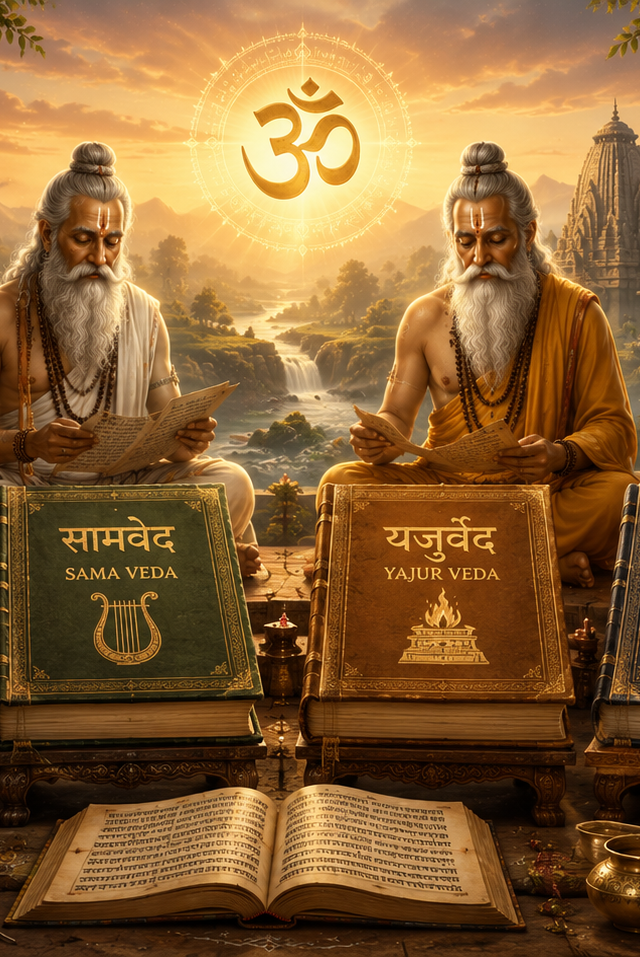
The Rig, Sama, Yajur, and Atharva Vedas form the foundation of Sanathana Dharma. Discover their contents, structure, and the eternal truths they contain.
The Vedic and Puranic cosmology describes a multi-layered universe of extraordinary scale — from the fourteen lokas to the cosmic egg of Brahmanda — that parallels and surpasses modern cosmological thought.
Comments(0)
Loading comments…