
The Four Yugas: Understanding Hindu Cosmic Time Cycles
From the golden Satya Yuga to the current Kali Yuga, discover how Hindu cosmology divides time into four great ages, each with its own quality of consciousness and duration spanning millions of years.
Time as a Cosmic Cycle
In Western thought, time is generally seen as linear — a straight line from past to future. Hindu cosmology offers a radically different vision: time is cyclical, revolving through great ages called Yugas like the turning of a cosmic wheel.
The fundamental unit is the Mahayuga (Great Age), comprising four Yugas totalling 4,320,000 human years.
The Four Yugas
Satya Yuga (Krita Yuga) — The Age of Truth
Duration: 1,728,000 years
The first and greatest age. Dharma stands on all four legs. Human lifespans extend to 100,000 years. People are naturally virtuous, possess direct knowledge of Brahman, and live in harmony with the cosmos. There is no disease, no deception, no inequality. The consciousness of humanity is at its purest.
Symbolism: A bull (representing dharma) stands on four legs: truth, compassion, austerity, and charity.
Treta Yuga — The Age of Three
Duration: 1,296,000 years
Dharma declines by one quarter. Human lifespans reduce to 10,000 years. Righteousness must now be maintained through ritual, sacrifice, and deliberate effort — it no longer arises spontaneously. The great Ramayana of Lord Rama took place in this age. Fire rituals (yajnas) become important as tools for maintaining cosmic order.
Symbolism: The dharma bull stands on three legs.
Dvapara Yuga — The Age of Two
Duration: 864,000 years
Dharma is reduced to half. Human lifespans are 1,000 years. Disease and conflict arise. The Vedas are divided into four by Vyasa to make them accessible to an increasingly limited humanity. The Mahabharata and Lord Krishna''s ministry belong to this age. Devotion to God through worship becomes a primary spiritual path.
Symbolism: The dharma bull stands on two legs.
Kali Yuga — The Age of Discord
Duration: 432,000 years
The age we currently inhabit. Dharma stands on only one leg — truth. Human lifespans drop to a maximum of 100 years. Materialism, ego, and conflict dominate. Spiritual knowledge is rare and often distorted. Yet the Puranas contain a remarkable promise: in the Kali Yuga, liberation is easier to attain than in any other age, because even simple acts of devotion — chanting the divine names, sincere prayer — yield results that would require elaborate austerities in higher ages.
Symbolism: The dharma bull balances on one leg.
The Mahayuga and Beyond
One complete Mahayuga = 4,320,000 years.
- 71 Mahayugas = 1 Manvantara (reign of one Manu, the cosmic progenitor)
- 14 Manvantaras = 1 Kalpa (one day of Brahma = 4.32 billion years)
- 2 Kalpas = 1 full day-and-night of Brahma
- Brahma''s lifespan = 100 Brahma years = ~311 trillion human years
At the end of each Kalpa, the universe is partially dissolved (pralaya) and then recreated. At the end of Brahma''s lifespan comes maha-pralaya — total dissolution — before the next Brahma begins the cycle anew.
Where Are We Now?
According to traditional calculation, we are in the Kali Yuga of the 28th Mahayuga of the 7th Manvantara of the current Kalpa. The Kali Yuga is said to have begun at the departure of Lord Krishna from the earth (traditionally dated to 3102 BCE).
We are approximately 5,126 years into a 432,000-year age — barely at the dawn of the Kali Yuga. The worst, and eventually the renewal, lie far ahead.
Practical Significance
Understanding the Yugas is not an exercise in fatalism. The tradition teaches that individual consciousness can transcend the Yuga it inhabits. A person who pursues genuine self-knowledge, devotion, and righteous living attains the qualities of the Satya Yuga within themselves, regardless of the outer age.
The Yuga doctrine is ultimately a map of consciousness — and a promise that the cosmic wheel always turns toward renewal.
Related articles in Cosmic & Vedic Science
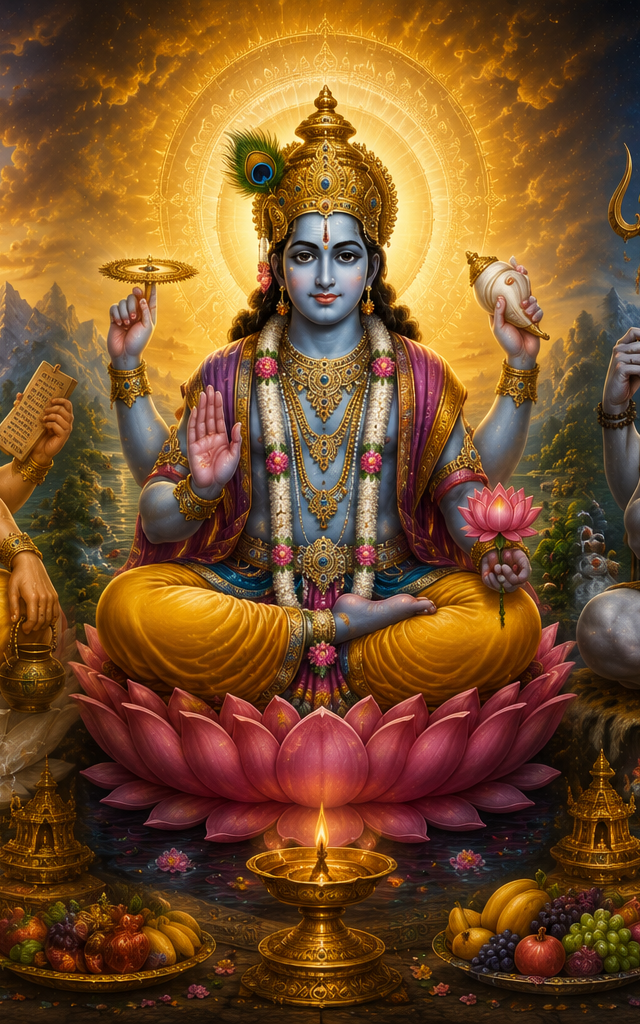
Understand how the Hindu cosmic trinity of Brahma the Creator, Vishnu the Preserver, and Shiva the Destroyer together govern the eternal cycle of creation, sustenance, and dissolution.
The Vedic and Puranic cosmology describes a multi-layered universe of extraordinary scale — from the fourteen lokas to the cosmic egg of Brahmanda — that parallels and surpasses modern cosmological thought.
The Navagraha are the nine celestial forces of Vedic astrology — Surya, Chandra, Mangala, Budha, Brihaspati, Shukra, Shani, Rahu, and Ketu — each governing specific domains of human life. Understanding them is at the heart of Jyotisha, the eye of the Vedas.
Comments(0)
Loading comments…