
Brahmanda: The Vedic Vision of the Universe
The Vedic and Puranic cosmology describes a multi-layered universe of extraordinary scale — from the fourteen lokas to the cosmic egg of Brahmanda — that parallels and surpasses modern cosmological thought.
A Universe of Unimaginable Scale
Long before modern telescopes revealed the vastness of space, the Vedic seers described a cosmos of breathtaking scale and complexity. The Puranas, particularly the Bhagavata and Vishnu Puranas, present a detailed model of the universe — the Brahmanda (Brahma''s egg) — that encompasses not just physical space but multiple planes of existence.
The Fourteen Lokas
The universe is vertically structured into fourteen lokas (worlds or planes), seven above and seven below the earthly plane:
Upper Worlds (Urdhva Lokas)
- Satya Loka (Brahma Loka) — abode of Brahma; the highest plane of existence within creation
- Tapa Loka — abode of ascetics who survive the pralaya
- Jana Loka — abode of the sons of Brahma
- Mahar Loka — abode of great sages and saints
- Svar Loka (Svarga) — the heavenly realm presided over by Indra
- Bhuvar Loka — the astral plane between earth and heaven
- Bhu Loka — the physical earth plane
Lower Worlds (Adho Lokas)
- Atala 9. Vitala 10. Sutala 11. Talatala 12. Mahatala 13. Rasatala 14. Patala
The lower lokas are not hellish in the Western sense — many are described as magnificent realms inhabited by nagas (serpent beings), danavas, and daityas who possess great powers and pleasures, though they lack the path to liberation.
Below even the Patala lies Naraka — the regions of temporary purgatorial experience where souls work off karmic debt before rebirth.
Mount Meru — The Cosmic Axis
At the centre of the known universe stands Mount Meru — the cosmic axis (axis mundi). The sun, moon, and stars revolve around it. The heavenly Ganga flows down from Brahma Loka, splits into four rivers as it strikes Meru, and flows outward to the four directions.
Meru is not merely a physical mountain — it is the vertical axis connecting all lokas, the spindle around which the cosmic wheel turns. Many scholars identify it with the concept of the polar axis or the celestial north pole.
Dvipas — The Cosmic Continents
Surrounding Meru are seven concentric island-continents (sapta dvipas), each separated by an ocean of a different substance:
- Jambu Dvipa (our world) — surrounded by a salt ocean
- Plaksha Dvipa — surrounded by a sugarcane juice ocean
- Shalmali Dvipa — surrounded by a wine ocean
- Kusha Dvipa — surrounded by a ghee ocean
- Krauncha Dvipa — surrounded by curds ocean
- Shaka Dvipa — surrounded by a milk ocean
- Pushkara Dvipa — surrounded by a freshwater ocean
Our earth (Bharata Varsha) is located in the southern portion of Jambu Dvipa.
The Brahmanda — The Cosmic Egg
The entire fourteen-loka universe is enclosed within the Brahmanda — the cosmic egg. Beyond its shell lie successive sheaths of the five elements (water, fire, air, ether, and space), each ten times larger than the last, before reaching the unmanifest prakriti and ultimately Brahman itself.
The Bhagavata Purana describes millions of such Brahmandas floating in the infinite ocean of Karana Jala (causal waters) — each one a complete universe with its own Brahma, Vishnu, and Shiva. This vision of a multiverse predates modern cosmological speculation by thousands of years.
Modern Parallels
While Vedic cosmology is not a scientific model in the modern sense, the correspondences are striking:
- The concept of multiple universes parallels the multiverse in modern physics
- The cyclical creation and dissolution of the Brahmanda mirrors Big Bang–Big Crunch cosmological models
- The extraordinary timescales of Vedic cosmology (trillions of years) align with modern estimates of the universe''s age and expected lifespan
The Vedic sages were not astronomers in the modern sense — they were seers of consciousness who perceived the structure of reality from within. Their cosmology maps not just outer space but inner space: the lokas are also states of consciousness accessible through deep meditation.
Conclusion
The Vedic vision of the universe is one of the most comprehensive cosmological systems ever conceived. It invites us to expand our sense of scale — not just spatially but in terms of time, consciousness, and the very nature of existence. To study Brahmanda is to glimpse the infinite creativity of the cosmos.
Related articles in Cosmic & Vedic Science
Born on a Yamuna island to sage Parashara and the fisher-girl Satyavati, Vyasa divided the one Veda into four, composed the Mahabharata with Ganesha as scribe, and wrote the Brahma Sutras. He is also a character within his own epic.
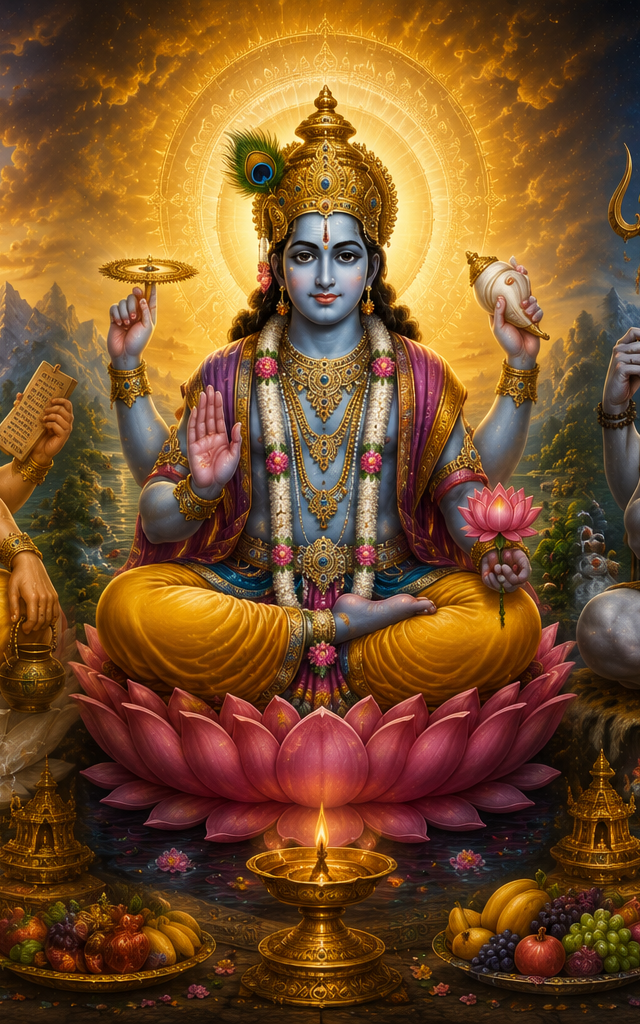
Understand how the Hindu cosmic trinity of Brahma the Creator, Vishnu the Preserver, and Shiva the Destroyer together govern the eternal cycle of creation, sustenance, and dissolution.
The Saptarishis — the seven great seers of the Vedic tradition — are among the most revered figures in all of Sanatana Dharma. As the original receivers of Vedic knowledge, progenitors of the great gotra lineages, and the seven stars of the constellation Ursa Major, they bridge the cosmic and the human. This encyclopaedic guide covers each of the seven Rishis in full depth — their complete biographies, Vedic hymns, philosophical teachings, family lineages, and enduring legacy across the Puranas, the night sky, and living Hindu practice today.
Comments(0)
Loading comments…