
The Four Vedas: Humanity's Oldest Sacred Knowledge
The Rig, Sama, Yajur, and Atharva Vedas form the foundation of Sanathana Dharma. Discover their contents, structure, and the eternal truths they contain.
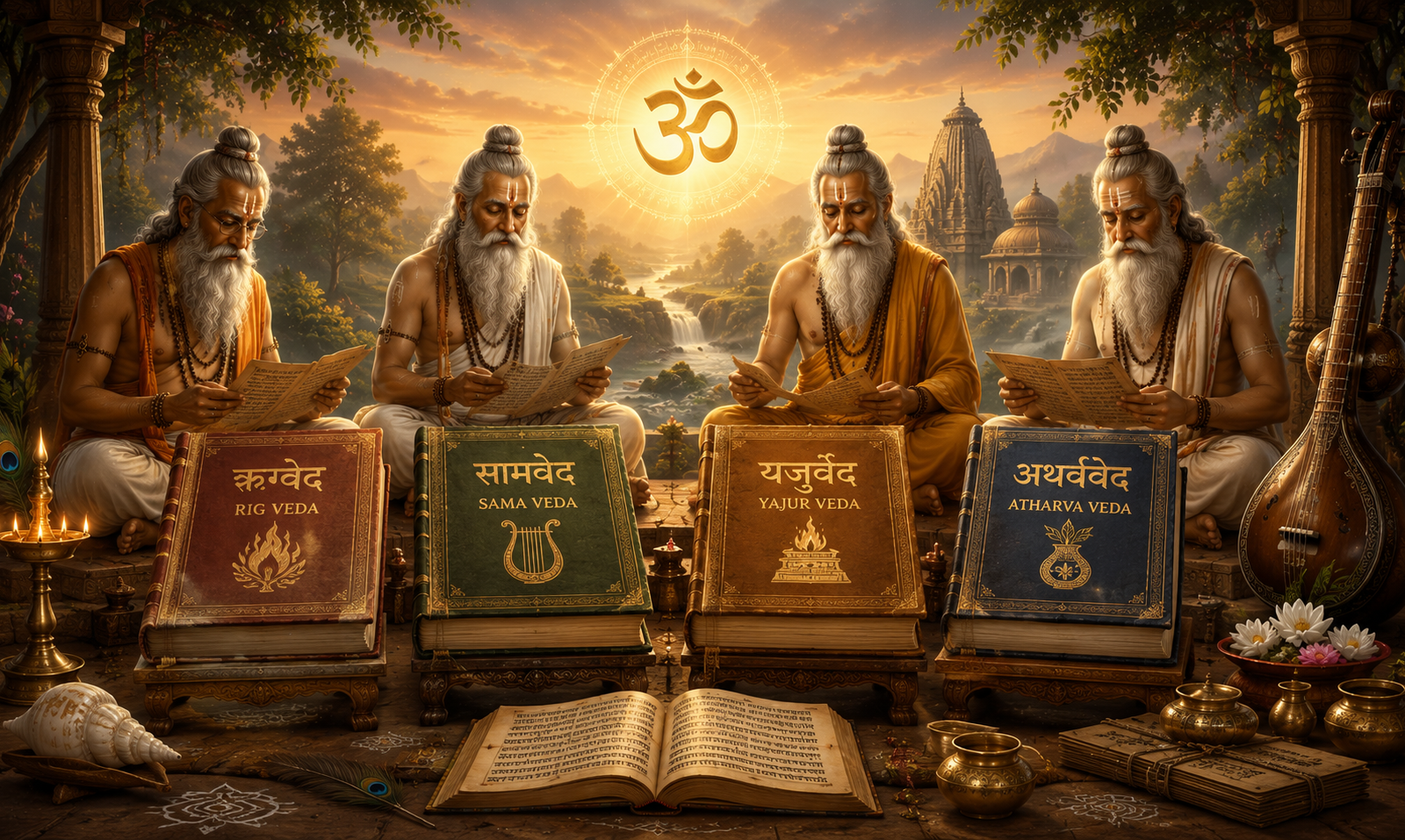
The Foundation of All Knowledge
The word Veda comes from the Sanskrit root vid — to know. The Vedas are apaurusheya — not composed by any human being. They are the eternal sounds of the cosmos, perceived by the ancient rishis (seers) in states of deep meditation and transmitted through an unbroken oral tradition for thousands of years before being written down.
They are the ultimate authority (pramana) in Sanathana Dharma — the source from which all other scriptures, philosophies, and practices flow.
Structure of the Vedas
Each of the four Vedas is divided into four sections:
- Samhitas — the core collection of hymns and mantras
- Brahmanas — prose texts explaining the ritual application of the Samhitas
- Aranyakas — "forest texts" for contemplative practice
- Upanishads — the philosophical culmination, exploring the nature of Brahman, Atman, and liberation
The Rig Veda — Hymns of Praise
The Rig Veda is the oldest and most foundational of the four. It contains 10,552 mantras arranged in 10 mandalas (books), addressed primarily to the Vedic devas: Agni (fire), Indra (thunder), Varuna (cosmic order), Surya (sun), and many others.
Its most famous verse is the Gayatri Mantra (RV 3.62.10):
Om Bhur Bhuva Svaha, Tat Savitur Varenyam, Bhargo Devasya Dhimahi, Dhiyo Yo Nah Prachodayat "We meditate on the effulgent glory of the divine Light; may He inspire our intelligence."
The Rig Veda also contains the Nasadiya Sukta (RV 10.129) — one of the most profound philosophical poems ever composed, contemplating the nature of existence and non-existence before creation.
The Sama Veda — Songs of the Divine
The Sama Veda is primarily melodic — it takes verses from the Rig Veda and sets them to musical scales (swaras) for chanting during the Soma sacrifices. It contains 1,875 verses.
The Sama Veda is the foundation of Indian classical music. The seven notes of the musical scale (Sa Re Ga Ma Pa Dha Ni) trace their origin to Vedic chanting. Lord Krishna declares in the Bhagavad Gita (10.22): "Among the Vedas, I am the Sama Veda."
The Yajur Veda — Manual of Sacrifice
The Yajur Veda is the handbook of ritual action — the yajurvedi priest (adhvaryu) recites its prose mantras while performing the physical acts of the yajna (sacrificial ritual). It exists in two recensions:
- Krishna (Black) Yajur Veda — mixes prose and verse in a less ordered arrangement (e.g., Taittiriya Samhita)
- Shukla (White) Yajur Veda — a purer arrangement of mantras separate from the explanatory prose (e.g., Vajasaneyi Samhita)
The Shri Rudram, one of the most powerful and widely chanted Vedic hymns in Shaivism, is found in the Krishna Yajur Veda.
The Atharva Veda — Knowledge for Daily Life
The Atharva Veda stands somewhat apart from the other three. Named after the sage Atharvan, it contains 5,977 hymns addressing practical matters: healing, protection from disease, prosperity, harmony in relationships, and cosmological speculation.
It includes sophisticated hymns on the nature of time (Kala Sukta), the earth (Prithvi Sukta), and breath (Prana Sukta). Many of its healing mantras form the foundation of Ayurveda, the Vedic science of life and medicine.
Preservation Through the Ages
The Vedas were preserved with extraordinary precision through an oral tradition called Vedic chanting, using multiple methods of recitation (Pada, Krama, Jata, Ghana patha) that served as error-correction mechanisms. A single misplaced syllable or tone would be identified and corrected by the recitation pattern. UNESCO has recognised the tradition of Vedic chanting as an Intangible Cultural Heritage of Humanity.
The Vedas Today
While full Vedic scholarship is rare, the influence of the Vedas permeates every aspect of Hindu life — from morning prayers and temple rituals to wedding ceremonies and funeral rites. The Gayatri Mantra is recited by millions daily. The Shri Rudram resounds in temples across the world.
To approach the Vedas is to approach the very heartbeat of Sanathana Dharma — the eternal rhythm of the cosmos expressed in sound.
Related articles in Scriptures
The Saptarishis — the seven great seers of the Vedic tradition — are among the most revered figures in all of Sanatana Dharma. As the original receivers of Vedic knowledge, progenitors of the great gotra lineages, and the seven stars of the constellation Ursa Major, they bridge the cosmic and the human. This encyclopaedic guide covers each of the seven Rishis in full depth — their complete biographies, Vedic hymns, philosophical teachings, family lineages, and enduring legacy across the Puranas, the night sky, and living Hindu practice today.
The Upanishads contain the philosophical crown of the Vedas — exploring the identity of Atman and Brahman, the nature of consciousness, and the path to liberation. Discover the key teachings of these timeless texts.
Driven from his kingdom by his elder brother Vali, sheltering on Rishyamukha with Hanuman, Sugriva struck the alliance with Rama that won the Ramayana war. After Vali's death, with Tara as queen, he ruled Kishkindha and sent his vanaras to the four directions.
Comments(0)
Loading comments…