
Guru Poornima: The Complete Guide to the Festival of the Divine Teacher
A complete and in-depth guide to Guru Purnima — the most sacred day in the Hindu, Buddhist, and Jain teacher-disciple tradition. Covers the meaning of “Guru”, the Adiyogi and Vyasa Purnima legends, the Guru-Shishya Parampara, great guru-disciple pairs from Vasishtha-Rama to Ramakrishna-Vivekananda, the Guru Gita, Dattatreya’s 24 teachers from nature, and how the festival is celebrated in ashrams, monasteries, and yoga centres worldwide.
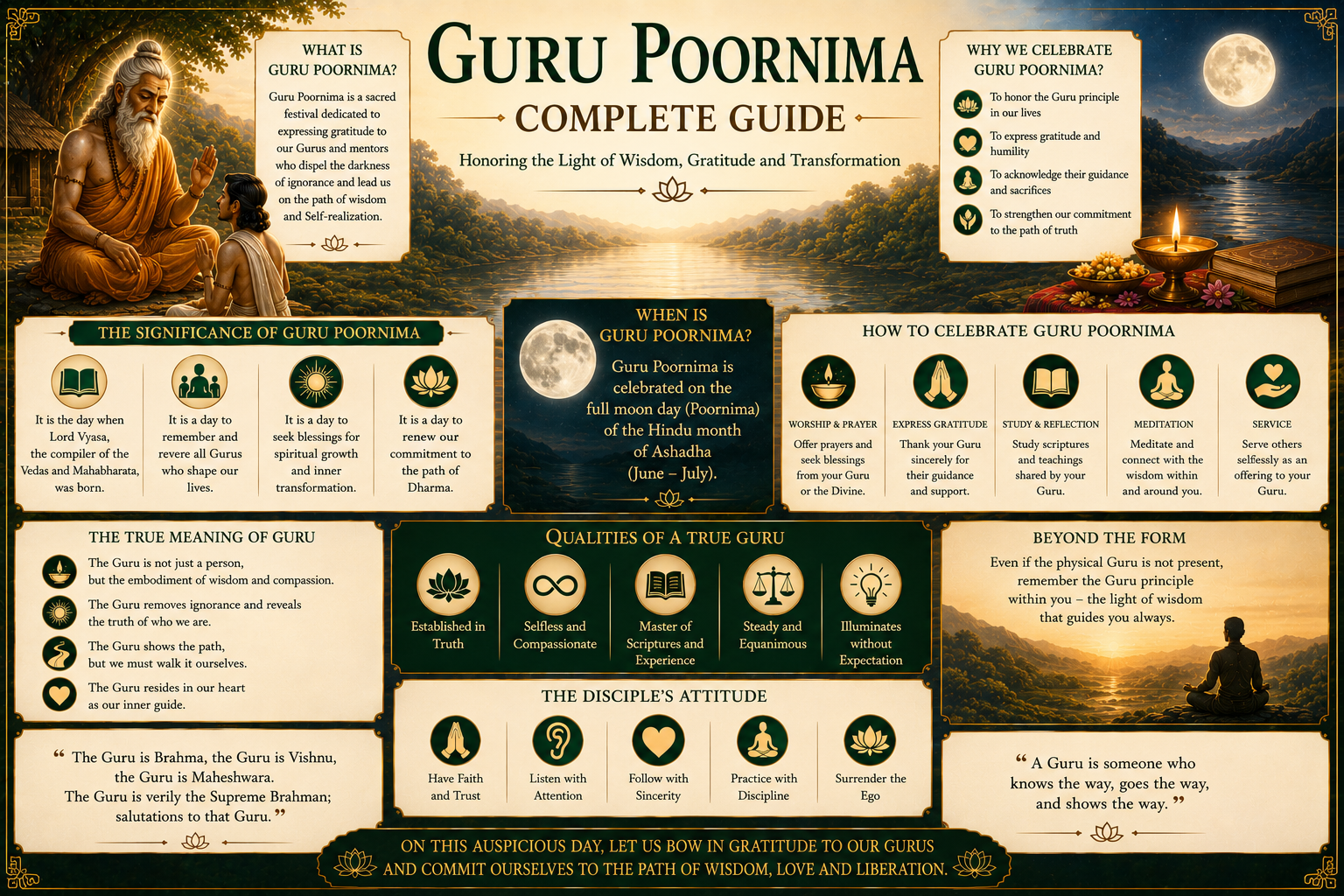
On the full moon night of the month of Ashadha — falling in June or July — something extraordinary happens across the Indian subcontinent and wherever Indian civilisation has taken root. Temples are lit, ashrams are filled with chanting, monasteries hold all-night vigils, and millions of spiritual seekers turn their hearts toward the most ancient of all human relationships: the relationship between the one who knows and the one who seeks to know.
This is Guru Purnima — the full moon of the Guru. Of all the sacred days in the Hindu-Buddhist-Jain calendar, this stands apart. It is not a celebration of a deity’s birth or a seasonal agricultural rite. It is the celebration of transmission itself — of the living chain of wisdom that has passed, unbroken, from teacher to disciple across thousands of years.
In the Indian understanding of civilisation, the Guru is not merely an instructor who passes on skills or information. The Guru is placed above all human relationships — above parents, above kings, above even one’s own intellect. The ancient verse Mata Pitamaha Daivam ranks the teacher above the divine itself in terms of direct access. Why? Because parents give you a body and a name, but the Guru gives you your Self. The Guru, in the deepest sense, introduces you to what you actually are.
This complete guide explores every dimension of Guru Purnima — its mythological roots, its astronomical significance, its observances across three great traditions, the sublime philosophy of the Guru principle, and the living legacy of the Guru-disciple relationship in the modern world.
The Word “Guru”: A Sanskrit Etymology That Contains an Entire Philosophy
The Sanskrit word Guru is one of the most precise and philosophically loaded words in any language. Its etymology is traditionally given as a compound of two seed syllables: Gu (darkness or ignorance) and Ru (the one who removes or dispels). The Guru, therefore, is literally “the dispeller of darkness” — the one who removes the fundamental ignorance (avidya) that causes a human being to mistake the temporary for the permanent, the unreal for the real, the body-mind for the Self.
This etymology immediately tells us something crucial: the Guru is not a teacher in the Western academic sense. A professor teaches mathematics or history — subjects that exist outside both teacher and student. The Guru teaches the Self, which is already fully present within both teacher and student. The Guru does not give you something you don’t have. The Guru removes the veil that prevents you from seeing what you already are.
This is why the tradition draws a sharp distinction between an Acharya (a teacher who transmits knowledge about things in the world, including scriptures) and a Guru (one who transmits being, consciousness, the direct experience of reality). Both are honoured, but they are not the same. You can have many Acharyas in a lifetime. You may have only one Guru — the one whose words, or even whose silence, strikes through the layers of your conditioning and reveals the ground of your existence.
The tradition goes further still with the concept of Guru Tattva — the Guru Principle. This teaching holds that the Guru is not merely a person but a universal principle, a quality of consciousness itself, which can manifest through any vehicle: a human teacher, a sacred text, a sudden experience of beauty or grief, an encounter with nature. The tradition is full of sages who received their decisive teaching not from a human master but from the world itself. The ocean taught one sage about depth. The moon taught another about reflection without possession. The hawk taught focus. The bee taught the extraction of essence from many flowers. The Guru Tattva pervades reality — and Guru Purnima is the day when that principle is consciously honoured in all its forms.
Why This Particular Full Moon: The Astronomical and Mythological Significance
The Astronomical Significance of Ashadha Purnima
Guru Purnima falls on the full moon of the month of Ashadha — the lunar month that spans roughly June to July in the Gregorian calendar. In the Vedic understanding of time, this full moon occupies a precise and symbolically significant position in the solar year: it falls near the summer solstice, the point at which the sun reaches its highest northern declination and then begins its southward journey, known as Dakshinayana (the sun’s southern course).
The symbolism here is elegant and profound. The solstice is the moment when outer light reaches its peak and then begins to wane. It is precisely at this threshold — as the world’s external illumination begins its six-month decline — that the inner light of the Guru is celebrated. The message is unmistakable: when outer light diminishes, seek inner light. When the world’s distractions peak, turn inward. Guru Purnima is the annual invitation to orient one’s life toward the inner sun.
The full moon itself amplifies this symbolism. The moon has no light of its own — it reflects the light of the sun, making that light accessible during the darkness of night. This is precisely the role of the Guru: to reflect the light of the Absolute (Brahma, the ground of all existence) in a form that a seeking human being can receive and be transformed by. The Guru is the full moon — shining in the darkness, reflecting something infinitely greater than themselves, illuminating the path for the traveller of the night.
The Adiyogi Legend: The First Guru Purnima
Perhaps the most sublime of all the stories associated with Guru Purnima is the legend of Adiyogi — Shiva as the First Yogi, the originating source of the entire science of yoga and inner transformation.
The legend begins in the remote Himalayas, at a place called Kantisarovar, where Shiva sat in a state of perfect stillness after his cosmic dance of awakening. Word of this extraordinary being spread, and gradually seven seekers — the Saptarishis, the seven great sages — made their way to him and begged to be taught what he knew. Shiva ignored them for a long time, dismissing them again and again. But the sages prepared themselves with fierce discipline, and after 84 years of waiting, Adiyogi looked at them and saw that they had become pure vessels — they were finally ready to receive.
On the day of the Ashadha Purnima, the full moon of Ashadha, Shiva turned south to face the Saptarishis and became Adi Guru — the first teacher. He began transmitting to them the seven dimensions of yoga, each calibrated to a different type of human being, each a complete path to liberation. The seven sages then dispersed to the four corners of the world, carrying these seven streams of yoga with them, and from them flows the entire river of spiritual knowledge that has sustained human beings ever since.
This is why Guru Purnima is said to be the birthday of the guru-disciple relationship itself. Not the birthday of any particular teacher, but of transmission — the act of one awakened being passing the living flame of knowledge to another. On this day, every Guru-disciple relationship that has ever existed is celebrated, because all of them ultimately trace their lineage back to this primordial moment at Kantisarovar.
Vyasa Purnima: Honouring the Adi Guru of Human Scripture
Guru Purnima is also known as Vyasa Purnima, and this name points to a different but equally important dimension of the day. Veda Vyasa — “the one who divided the Vedas” — is the sage credited with one of the most extraordinary intellectual and spiritual achievements in human history.
At a time when the Vedic revelation was in danger of being lost — too vast, too complex, too demanding for the shortened lifespans and diminished capacities of human beings in the Kali Yuga — Vyasa undertook a single-handed mission of preservation and organisation. He compiled and arranged the four Vedas (Rig, Sama, Yajur, and Atharva) in their current form. He composed or compiled the 18 Puranas, making the philosophical and cosmological content of the Vedas accessible through narrative and story. He authored the Mahabharata — the longest poem ever written, containing within it the Bhagavad Gita, one of the world’s supreme spiritual texts. And he authored the Brahma Sutras, the systematic philosophical distillation of Vedantic thought.
In a very real sense, everything we know of Hindu dharma — every text, every school of philosophy, every ritual, every story — passes through Vyasa’s hands. He is not merely a historical figure but the Adi Guru (the first human Guru) of the entire tradition. Guru Purnima is celebrated on his birthday (or, in some traditions, the day he completed his works) as an act of gratitude to the one through whom the Vedic river flowed into accessible human form.
The Guru-Shishya Parampara: The Unbroken Chain of Living Knowledge
The Concept of Parampara
One of the most distinctive features of the Indian knowledge tradition is its insistence that the highest knowledge cannot be transmitted through books alone. This is not a rejection of text — the Hindu tradition has produced more sacred literature than any other civilisation on earth. It is, rather, an understanding that certain dimensions of knowledge are alive, and that alive knowledge can only be transmitted through a living connection.
This is the principle behind Parampara — the lineage or chain of transmission. The word literally means “one after the other,” suggesting an unbroken sequence. Knowledge flows from the Guru to the disciple, and when that disciple matures into a Guru themselves, it flows through them to their disciples, and so on across generations. The quality of the knowledge is preserved not in its written form alone but in the quality of the beings through whom it passes.
This is why authenticity of lineage (sampradaya) matters enormously in the Hindu tradition. When a teacher claims to teach meditation or yoga or Vedanta, the question asked is: who is your Guru? And who was their Guru? Can you trace your knowledge back to a living chain that ultimately connects to the Saptarishis or to Shiva himself? This is not a question of elitism or credentialism — it is a question about whether what is being transmitted is truly alive, or merely a historical reconstruction.
The Upanishadic Model of Learning
The word Upanishad — the name of the texts that form the philosophical summit of the Vedas — is itself a precise description of this model. It combines three Sanskrit elements: Upa (near), ni (down), and shad (to sit). An Upanishad is a teaching received by sitting close at the feet of the teacher — in intimate proximity, in an attitude of complete receptivity, stripped of the armour of one’s own opinions and certainties.
The Upanishads themselves are full of paradigmatic accounts of this learning. In the Chandogya Upanishad, a young boy named Satyakama Jabala approaches the sage Gautama and asks to be accepted as a student. When Gautama asks about his lineage — as was customary — Satyakama truthfully admits that his mother, a maidservant named Jabala, had many partners and does not know who his father is. Rather than rejecting him (as the social norms of the time might have demanded), Gautama accepts him immediately: “No one but a Brahmin — a true seeker — could speak with such truthfulness. Come, I will teach you.” What matters for discipleship is truthfulness and sincerity, not birth or social status.
In the Katha Upanishad, the boy Nachiketa descends to the realm of Yama, the god of death, and sits at his feet for three days without food or water waiting for his teacher to return. When Yama arrives, he offers Nachiketa three boons to compensate for his neglect. Nachiketa asks first for the restoration of his father’s peace, second for the secret of the sacred fire, and third — the question Yama tries repeatedly to deflect with offers of wealth, power, and beautiful women — for the knowledge of what lies beyond death. This is Mumukshutva — the burning, undeflectable desire for liberation — the single most important quality of a genuine disciple.
And in the Bhagavad Gita, the entire teaching is framed as a guru-disciple encounter. Arjuna — a great warrior, a man of considerable knowledge and worldly competence — collapses in grief and confusion at the threshold of the most important action of his life. He turns to Krishna not as a friend asking for advice but as a disciple surrendering to a Guru: “Shishyas te ‘ham shadhi mam tvam prapannam” — “I am your disciple; teach me, who has surrendered to you.” The Gita begins only when this moment of genuine surrender occurs.
The Four Qualifications of a Genuine Disciple
The Vedantic tradition is extraordinarily precise about what makes a genuine disciple, a genuine seeker. The text known as Vivekachudamani (attributed to Adi Shankaracharya) describes the Sadhana Chatustaya — the fourfold preparation — as the necessary foundation without which no teaching, however sublime, can take root:
- Viveka (Discrimination): The capacity to distinguish between the permanent and the impermanent, between the Real (Brahma, consciousness itself) and the unreal (all phenomena that arise and pass away). Without this basic orientation of intelligence, the mind cannot hold the direction of spiritual practice.
- Vairagya (Dispassion): Not the suppression of desire, but the natural falling away of passionate attachment to the objects of this world — and the next — when one has truly seen their impermanent nature. Vairagya is the fruit of Viveka, not a practice imposed upon the mind from outside.
- Shatsampat (The Six Virtues): Shama (control of the mind), Dama (control of the senses), Uparama (the natural withdrawal of the mind from external objects), Titiksha (endurance — the capacity to bear heat and cold, pleasure and pain, honour and dishonour without being destabilised), Shraddha (faith — not blind belief but an open, trusting receptivity to the Guru’s teaching), and Samadhana (one-pointed concentration of the mind).
- Mumukshutva (The Burning Desire for Liberation): This is the most important of all four — the intense, non-negotiable longing for liberation (moksha) that makes everything else in life secondary. The tradition says that when Mumukshutva reaches its full intensity, liberation is near, because a longing of that quality cannot be denied its object.
The Four Qualifications of a Genuine Guru
The tradition is equally precise about what qualifies a genuine Guru. The Mundaka Upanishad specifies two essential qualities: Shrotriya (one who is deeply learned in the scriptures, having received their teaching through proper lineage) and Brahmanishtha (one who is firmly established in the experience of Brahma, the Absolute — whose knowledge is not theoretical but lived and direct).
Other texts add two more: Apta Kama (one whose desires have been fulfilled or transcended — who has nothing personal to gain from the relationship with the disciple) and Karuna (one who teaches purely out of compassion, without any agenda of self-glorification or power). A Guru who needs your admiration, your money, or your psychological dependence is not truly established in the Guru principle — they are using the sacred role to fulfil their own incompleteness.
This precision cuts both ways: it protects seekers from exploitation, and it protects the purity of the teaching from contamination by the Guru’s own unresolved psychology.
Great Guru-Disciple Relationships in Hindu History and Legend
Shiva and Nandi: The Eternal Prototype
Before the Saptarishis, before all human history, Nandi — the great bull, the eternal gate-keeper of Kailash — sat at Shiva’s feet in perfect stillness, in perfect love, in perfect receptivity. The tradition regards Nandi as the prototype of the ideal disciple: fully present, completely surrendered, asking nothing and receiving everything. The image of Nandi eternally facing the Shivalinga in every Shiva temple in India is a living reminder of this original posture of discipleship.
Vasishtha and Rama: The Yoga Vasishtha
When the young prince Rama returned from his first travels across India deeply disturbed by what he had seen — the suffering, the impermanence, the pointlessness of worldly existence — his father, King Dasharatha, called in the sage Vasishtha to counsel him. What followed was one of the most extraordinary dialogues in Sanskrit literature: the Yoga Vasishtha, or Vasishtharamayana, a vast text of approximately 32,000 verses in which Vasishtha systematically addresses every dimension of Rama’s existential crisis and leads him, step by step, to the direct recognition of his own nature as pure consciousness.
The Yoga Vasishtha is remarkable for the depth and breadth of its philosophical exploration. It addresses consciousness, the nature of reality, the mechanism of creation, the power of the mind to construct entire worlds of experience, the nature of liberation, and the full range of paths to self-realisation. That this teaching is given to Rama — who is himself an avatar of Vishnu — underscores the tradition’s insistence that even the divine, in human form, must walk the path of the disciple.
Sandipani and Krishna: Even the Avatar Goes to School
The story of Krishna and his brother Balarama at the gurukul of the sage Sandipani in Ujjain contains a lesson that the tradition never tires of repeating. Krishna — who is celebrated throughout the Mahabharata and the Puranas as the supreme being, the source of all knowledge, the one who reveals the Gita — nonetheless, in his human life, submitted himself to the disciplines of a student. He and Balarama lived at Sandipani’s ashram, served their Guru, studied under him, and honoured him in the traditional way.
The message is not subtle: if the avatar himself became a disciple, what excuse does any human being have for bypassing this relationship? The gurukul form — living with the Guru, serving, observing, absorbing not just the teaching but the being of the teacher — is presented as the optimal environment for the transmission of living knowledge.
Dronacharya and Arjuna — and the Haunting Story of Ekalavya
The archery teacher Dronacharya and his supreme student Arjuna represent one of the tradition’s most celebrated examples of a disciple achieving extraordinary mastery through total dedication to the Guru’s vision. Drona’s teaching method was exacting: he perceived Arjuna’s exceptional potential and deliberately concentrated the most refined instruction on him, shaping him into the finest archer the world had ever seen.
But the Mahabharata also tells the story of Ekalavya — a low-caste forest boy who was turned away by Drona because of his birth. Ekalavya returned to the forest, built a clay image of Drona, and trained before it every day with complete devotion, treating the image as his living Guru. He achieved a level of mastery that surpassed even Arjuna. When Drona eventually encountered him and, in the infamous act of dakshina, asked for the thumb of his right hand — ensuring that Arjuna’s supremacy would not be challenged — Ekalavya cut it off without hesitation.
The tradition has wrestled with this story for millennia. Some see in it a model of absolute surrender to the Guru that transcends all personal interest. Others read it as a moral indictment of caste-based gatekeeping of knowledge. Both readings are alive in the tradition. But all readings agree on one thing: Ekalavya’s devotion to his imagined Guru was so complete and so sincere that it produced genuine transformation. The principle was enough, even without the physical presence.
Ramakrishna and Vivekananda: The 19th Century’s Great Transmission
If one were to choose a single guru-disciple relationship from the modern period to illustrate the living reality of this tradition, it would almost certainly be the relationship between Sri Ramakrishna Paramahamsa and Swami Vivekananda.
Ramakrishna was a temple priest in Dakshineswar, near Calcutta — functionally illiterate by formal standards, incapable of complex philosophical discourse in the academic sense, and yet universally regarded by those who met him as a being who lived in constant direct communion with the divine. He had practised every major spiritual path available to him — Vaishnavism, Shaivism, Tantra, Islam, Christianity — and declared from direct experience that they all led to the same ocean.
Vivekananda — born Narendranath Datta — was everything Ramakrishna was not: formally educated, intellectually formidable, sceptical to the point of agnosticism, trained in Western philosophy, and absolutely unwilling to accept anything on the basis of authority alone. When he first came to Ramakrishna, he came to interrogate him. He left as his devoted disciple.
What transformed Vivekananda was not an argument. It was an experience. Ramakrishna touched him — placed his hand on the young man’s chest — and Vivekananda described feeling the entire world dissolve, all his certainties collapse, the ground of ordinary consciousness give way to something vast and formless and absolute. This is what the tradition means by transmission: not the communication of information but the direct induction of an experiential state, the living flame lit from the burning flame of the Guru’s own realisation.
The fruits of this transmission transformed the world. Vivekananda’s 1893 address to the Parliament of World’s Religions in Chicago announced Vedanta to the Western world and began the global spread of Indian spirituality that continues to this day.
Ramana Maharshi: The Silence That Teaches
The sage Ramana Maharshi, who spent most of his adult life on the slopes of the sacred hill Arunachala in Tamil Nadu, represents a different and perhaps even more extreme model of the Guru: the one whose primary teaching is silence. Many of those who came to him and sat in his presence described profound inner transformations — not as a result of anything he said or did, but simply from the quality of awareness that radiated from him. His formal teaching — the inquiry practice of Atma Vichara, or self-enquiry (“Who am I?”) — is devastatingly simple and can be explained in a few sentences. But the force with which it worked in the presence of Ramana Maharshi himself was, by many accounts, unlike anything available from reading his words on a page.
Nisargadatta Maharaj and Siddharameshwar Maharaj: Liberation in Three Years
The Mumbai bidi-seller who became the sage Nisargadatta Maharaj — whose teachings were captured in the book I Am That — is one of the most striking examples of what can happen when a disciple follows the Guru’s instruction with complete fidelity. Nisargadatta met his Guru, Siddharameshwar Maharaj, in 1933. Siddharameshwar gave him a single, precise instruction: meditate on the sense of “I Am” — the bare feeling of existence before any thought about yourself arises. Hold to that sense of pure being as your anchor. Nisargadatta followed this instruction with the complete one-pointedness of a man who had nothing to lose, and within approximately three years, he reported the dissolution of all sense of being a separate individual and the recognition of himself as the absolute witness of all experience. Siddharameshwar died before seeing the full flowering of his disciple — but the fruit was there, and it grew.
How Guru Purnima Is Celebrated: Rituals, Observances, and Traditions
In Hindu Ashrams and Temples: The Guru Paduka Puja
In most Hindu spiritual communities, the central ritual of Guru Purnima is the Guru Paduka Puja — the worship of the Guru’s sandals. This practice deserves careful reflection, because to an uninitiated eye it can appear strange or even demeaning. The symbolism is anything but.
The sandals (Padukas) represent the Guru’s feet — and in the Indian tradition, the feet of the Guru are the site of the most concentrated and most accessible grace. The feet have touched the earth; they carry the dust of sacred places; they are the lowest part of the body, and therefore the most appropriate point of contact for a disciple who comes in humility. To place one’s head at the Guru’s feet — Charan Sparsha — is to make the most complete possible gesture of surrender: the head (the seat of the ego, of the intellect, of all one’s certainties about who one is) is placed below the Guru’s feet.
When the Guru is not physically present, the sandals serve as their living symbol. The tradition holds that the Guru’s sandals contain the entire grace of the Guru’s presence. This is not superstition but a precise psycho-spiritual technology: in the act of worshipping the sandals with complete sincerity, the disciple’s consciousness is oriented toward the Guru principle, and the receptivity that this creates allows the teaching to do its work.
Guru Purnima celebrations in ashrams typically include: the ritual washing of the Guru’s feet (Pada Puja), the offering of flowers, fruits, and incense, the recitation of the Guru Stotram and the Guru Gita, the full-body prostration (Sashtanga Pranam — “eight-limbed prostration,” touching feet, knees, stomach, chest, hands, eyes, head, and mind to the ground or to the Guru’s feet), and the giving of dakshina — a symbolic offering that traditionally represents the disciple’s willingness to give everything they have.
Vyasa Puja: Honouring the Great Compiler
In many traditions, particularly those in the Vedantic lineages, Guru Purnima is observed as Vyasa Puja — a formal ceremony of worship to Veda Vyasa as the source of all scriptural knowledge. This typically includes the recitation of the opening verse of the Brahma Sutras (Athato Brahma Jijnasa — “Now, therefore, the inquiry into Brahma”), the reading of Puranic texts, and the offering of gratitude to the entire lineage of teachers through whom the Vedic wisdom has been preserved.
In monastic communities following Adi Shankaracharya’s tradition, Guru Purnima is one of the most important days of the year, involving all-night chanting, formal philosophical discourse, and the renewal of the disciple’s commitment to the path.
In Buddhist Monasteries: Dhamma Day
In the Buddhist tradition, Guru Purnima is known as Dhamma Day (Asalha Puja in the Theravada calendar), and it celebrates one of the most important events in Buddhist history: the day the Buddha, approximately seven weeks after his enlightenment under the Bodhi tree at Bodh Gaya, gave his very first teaching.
The Buddha travelled from Bodh Gaya to the Deer Park at Isipatana (Sarnath), near Varanasi, where he found his five former companions — the men who had practised with him during his years of severe asceticism and had abandoned him when he gave up that path. Seeing the Buddha approach, they decided to ignore him, since (they reasoned) a man who had abandoned austerity was no longer a serious seeker. But as he drew near, the force of his presence — the radiance of a fully awakened being — overcame their resolution, and they rose to greet him respectfully.
What the Buddha then taught them is known as the Dhammacakkappavattana Sutta — “The Discourse on Setting the Wheel of Dhamma in Motion.” It contains the Four Noble Truths (the truth of suffering, of its origin, of its cessation, and of the path to cessation) and the Noble Eightfold Path. With this first teaching, the Dhamma Wheel began its turning — the first guru-disciple relationship in the Buddhist tradition was established, and the Sangha (community of practitioners) was born.
Dhamma Day is observed throughout the Buddhist world: in Theravada communities across Sri Lanka, Thailand, Myanmar, Cambodia, and Laos with candlelight processions and temple ceremonies; in Mahayana communities with the reading of sutras; and in Vajrayana (Tibetan) communities with elaborate tantric puja ceremonies honouring the lineage of transmission teachers.
In the Jain Tradition
For Jains, Guru Purnima carries a specific significance: it is traditionally associated with the day that Mahavira — the 24th Tirthankara (ford-maker, one who helps others cross the ocean of samsara) — gave his first discourse after attaining Kevala Jnana (omniscience, perfect and complete knowledge). Having achieved this ultimate liberation of consciousness, Mahavira became the supreme teacher of the Jain path, establishing the fourfold Sangha (monks, nuns, laymen, laywomen) that continues to this day.
In Jain communities, Guru Purnima is observed with visits to temples, veneration of the Tirthankaras, and expressions of gratitude to one’s own spiritual teachers and mentors.
Personal Practice: The Inner Dimension of the Day
Beyond formal ritual, the tradition encourages a deeply personal observance of Guru Purnima. This includes: sitting in extended meditation on the form or presence of one’s own Guru (or, if one has not taken a human Guru, on the Guru Tattva as an inner principle); journaling in gratitude about all the teachers — formal and informal, human and non-human — who have contributed to one’s growth; reading from the texts most central to one’s practice; and, crucially, renewing one’s commitment to the actual practice of the teaching one has received.
The tradition is emphatic on this last point: the highest form of Guru Puja is not the offering of flowers or money but the implementation of the teaching in one’s own life. The Guru has given a lamp. The greatest offering one can make is to actually light the darkness with it.
The Guru Gita: The Definitive Scripture on the Nature of the Guru
Of all the texts in the Indian tradition that deal with the Guru principle, the Guru Gita stands supreme. This dialogue of 352 verses between Shiva and his consort Parvati is embedded in the Skanda Purana and is considered the most sacred and comprehensive teaching on the nature, significance, and worship of the Guru in the entire Sanskrit canon. It is recited in ashrams on Guru Purnima and throughout the year as a daily practice in communities that regard the Guru relationship as the central axis of spiritual life.
The Guru Gita begins with Parvati asking Shiva: “O Lord, I have heard your teachings on many subjects — on yoga, on tantra, on devotion — but I have one burning question. Who is the Guru? What is the Guru’s nature? And how should the disciple relate to the Guru?” Shiva’s answer unfolds across hundreds of verses, touching on cosmology, psychology, devotional practice, meditation, and the metaphysics of consciousness.
The most celebrated verse of the Guru Gita — and one of the most famous single verses in the entire tradition of bhakti and spiritual practice — encapsulates the whole teaching in four lines:
Guru Brahma Guru Vishnu, Guru Devo Maheshvara,
Guru Sakshat Para Brahma, Tasmai Shri Gurave Namaha.
The Guru is Brahma — the creator. Just as Brahma creates the universe from the void, the Guru creates the disciple’s new understanding from the darkness of ignorance. The Guru is Vishnu — the sustainer. Just as Vishnu sustains the universe through its full span, the Guru sustains the disciple through the long, difficult, often discouraging arc of the spiritual path. The Guru is Shiva (Maheshvara) — the destroyer. Just as Shiva dissolves the universe at the end of the cosmic cycle, the Guru destroys the disciple’s false identity, their limiting beliefs, their attachment to the ego that has kept them bound. And ultimately, the Guru is Para Brahma itself — the Absolute, the ground of all existence, the Self of all selves. The Guru is not pointing toward the Absolute from outside. The Guru is the Absolute, appearing in the form most accessible to this particular disciple at this particular moment.
The Guru Gita also contains extensive practical teaching on the proper attitude of the disciple: serving the Guru with the same reverence one would offer the divine, never speaking disparagingly of the Guru, meditating on the Guru’s form as a means of stabilising awareness, and understanding that the relationship with the Guru is not merely personal but cosmic — it is the relationship between the individual self and the universal Self, taking a particular and accessible form.
Dattatreya’s 24 Teachers: The Guru Beyond the Human Form
One of the most philosophically rich and spiritually liberating teachings associated with the Guru principle comes from the story of Dattatreya — the Avadhuta, the divine wanderer who is regarded as the combined avatar of Brahma, Vishnu, and Shiva, and who is the patron deity of the Nath and Avadhuta traditions of India.
In the eleventh book of the Bhagavata Purana, a king named Yadu encounters the wandering sage Dattatreya and, struck by his extraordinary radiance and equanimity, asks: “Who is your teacher? From whom have you received the wisdom that shines through you so clearly?” Dattatreya’s answer is one of the most unusual and liberating in the entire tradition: “I have had 24 teachers,” he says. “And none of them were human.”
He then lists them: the Earth, which taught him patience and non-retaliation — the earth bears the weight of all creatures upon it and absorbs all that is poured onto it without complaint or resentment. Water, which taught him purity — water takes the shape of any container it is poured into but remains essentially itself, and it purifies everything it touches. Fire, which taught him luminosity — fire consumes everything offered to it and transforms it, and shines equally for all who are near it. The Sky (Akasha), which taught him non-attachment — the sky is not stained by the clouds that pass through it, not diminished by the birds that fly across it. The Wind, which taught him freedom from identification with place — the wind passes through all environments, carrying the fragrance of each without being defined by any.
The Sun taught him that the same light illuminates all beings equally, that the Self is equally present in all, without preference or discrimination. The Moon taught him the distinction between the witness and what it witnesses — the moon reflects the sun’s light without being diminished or augmented by it, just as the Self reflects the play of existence without being defined by it. The Ocean taught him undisturbed depth — the surface of the ocean may be turbulent with waves, but its depths are always still; the sage learns to inhabit those depths regardless of what stirs at the surface.
The Hawk taught him the danger of distraction and the power of single-pointed focus — when a hawk is diverted from its prey by other birds trying to steal its catch, it loses its meal; when the seeker’s attention is scattered by the demands and opinions of others, the goal of liberation slips away. The Bee taught him the art of selective gathering — the bee takes a little from many flowers and transforms it into honey; the sage takes what is most essential from many sources of teaching and transforms it into wisdom. The Deer taught him the danger of being distracted by beauty — the deer is lured by music and captured; the seeker must be careful not to be ensnared by the beautiful traps the world sets.
The Snake taught him solitary practice and the wisdom of changing environments regularly — the snake lives alone, requires no permanent home, and moves on before it becomes too comfortable; the sage should not become addicted to the comfort of any particular situation. The Spider taught him that the mind weaves its own world out of itself — just as the spider spins its web from its own body and then retreats back into itself, consciousness creates the universe from itself and then re-absorbs it. The Wasp (or mud-dauber) taught him the transformative power of intense meditation — the wasp captures a larva and keeps it prisoner, constantly buzzing around it; the larva, in constant awareness of the wasp, takes on its very form; whatever the mind meditates upon with complete intensity, it becomes.
Dattatreya’s teaching is radical in its implications: the universe itself is a Guru for one who is truly awake and truly open. Every moment carries a teaching. Every encounter contains wisdom. The entire creation is in continuous dialogue with the seeker who has the ears to hear. This does not diminish the importance of the human Guru — for most people, in most circumstances, the human Guru is essential as the primary catalyst. But it opens the understanding of the Guru Tattva to its full cosmic dimensions: the principle of teaching and awakening pervades all of existence.
Guru Purnima in the Yogic Calendar and the Modern World
Guru Purnima has become, in the contemporary world, one of the most widely observed spiritual days outside India’s borders. This global reach is largely the result of two waves of transmission.
The first wave was initiated by Swami Vivekananda, whose 1893 appearance at the Parliament of World’s Religions introduced Vedanta — and with it the concept of the Guru — to Western audiences for the first time at any scale. Vivekananda founded the Ramakrishna Mission, which established centres across Europe and America and began the tradition of Western students celebrating Guru Purnima in honour of Ramakrishna as their Guru. This was followed by a succession of Indian teachers who came West in the early and mid-twentieth century: Paramahansa Yogananda (whose Autobiography of a Yogi made the guru-disciple relationship comprehensible to millions of Western readers), Swami Sivananda, Swami Satchidananda, and many others.
The second wave was the explosion of yoga and meditation in the late twentieth century. As Hatha yoga spread globally and millions of people began practising under teachers in studios and ashrams around the world, many of those teachers introduced their students to the concept of the Guru lineage and to Guru Purnima as the day for acknowledging the teacher-student relationship. ISKCON (the International Society for Krishna Consciousness) established Guru Purnima as a major observance worldwide. The Transcendental Meditation movement under Maharishi Mahesh Yogi celebrated it as the day for honouring the tradition of teachers. And contemporary organisations — from the Isha Foundation (founded by Sadhguru) to the Bihar School of Yoga (founded by Swami Satyananda Saraswati) to countless individual ashrams and yoga centres — mark Guru Purnima as the most important day of the spiritual year.
In the modern yogic world, Guru Purnima functions as both a sacred celebration and a cultural anchor — a day when the often diffuse, individualised spirituality of contemporary practitioners is connected to something ancient, lineaged, and communal. It is a day for remembering that one does not practice alone, that one stands in a chain of transmission, and that whatever light one has received came through human hands before reaching one’s own.
As the world grows increasingly atomised and the concept of mentorship and transmission weakens in many domains of life, Guru Purnima carries a message of particular relevance: that there are forms of knowledge which cannot be packaged, downloaded, or algorithmically delivered — forms that require the presence of a living being who has walked the path, and the genuine receptivity of a seeker who is willing to be changed by what they receive.
On the full moon of Ashadha, across thousands of years and on every continent of the earth, human beings pause to bow — in gratitude, in humility, in recognition — to the ones through whom the light has flowed. This is Guru Purnima: the festival of the living flame, passed from hand to hand across the darkness of time.
Key Takeaways
- Guru Purnima is celebrated on the full moon (Purnima) of the Hindu month of Ashadha (June–July), falling near the summer solstice — the threshold where outer light peaks and begins to wane, and inner light is celebrated.
- The word Guru derives from the Sanskrit syllables Gu (darkness/ignorance) and Ru (remover) — the Guru is the one who removes ignorance and reveals the Self that was always already present.
- The day is simultaneously Vyasa Purnima (honouring Veda Vyasa, the Adi Guru who compiled the Vedas, Puranas, Mahabharata, and Brahma Sutras) and the anniversary of Adiyogi Shiva’s first transmission of yoga to the seven Saptarishis.
- The Guru-Shishya Parampara (lineage of teacher-disciple transmission) holds that the highest knowledge must be transmitted person-to-person through direct experience — books preserve the form; the Guru transmits the life.
- The Sadhana Chatustaya (fourfold preparation for discipleship) — Viveka, Vairagya, Shatsampat, and Mumukshutva — describes the inner readiness required to receive and retain the Guru’s teaching.
- Great guru-disciple pairs across history — Vasishtha-Rama, Dronacharya-Arjuna, Ramakrishna-Vivekananda — illustrate different dimensions of the transmission relationship, from the philosophical to the devotional to the experiential.
- The Guru Gita‘s central verse — Guru Brahma Guru Vishnu, Guru Devo Maheshvara, Guru Sakshat Para Brahma, Tasmai Shri Gurave Namaha — identifies the Guru with all three aspects of the divine trinity and ultimately with the Absolute itself.
- Dattatreya’s 24 teachers from nature expand the Guru Tattva to cosmic proportions: the entire universe is teaching at every moment for the one who is genuinely open.
- Guru Purnima is observed across three great traditions: in Hinduism as Vyasa Purnima with Guru Paduka Puja; in Buddhism as Dhamma Day commemorating the Buddha’s first sermon at Sarnath; in Jainism celebrating Mahavira’s first discourse after attaining Kevala Jnana.
- The highest form of Guru Puja, in all traditions, is not the offering of flowers or money but the living of the teaching — the practical implementation of what one has received in the laboratory of one’s own life.
Frequently Asked Questions About Guru Purnima
What is Guru Purnima and why is it celebrated?
Guru Purnima is the full moon day of the Hindu month of Ashadha (June–July), dedicated to the honouring of the Guru — the spiritual teacher who removes ignorance and transmits the living experience of truth. It is celebrated because the Indian tradition holds the Guru-disciple relationship as the most sacred of all human relationships — the one through which the highest knowledge (self-knowledge, liberation) is transmitted from those who have crossed the ocean of existence to those who are still seeking the far shore. The day simultaneously honours Veda Vyasa (Vyasa Purnima) as the Adi Guru of the Hindu tradition and marks the anniversary of Adiyogi Shiva’s first transmission of yoga to the Saptarishis.
What does the word “Guru” actually mean in Sanskrit?
The traditional Sanskrit etymology of Guru derives it from two syllables: Gu (darkness or ignorance) and Ru (the remover or dispeller). The Guru is therefore “the one who dispels darkness” — not metaphorically but in the most direct sense: the Guru removes the fundamental ignorance (avidya) that causes a human being to misidentify themselves as a limited body-mind rather than recognising their true nature as pure consciousness. The tradition further refines this with the concept of Guru Tattva — the Guru Principle — which can manifest not only through a human teacher but through a text, an experience, an encounter with nature, or any vehicle through which the light of awareness reaches a seeking being.
What is the connection between Guru Purnima and the Buddha?
In the Buddhist tradition, Guru Purnima coincides with Dhamma Day (Asalha Puja in Pali) — the day the Buddha Shakyamuni gave his very first teaching after his enlightenment. Having attained liberation under the Bodhi tree at Bodh Gaya, the Buddha travelled to the Deer Park at Sarnath and delivered the Dhammacakkappavattana Sutta (Setting the Wheel of Dhamma in Motion) to his five former companions. This first teaching, containing the Four Noble Truths and the Noble Eightfold Path, established the Three Jewels — Buddha, Dhamma, and Sangha — and set in motion the transmission of the Dharma that has continued without interruption for 2,500 years. Dhamma Day is observed with vigils, processions, and formal ceremonies throughout the Theravada world and is acknowledged in Mahayana and Vajrayana communities as well.
Who was Veda Vyasa and why is Guru Purnima called Vyasa Purnima?
Veda Vyasa — whose full name is Krishna Dvaipayana Vyasa — is the sage credited with the compilation and organisation of the Vedic revelation in a form accessible to human beings. Before Vyasa, the Vedas existed in a vast, undivided oral form that was becoming inaccessible to most people. Vyasa divided and organised the four Vedas (Rig, Sama, Yajur, Atharva), composed the 18 Puranas (including the Bhagavata Purana and the Vishnu Purana), authored the Mahabharata (the world’s longest epic, containing the Bhagavad Gita), and composed the Brahma Sutras (the systematic philosophical summary of the Upanishads). In doing so, he preserved and made accessible virtually the entire intellectual and spiritual heritage of Indian civilisation. He is regarded as the Adi Guru — the first human guru — of the Hindu tradition, and Guru Purnima is celebrated on his birthday (or in some traditions, the day he completed his monumental works) in his honour.
What is the Guru Gita and what does it teach?
The Guru Gita (Song of the Guru) is a dialogue of 352 verses between Shiva and Parvati, embedded in the Skanda Purana and considered the most sacred and authoritative text on the Guru principle in the Sanskrit tradition. In it, Shiva responds to Parvati’s question about the nature and significance of the Guru with a comprehensive teaching that covers the cosmological status of the Guru (identified with Brahma, Vishnu, and Shiva, and ultimately with Para Brahma, the Absolute itself), the proper attitude and behaviour of the disciple, the methods of Guru Puja (worship of the Guru), the different types of Gurus, and the mechanics of how transmission works. Its most celebrated verse — Guru Brahma Guru Vishnu, Guru Devo Maheshvara, Guru Sakshat Para Brahma, Tasmai Shri Gurave Namaha — is chanted in ashrams worldwide as a daily salutation to the Guru principle. The Guru Gita is traditionally recited in full on Guru Purnima in many spiritual communities.
How can someone observe Guru Purnima if they do not have a living Guru?
The tradition offers several meaningful approaches for those who have not yet connected with a living human Guru. The first is to honour the teachers one has had — parents, mentors, therapists, authors whose words have genuinely changed one’s understanding; the day is an opportunity to formally express gratitude for every form of guidance received. The second is to contemplate Dattatreya’s teaching of the 24 natural teachers — to spend time in nature with the conscious intention of receiving its instruction, observing what the earth, water, fire, sky, and living creatures are demonstrating. The third is to read or recite from a text that has functioned as a Guru in one’s life — to sit with it meditatively rather than analytically, allowing it to work on the level of being rather than intellect. And the fourth — recommended strongly by many teachers — is to approach the day with the sincere question: “Am I genuinely ready to receive a teacher? Have I developed the four qualities of a genuine disciple?” The tradition holds that when the disciple is truly ready, the Guru appears — in whatever form is most appropriate.
Related articles in Festivals & Rituals
Sage Jaimini is the founder of the Purva Mimamsa school, honoured for his rigorous inquiry into dharma and the right interpretation of the Vedas.
Sage Kanada is the founder of the Vaisheshika school, remembered for an early and remarkable analysis of nature, the categories of reality, and the idea of indivisible atoms.
Sage Kapila is traditionally honoured as the founder of Samkhya, one of the oldest systems of Indian philosophy, with its profound analysis of consciousness and nature.
Comments(0)
Loading comments…