Ram Navami: The Complete Guide to the Celebration of Lord Rama’s Birth
A complete and in-depth guide to Ram Navami — the sacred celebration of Lord Rama’s birth on the ninth day of Chaitra. Covers the astrological perfection of Rama’s birth, his identity as Maryada Purushottama, the nine-day Chaitra Navratri rituals, Ayodhya’s Surya Tilak engineering marvel, the Bhadrachalam Sita Rama Kalyanam, Tulsidas’s Ramcharitmanas and its Ram Navami origin, and regional celebrations across India.
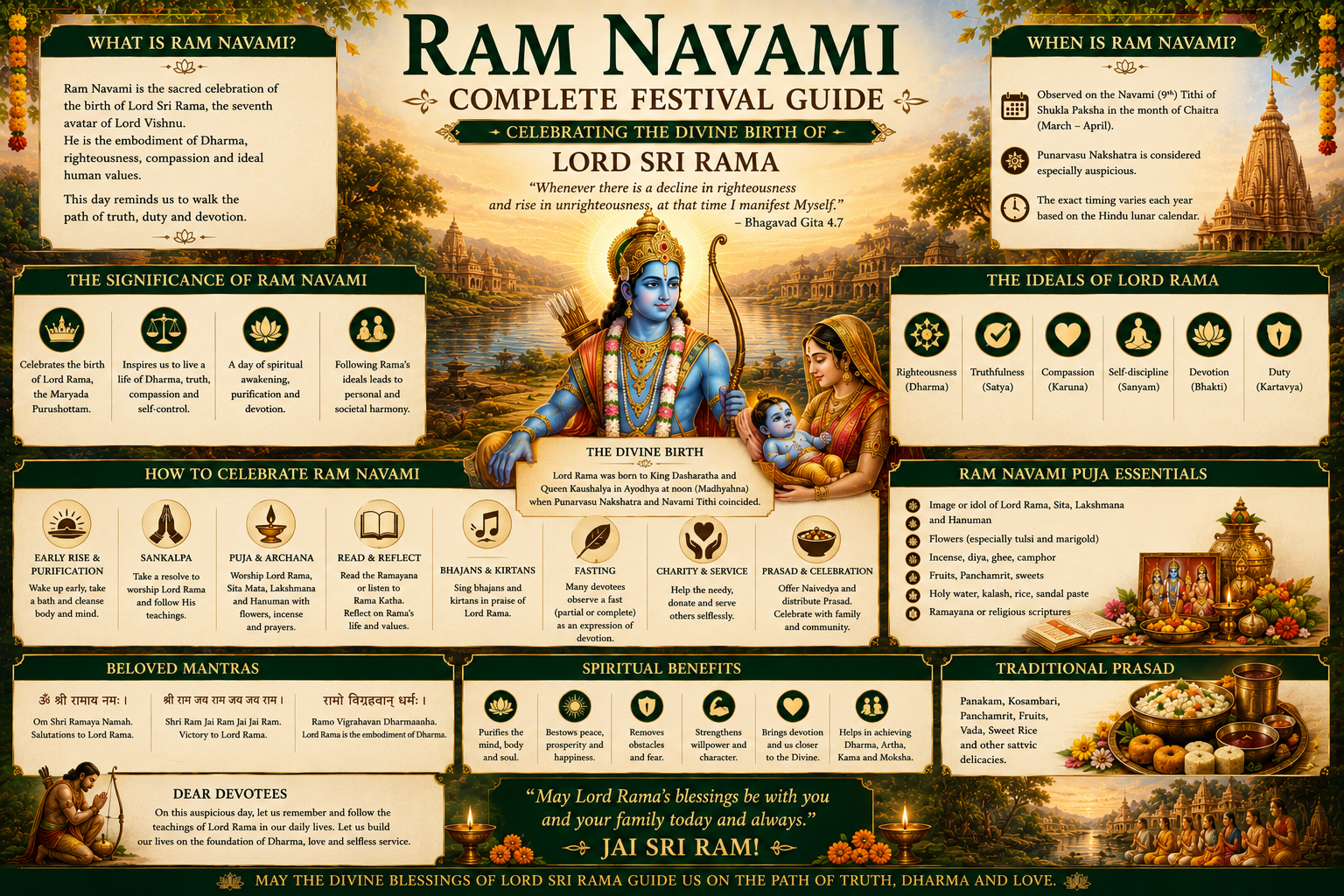
Every year, as the warmth of spring settles over the Indian subcontinent and the Chaitra month ushers in the Hindu New Year, millions of devotees prepare for one of the most sacred festivals in the Vaishnava calendar: Ram Navami. Celebrated on the ninth day (Navami) of the bright fortnight (Shukla Paksha) of the month of Chaitra — which falls in March or April — this festival marks the birth of Lord Rama, the seventh avatar of Lord Vishnu and the embodiment of dharmic perfection.
Ram Navami is far more than a birthday celebration. It is a day when Hindus across every region of India, and in the global diaspora, reflect on the eternal ideal that Rama represents: the Maryada Purushottama, the supreme person who upholds every boundary of righteousness even at the most devastating personal cost. It is also the culmination of Chaitra Navratri — the first of the four Navratris in the Hindu year — nine days of fasting, scripture recitation, and devotion that lead up to the auspicious noon hour when Rama entered the world.
This complete and in-depth guide takes you through every dimension of Ram Navami: the celestial story of Rama’s birth, the astrological perfection of that moment, the deep philosophical meaning of his life and character, the rituals observed across the nine days and on the festival day itself, the extraordinary regional celebrations from Ayodhya to Bhadrachalam, the legacy of Tulsidas and the Ramcharitmanas, the modern engineering marvel of the Surya Tilak, and the sacred foods of this festival.
The Story of Rama’s Birth: The Divine Advent in Ayodhya
King Dasharatha’s Longing for an Heir
The story of Ram Navami begins in the magnificent city of Ayodhya, capital of the Kosala kingdom, where the great solar-dynasty king Dasharatha ruled with justice and glory. Despite his power, his enormous armies, and his three beloved queens — Kaushalya (the eldest and most virtuous), Kaikeyi (the fierce and beloved youngest), and Sumitra (the gentle middle queen) — Dasharatha carried a profound sorrow: he had no son to inherit his throne. In the ancient Vedic world, the continuation of the dynasty, the performance of the father’s last rites, and the maintenance of the ancestral lineage all depended on a male heir. Without a son, a king was considered incomplete in his dharmic obligations.
Dasharatha turned to his trusted royal sage and minister, Vasishtha, who directed him to seek out the great sage Rishyashringa — the brahmin rishi who possessed the power to perform the Putrakameshti Yajna, the sacred fire sacrifice specifically performed to obtain sons. Rishyashringa arrived at Ayodhya, and the elaborate yajna was conducted with all proper Vedic rites. The sacred fire blazed magnificently, and from within its heart emerged a divine figure bearing a golden vessel of payasam — a celestial pudding of extraordinary fragrance and power, infused with the blessings of the gods themselves.
The Divine Pudding and the Four Sons
The divine being from the fire — understood to be Agni Deva, the god of fire, acting as the messenger of all the gods — instructed Dasharatha to distribute this sacred payasam among his queens. Dasharatha offered the first, largest portion to Kaushalya. He gave the second portion to Kaikeyi. And the remaining portion he divided and gave to Sumitra — the Valmiki Ramayana in some recensions records that Sumitra received two portions, which explains why she gave birth to twins.
The timing of the births is described with remarkable astrological precision in the Valmiki Ramayana (Bala Kanda). When the appointed time arrived, all three queens went into labour. Rama was born to Queen Kaushalya at noon on the ninth day (Navami) of the bright fortnight of Chaitra. This precise moment — noon, Navami, in the month of Chaitra — became the fixed sacred time of Ram Navami observance for all time to come. Lakshmana and Shatrughna were born to Sumitra (a twin birth), and Bharata was born to Kaikeyi. The four princes completed Dasharatha’s dynasty and fulfilled his deepest longing.
The Astrological Configuration of Rama’s Birth: The Rama Navami Yoga
The birth of Rama is described in Vedic astrological terms that mark it as one of the most extraordinary celestial configurations possible — and this is no accident, for it underscores his divine nature. The Valmiki Ramayana describes the sky at the moment of Rama’s birth with striking specificity:
- The Sun (Surya) was in Aries (Mesha) — its sign of exaltation, where the Sun is at maximum strength and brightness. Rama belongs to the Surya Vamsha (Solar Dynasty), and the Sun himself was exalted at his birth.
- Jupiter (Brihaspati) was in Cancer (Karka) — its sign of exaltation. Jupiter, the great planet of wisdom, dharma, and the guru principle, was at its peak power.
- The Moon was in the Punarvasu nakshatra (the star of renewal and restoration). Punarvasu — literally “return of the light” — is associated with the qualities of generosity, restoration, and divine benevolence that define Rama’s character.
- The Lagna (Ascendant) was Cancer (Karka) — the sign of the Moon, associated with nurturing, protection of the people, and emotional depth. A Cancer lagna king rules with both strength and compassion.
- Multiple planets — the Ramayana mentions five — were simultaneously in their own signs or exaltation signs, creating what Jyotishis (Vedic astrologers) call the Rama Navami Yoga: a configuration of extraordinary auspiciousness that almost never repeats.
This astronomical precision was not merely poetic embellishment. For the ancient Vedic world, the celestial configuration at the moment of birth determined the soul’s purpose and capacity. The sky at Rama’s birth declared: here is a being of solar radiance, Jupiterian wisdom, lunar compassion, and the nakshatra of divine renewal. The entire cosmos aligned to welcome the Maryada Purushottama.
Why Vishnu Chose to Be Born as a Human
The theological reason for Rama’s birth is explained in both the Valmiki Ramayana and the Vishnu Purana. Ravana, the mighty demon king of Lanka, had performed extreme austerities and obtained powerful boons from Brahma that made him virtually invulnerable: he could not be killed by gods, demons, nagas, yakshas, gandharvas, or any celestial being. In his arrogance, Ravana had omitted to ask for protection against humans and monkeys — deeming them too insignificant to worry about. This deliberate omission left a gap that Vishnu could exploit.
Vishnu, hearing the pleas of the gods who were oppressed by Ravana’s tyranny, vowed to incarnate as a human being — born of a mortal womb, subject to the full range of human experience including grief, exile, and loss — so that he could face and destroy Ravana within the rules of the boons Ravana had obtained. This is the doctrine of the avatar in its most complete form: the divine enters fully into the human condition, not as a visitor, but as a participant, to restore cosmic order (dharmasya sthapanarthaya).
Rama as Maryada Purushottama: The Ideal Person
What “Maryada Purushottama” Truly Means
Of all the epithets given to Rama, none is more defining than Maryada Purushottama — a Sanskrit compound that rewards careful unpacking. Maryada means “boundary” or “limit” — specifically the boundaries and limits that define proper conduct, social order, and dharmic obligation. Purushottama means “the highest person” or “the supreme man” (with Purusha meaning “person/man” and Uttama meaning “highest/best”). Together: the supreme person who perfectly upholds every boundary of dharma.
What makes this title so philosophically significant is its emphasis on limits rather than transcendence. Where other avatars and divine heroes sometimes operate beyond conventional rules for higher purposes, Rama is celebrated precisely for never stepping outside the dharmic boundaries, no matter the cost. He does not use his divine power to cheat his enemies, does not break his word even when doing so would serve his own happiness, and does not abandon any relationship or obligation regardless of how difficult the circumstances become. In a world where we often celebrate those who “break the rules to do the right thing,” Rama’s ideal is its mirror image: doing the right thing by never breaking the rules.
Rama as the Ideal Son, Husband, Brother, and King
The Ramayana is structured to demonstrate Rama’s perfection across every relational role a person can occupy:
The Ideal Son: When his stepmother Kaikeyi invoked her two boons from Dasharatha — sending Rama into fourteen years of forest exile and crowning Bharata instead — Rama did not protest, argue, or use his enormous popularity with the citizens to resist. He accepted the exile with perfect equanimity, insisting that his father’s word must be kept, even at the cost of his own crown and his own happiness. This is often read as mere obedience, but it is more profound: Rama recognises that the dharmic structure of family and kingdom depends on the sanctity of the king’s promise. His personal sacrifice preserves the entire moral order.
The Ideal Husband: Rama’s love for Sita is one of the great love stories of world literature — but what makes it dharmic rather than merely romantic is its combination of devotion and principle. He crosses oceans and fights an invincible demon king to rescue her. Yet later, when political duty requires him to consider public perception about Sita’s purity during her captivity, his act of asking her to prove herself — however painful and controversial — is understood by traditional commentators as the anguish of a man trapped between his personal love and his dharmic duty as king. The Ramayana does not present this as easy or without tragedy; it presents it as the weight of being Maryada Purushottama.
The Ideal Brother: The brotherhood depicted in the Ramayana is extraordinary. Lakshmana voluntarily abandons his own wife and home to follow Rama into the forest for fourteen years, serving with total selflessness. Bharata, when he returns to find himself made king in Rama’s place through their mother’s scheming, is devastated. He refuses to sit on the throne, instead placing Rama’s sandals on it as the symbol of the true king, and governs Ayodhya as Rama’s regent while himself living in a forest hut, refusing every luxury until Rama returns. This selfless love between brothers — contrasted with the jealousy and competition that fractures other royal families in Indian mythology — is held up as the Ramayana’s domestic ideal.
The Ideal King — Rama Rajya: The concept of Rama Rajya — Rama’s governance — became the gold standard for just kingship in Indian political thought. Under Rama’s rule, the Ramayana tells us, there was no premature death, no disease, no poverty, no injustice, no natural disaster. Every citizen was happy and every creature was at peace. Mahatma Gandhi invoked Rama Rajya as his vision for independent India — not a theocratic state, but a polity of perfect justice and dharmic governance. The ideal has resonated across centuries because it combines personal virtue in the ruler with structural justice in the kingdom.
Rama and Krishna: Two Faces of the Divine
Hindu philosophy draws a meaningful contrast between Rama and Krishna — two of the most beloved avatars of Vishnu — that illuminates the depth of what Maryada Purushottama means. Rama operates within all social and dharmic rules; his greatness is demonstrated through perfect adherence to every obligation he carries. Krishna operates through Leela (divine play); he sometimes transcends conventional rules — stealing butter as a child, dancing with the Gopis, advising Yudhishthira on strategic deceptions in battle — because his consciousness is always established in the highest dharma, which sometimes supersedes the conventional.
Theologically, these are not contradictions but complementary revelations: the divine can be worshipped as the lord of rules and limits (Rama) or as the lord who transcends all limits (Krishna). Most Hindu devotees feel drawn to one or the other — and many are devoted to both simultaneously — but the distinction clarifies why Ram Navami has its particular emotional quality: it is a festival of reverence for order, for keeping one’s word, for bearing suffering with grace, and for the dignity of righteous action in a complicated world.
The Nine Days of Chaitra Navratri Leading to Ram Navami
Chaitra Navratri: The First Navratri of the Year
Ram Navami does not arrive alone — it comes at the end of Chaitra Navratri, the nine-day festival that begins on the first day of the bright fortnight of Chaitra and reaches its climax on the Navami. There are four Navratris in the Hindu year; Chaitra Navratri is the first. Unlike the more widely celebrated Sharada Navratri (the autumn festival dedicated primarily to Durga), Chaitra Navratri has a dual character: it honours the nine forms of Devi Durga (particularly Goddess Skandamata, who is also the mother of the warrior god Skanda, the protector of Rama’s solar lineage) and simultaneously builds toward the worship of Rama on Navami.
Devotees who observe the full nine days typically maintain sattvic fasting: abstaining from non-vegetarian food, onions, garlic, alcohol, and certain grains. The days are filled with prayer, scripture recitation, and acts of service. Many households set up a small altar with an image of Rama, Sita, Lakshmana, and Hanuman and perform morning and evening worship (puja) throughout the nine days.
The Akhand Ramayan Path
One of the most powerful observances during Chaitra Navratri is the Akhand Ramayan Path — the continuous, unbroken recitation of the Valmiki Ramayana or, more commonly, Tulsidas’s Ramcharitmanas. “Akhand” means unbroken; the recitation continues day and night without interruption, performed by a relay of readers who take turns so that the sacred text is never silenced. The complete Ramcharitmanas takes approximately 24 hours to read aloud at a devotional pace.
This practice is based on the belief that the sound of Rama’s name and story purifies the environment, creates a protective sacred field, and draws divine blessings into a household or community. The Akhand Path is often completed in the 24 hours leading up to the noon of Navami, so that the recitation ends precisely as Rama’s birth hour arrives. In temples and at large community events, the Akhand Path becomes a community affair with hundreds of participants, with the singing of bhajans woven between readings.
The Sundarkand Path
Among the seven books (kandas) of the Valmiki Ramayana, the Sundarkand — the fifth book, meaning “The Beautiful Chapter” — holds a special status in Ram Navami observances. The Sundarkand describes Hanuman’s extraordinary solo mission to Lanka: his impossible leap across the ocean, his search through Ravana’s city for Sita, his discovery of her in the Ashoka grove, his encounter with Ravana, and his burning of Lanka. It is the chapter of pure bhakti (devotion) in action — Hanuman’s absolute love for Rama translating into superhuman feats.
Reciting the Sundarkand on Ram Navami is considered especially meritorious because it tells the story of how Rama’s most devoted servant brought the first news that Sita had been found — the turning of the tide in the epic struggle. Devotees recite it both as an act of worship to Rama and as an invocation of Hanuman’s protective grace. Many families read the Sundarkand on this day even if they do not read any other portion of the Ramayana.
Ram Navami Rituals: The Janmotsav Celebration
Fasting Until Noon
The most universal Ram Navami observance is fasting until noon — specifically, until the moment corresponding to the hour of Rama’s birth. Since Rama was born at midday (noon), devotees abstain from all food and often from water from the previous night until the noon birth moment arrives. This fast is understood both as a physical act of purification and as an empathetic re-enactment: the devotee experiences a small hunger while awaiting the moment when the divine nourishment of Rama’s presence arrives in the world.
The fast is broken after the noon puja with the distribution of prasadam — typically the panakam and panchamrita distributed in temples, and whatever sattvic food has been prepared at home. The act of breaking the fast at the exact birth moment transforms eating itself into a sacred participation in the divine event.
The Janmotsav: The Birth Ceremony in Temples
In Rama temples across India, the Navami day is structured around the Janmotsav — the birth festival ceremony that recreates the moment of Rama’s arrival in the world. The temple schedule typically follows this pattern:
- Early morning: The Ramayana Akhand Path concludes; morning abhishekam (ritual bathing) of the Rama deity with panchagavya (five products of the cow) is performed.
- Mid-morning: The Rama idol is placed in a beautifully decorated jhula (cradle or swing). The jhula ceremony is a beloved feature of many Indian birth celebrations — gently swinging the infant deity’s cradle while singing birth songs (sohar in the North Indian tradition).
- Approaching noon: The recitation of the Bala Kanda passages describing Rama’s birth grows louder and more celebratory. Devotees crowd the temple with flowers, garlands, and offerings.
- At noon exactly: Conches are blown, bells ring in a great cascade of sound, and the priest performs the panchamrita abhishekam — bathing the Rama idol with the five sacred substances (milk, curd, ghee, honey, and sugar syrup). This is the climax of the Janmotsav. The atmosphere becomes one of joyous celebration, with flowers and petals showered on the deity.
- Post-noon: Distribution of charnamrit (the liquid from the abhishekam, collected and distributed as prasadam) and the special Ram Navami prasadam foods.
Rath Yatras and Processions
In many towns and cities, Ram Navami is marked by Rath Yatras — processions in which beautifully decorated chariots (raths) carry images or idols of Rama, Sita, Lakshmana, and Hanuman (the Rama Parivar — Rama’s divine family) through the streets. Devotees line the procession route to receive darshan (the blessed sight) of the deities. Musicians, bhajan singers, and performers accompany the procession.
In some cities, particularly in parts of Bengal, Odisha, and certain cities of Maharashtra and Andhra Pradesh, these processions have grown into large community events with floats, cultural performances, and religious discourses (kathas) delivered by prominent speakers. The procession also serves as a public celebration of Rama’s values — an affirmation, in the streets of the city, of the ideals of dharmic governance and just conduct that Rama represents.
Regional Celebrations: Ram Navami Across India
Ayodhya: The Sacred Birthplace
No celebration of Ram Navami can be discussed without beginning at Ayodhya — the ancient city in Uttar Pradesh on the banks of the sacred Saryu river that the Ramayana identifies as Rama’s birthplace and capital. On Ram Navami, Ayodhya transforms completely. The city’s narrow streets fill with millions of pilgrims who arrive days in advance. The Saryu ghats become the site of ritual bathing in the sacred river, as devotees believe that the Saryu on this day carries the blessings of Rama himself.
The most celebrated temple in Ayodhya for Ram Navami is the Kanak Bhawan — often called Sita’s private temple, as tradition holds that it was given to Sita by Kaikeyi as a personal wedding gift (this act is interpreted as an expression of Kaikeyi’s original good nature, before her transformation by the maidservant Manthara). The Kanak Bhawan houses golden (kanak = gold) images of Rama and Sita and is particularly beloved by female devotees.
The consecration in January 2024 of the Ram Janmabhoomi temple — the grand new temple built on the site traditionally identified as Rama’s birthplace, following a decades-long legal and political journey that culminated in a 2019 Supreme Court ruling — has added an entirely new dimension to Ram Navami in Ayodhya. Hundreds of millions of Hindus consider this temple’s completion a historic moment of dharmic restoration. The temple is designed to receive enormous pilgrimage volumes, with facilities for millions on festival days.
The Surya Tilak: A Modern Engineering Marvel
Perhaps the most remarkable feature of the new Ram Janmabhoomi temple’s Ram Navami celebration is the Surya Tilak — an engineering achievement that has drawn global attention. Designed and executed by scientists and engineers from institutions including the CSIR-Central Building Research Institute and optical scientists from IIT Roorkee, the Surya Tilak is a system of lenses, mirrors, and prisms installed within the temple’s upper structure that is precisely calibrated so that on Ram Navami, at the exact noon hour, a beam of sunlight travels through the optical system and falls directly on Lord Rama’s forehead as a solar tilak (the sacred mark placed on the forehead as a blessing).
The symbolism is layered and powerful: the Sun, which was exalted in Aries at Rama’s birth, which belongs to the Solar Dynasty from which Rama descends, which Agastya invoked in the Aditya Hridayam to give Rama strength before his final battle — that same Sun now performs the cosmic tilak on Rama’s image every year at his birth hour. The 2024 Ram Navami saw the first demonstration of the Surya Tilak, which was transmitted live to tens of millions of viewers and received with enormous reverence. It represents a meeting of ancient astronomical knowledge and modern optical engineering in the service of devotion.
Bhadrachalam: The Great Celebration of South India
In South India, the most important Ram Navami celebration takes place at Bhadrachalam in Telangana, on the banks of the sacred Godavari river. The Bhadrachala Ramadas temple is dedicated to Rama, Sita, and Lakshmana, and its story is inseparable from the 17th-century saint-devotee Ramadas (Kancherla Gopanna), who is said to have embezzled government funds to build this temple out of his overwhelming love for Rama — and who was imprisoned by the Golconda Sultanate for this act, only to be freed when, according to tradition, Rama and Lakshmana themselves appeared before the Nawab and repaid the money in gold coins.
The central Ram Navami event at Bhadrachalam is the Sita Rama Kalyanam — the divine wedding ceremony of Rama and Sita re-enacted each year on Ram Navami. This is not a symbolic ceremony; it is performed with full Vedic rites, with the temple priests serving as officiants and the entire town as the wedding party. Historically, the Nizams of Hyderabad — Muslim rulers — funded this celebration as an act of respect toward Rama and the local tradition, sending official gifts (pearls and jewels used to adorn the deities) annually. This tradition of Nizam patronage continued for centuries and is a celebrated example of inter-religious patronage in Indian history.
On Ram Navami, the Godavari river at Bhadrachalam is thick with devotees performing ritual bathing, and the town celebrates with music, processions, and the distribution of prasadam to hundreds of thousands of pilgrims.
Rameswaram: Where Rama Worshipped Shiva
Rameswaram in Tamil Nadu — one of the four Char Dham pilgrimage sites — holds particular significance on Ram Navami because this is the spot where Rama himself, before crossing to Lanka, installed a Shivalinga and worshipped Lord Shiva to seek his blessings for the coming battle. The act of Vishnu’s avatar worshipping Shiva embodies the Vedantic unity of the divine — Shaivism and Vaishnavism are not in opposition but are two names for the one reality. Ram Navami at Rameswaram celebrates this unity, with both Shaivite and Vaishnava communities participating in shared worship. The sacred corridor of the Ramanathaswamy temple fills with thousands of pilgrims on this day.
Hampi and the Vijayanagara Connection
The ruins of Hampi in Karnataka — the capital of the great Vijayanagara Empire (14th–16th centuries) — are intimately connected to the Ramayana through the identification of this region as ancient Kishkindha: the kingdom of the Vanaras (forest warriors) led by Sugriva and Hanuman. Nearby Anegundi is traditionally identified as the location where Rama met Hanuman for the first time. Ram Navami at Hampi and Anegundi is thus not only a devotional festival but a geographical pilgrimage — walking the very landscape where the Ramayana story unfolded. The Vijayanagara kings, who styled themselves as protectors of the Rama tradition, made Ram Navami a state festival, and their architectural legacy at Hampi still bears the imprint of this devotion in its Rama and Hanuman temples.
Tulsidas and the Ramcharitmanas: Ram Navami’s Literary Gift
The Poet-Saint Who Democratised Rama’s Story
The Ramayana as the world knows it today — particularly in North India — is not primarily the Sanskrit Valmiki Ramayana but the Ramcharitmanas of Tulsidas (1532–1623 CE). Tulsidas was a Brahmin poet-saint of the Bhakti period who composed the Ramcharitmanas in Awadhi — a vernacular Hindi dialect of the common people of Uttar Pradesh — at a time when religious literature was predominantly in Sanskrit, accessible only to the learned. By writing in the people’s language, Tulsidas performed an act of profound spiritual democratisation: he made Rama’s story available to every farmer, weaver, washerwoman, and trader in the Hindi heartland.
The Ramcharitmanas is a work of extraordinary literary beauty. Its verses — particularly the chaupais (four-line verses) and dohas (couplets) — are so melodically structured that they are easily memorised and sung. Even today, millions of North Indians can recite long passages from the Ramcharitmanas from memory, not because they studied it but because they heard it sung at festivals, at funerals, at harvest celebrations, and in the daily rhythm of village life from childhood. No other text in Hindi literature approaches its cultural pervasiveness.
Tulsidas Began Writing on Ram Navami
The connection between Tulsidas and Ram Navami is direct and documented within the text itself. Tulsidas records in the Mangalacharan (opening invocation) of the Ramcharitmanas that he began composing the work on Ram Navami of Vikram Samvat 1631 (corresponding to 1574 CE) in Ayodhya. He chose this day deliberately: what better day to begin the telling of Rama’s story than the day of his birth? The text took Tulsidas approximately two years, seven months, and twenty-six days to complete.
This origin gives Ram Navami an additional literary and cultural significance: it is not only the birthday of Rama but the birthday of the greatest retelling of his story in the language of the Hindi-speaking world. Reciting the Ramcharitmanas on Ram Navami is thus a double act of commemorating both the divine birth and the literary act of devotion that made that birth accessible to hundreds of millions of readers and listeners over five centuries.
Today, more Indian households possess a copy of the Ramcharitmanas than almost any other text — in many parts of North India, it is more common than any other religious book. The tradition of the Ramcharitmanas Akhand Path on Ram Navami is the most direct continuation of Tulsidas’s original act of devotion.
Rama and Solar Symbolism: The Sun King
The Solar Dynasty and Rama’s Sun Connection
Rama’s connection to solar symbolism runs deeper than mere astrological coincidence. He belongs to the Ikshvaku dynasty — also called the Surya Vamsha or Solar Dynasty — which traces its lineage directly to Surya, the Sun God. The founder of this dynasty, Ikshvaku, was the son of Manu (the progenitor of humanity), who was himself the son of Surya. Every king of Ayodhya, including Dasharatha and Rama, was thus a descendant of the Sun, carrying the solar qualities of radiance, justice, clarity, and life-giving warmth in their lineage.
The Ramayana amplifies this symbolism throughout. Rama’s name itself is derived from the root ram, meaning “that which delights” — but it also resonates with ravi (another name for the Sun). His complexion is described as the colour of a dark raincloud (shyama) — not black but the deep blue-black of the sky in which the Sun moves. His eyes are described as lotus-like, open and bright as the Sun’s face. When Rama smiles, the Ramayana says, his face illuminates the court like the sun emerging from behind clouds.
The Aditya Hridayam: The Sun Hymn Given to Rama
The most direct expression of the Rama-Sun connection in the Ramayana is the Aditya Hridayam — “The Heart of the Sun” — a powerful hymn to the Sun God that the great sage Agastya recited to Rama on the battlefield of Lanka. The scene is pivotal: Rama and Ravana are locked in battle, but Rama appears temporarily exhausted and unable to find a way to overcome his formidable opponent. Agastya, watching from the heavens, descends and instructs Rama to recite the Aditya Hridayam — a hymn that invokes every form and quality of the Sun, drawing on that limitless solar energy as both a physical invigoration and a spiritual armament.
After reciting the Aditya Hridayam three times, Rama rises with renewed strength and proceeds to the final battle that kills Ravana. The hymn is still recited daily by many Hindus, particularly before facing difficult challenges, and holds a prominent place in Ram Navami worship precisely because it links the day of Rama’s solar birth with the moment of his solar empowerment. The Sun anoints Rama at birth (as the Surya Tilak will do at Ayodhya each Ram Navami) and the Sun empowers Rama at his moment of greatest need. The circle of solar symbolism is complete.
The Sacred Foods of Ram Navami
Chaitra Navratri Dietary Principles
The dietary practices of Ram Navami and the preceding Chaitra Navratri are rooted in the sattvic principle — the Ayurvedic and philosophical ideal of food that is pure, calming, energy-giving, and conducive to spiritual clarity. Navratri fasting means abstaining from non-vegetarian food, onion, garlic (considered rajasic — stimulating and agitating), alcohol, certain grains (rice, wheat, and regular lentils are often avoided, with the fasting foods substituted instead), and processed foods.
The spring season of Chaitra also has an Ayurvedic rationale: it is a time when the body transitions from the cold of winter to the heat of summer, and a lighter, purifying diet supports the health adjustments this seasonal shift requires. The Ram Navami foods are therefore not only religiously prescribed but are genuinely aligned with traditional health wisdom about seasonal eating.
Panakam: Rama’s Beloved Drink
Panakam (also spelled panagam) is the most iconic Ram Navami prasadam, particularly in South India — a refreshing ceremonial drink made from jaggery (unrefined cane sugar), water, dry ginger powder, cardamom, and often a pinch of black pepper and edible camphor. Sometimes a few tulsi (holy basil) leaves are added, as tulsi is considered sacred to Vishnu. The drink is cooling, mildly sweet, gently spiced, and deeply fragrant.
Tradition holds that panakam is Lord Rama’s favourite drink — the drink of choice of a solar dynasty king who spent years in forest exile with simple forest resources. Its ingredients align perfectly with Ayurvedic wisdom: jaggery provides natural sweetness and minerals without the heating effect of refined sugar; ginger and pepper aid digestion; cardamom cools and refreshes. Drinking panakam after the Ram Navami noon fast becomes a sensory experience that is simultaneously refreshing, devotional, and medicinally sound.
Kosambari, Neer Mor, and Vada Pappu
In Karnataka and Andhra Pradesh, Ram Navami prasadam includes several other traditional preparations:
- Kosambari: A fresh salad made from soaked and drained moong dal (split green lentils), finely chopped cucumber, grated coconut, green chilli, lemon juice, and a tadka (tempering) of mustard seeds and curry leaves. It is light, fresh, and perfectly suited to breaking a fast.
- Neer Mor: A spiced, diluted buttermilk drink made with water, yogurt, green chilli, ginger, curry leaves, coriander, and a pinch of asafoetida (hing is an exception to the “no pungent spices” rule in some traditions). It is deeply cooling and excellent for the digestion during the warm spring season.
- Vada Pappu: Soaked chana dal (split Bengal gram) or moong dal, mixed with fresh coconut, green chilli, and coriander. In some temples in Andhra and Telangana, vada pappu is the primary prasadam distributed after the noon puja on Ram Navami.
Panchamrita Prasadam
In every Rama temple on Ram Navami, the panchamrita — the five sacred substances used in the noon abhishekam of the Rama idol — becomes the primary prasadam. The five substances (milk, curd, ghee, honey, and sugar syrup — sometimes with the addition of coconut water) are mixed together after the abhishekam and distributed as charnamrit to all devotees. Each of the five ingredients carries both a practical nutritional quality (collectively, panchamrita is highly nutritious and easily digestible) and a symbolic significance: milk for purity, curd for prosperity, ghee for knowledge, honey for sweetness, and sugar for happiness.
Receiving the charnamrit — held in cupped palms, consumed immediately, and never wasted — is understood as receiving the blessings that have been infused into the substances by the presence and touch of the divine image during the abhishekam. It is one of the most intimate moments of the Ram Navami temple experience.
Ram Navami in the Global Hindu Diaspora
Ram Navami today is observed not only across India but wherever the Hindu diaspora has settled: in Trinidad and Tobago (where it is a public holiday and one of the most elaborately celebrated festivals in the Caribbean), in Fiji, in Mauritius, in South Africa, in the United Kingdom, in the United States, in Canada, and in Southeast Asia. In these diaspora communities, Ram Navami serves the additional function of cultural continuity — a way of transmitting to second and third generation children the stories, values, and spiritual practices of the ancestral tradition. The Ramcharitmanas recitation, the noon puja with panakam and kosambari, and the Rath Yatra procession all travel wherever Hindus travel, making Ram Navami one of the most globally distributed of all Hindu festivals.
In countries like Trinidad, where the Hindu community has been present for over 180 years (descended from indentured labourers brought by the British), Ram Navami processions through towns are major civic events that draw participation from across communities, and the Ramayan has been continuously recited in public mandirs (temples) since the 19th century.
The Eternal Relevance of Ram Navami
Ram Navami persists across millennia and continents because the ideal it celebrates — the Maryada Purushottama, the person who upholds every obligation of righteousness regardless of personal cost — addresses something that every human being, in every age, wrestles with. The question of how to act rightly when acting rightly is costly; how to keep one’s word when breaking it would be advantageous; how to govern oneself and one’s relationships with fairness when power would permit injustice; how to face exile, loss, and betrayal without losing one’s essential character — these are not ancient questions but permanent ones.
Every Ram Navami, the story is retold. The same verses that Tulsidas wrote in Awadhi five centuries ago are sung in the same melody in temples in Ayodhya and Ayodhya-in-diaspora simultaneously. The noon conch is blown, the cradle is swung, the sun touches Rama’s forehead in Ayodhya’s new temple with optical precision, the panakam is distributed in South Indian temples, and the Sundarkand is recited in households across the world. In all of this, the festival does what the best religious observances always do: it takes the profound and makes it participatory, and takes the ancient and makes it present.
Key Takeaways
- Ram Navami is the ninth day (Navami) of the bright fortnight (Shukla Paksha) of the month of Chaitra, celebrated at noon — the exact hour of Lord Rama’s birth to Queen Kaushalya in Ayodhya.
- Rama is the seventh avatar of Vishnu, born through the Putrakameshti Yajna performed by sage Rishyashringa for King Dasharatha; the divine payasam was distributed among the three queens, and all four princes were born simultaneously.
- The astrological configuration at Rama’s birth — the Sun exalted in Aries, Jupiter exalted in Cancer, Moon in Punarvasu, Cancer lagna — constitutes the “Rama Navami Yoga,” one of the most auspicious astronomical configurations in Jyotish.
- Maryada Purushottama means “the supreme person who upholds every dharmic boundary” — Rama is celebrated not for transcending rules but for upholding them perfectly as the ideal son, husband, brother, and king.
- Ram Navami is the culmination of Chaitra Navratri, observed with Akhand Ramayan Path, Sundarkand recitation, fasting until noon, and the Janmotsav (birth ceremony) in temples.
- The Surya Tilak at Ayodhya’s Ram Janmabhoomi temple uses an optical system of mirrors and lenses to direct a beam of sunlight onto Rama’s forehead at exactly noon on Ram Navami — an engineering tribute to Rama’s solar lineage.
- Bhadrachalam in Telangana hosts the most important South Indian Ram Navami — the Sita Rama Kalyanam, historically funded by the Nizams of Hyderabad and still the centrepiece of the region’s celebration.
- Tulsidas began writing the Ramcharitmanas on Ram Navami, Vikram Samvat 1631 (1574 CE), in Awadhi Hindi — making Rama’s story accessible to all and creating the most widely distributed text in the Hindi world.
- Panakam — jaggery water with ginger, cardamom, and pepper — is Rama’s traditional favourite drink and the signature prasadam of Ram Navami, alongside panchamrita charnamrit, kosambari, neer mor, and vada pappu.
Frequently Asked Questions About Ram Navami
Why is Ram Navami celebrated on the ninth day of Chaitra?
Ram Navami falls on the Navami (ninth) tithi of the bright fortnight (Shukla Paksha) of the month of Chaitra because the Valmiki Ramayana precisely records that Rama was born on this day, at noon, under the Punarvasu nakshatra with Cancer ascendant. The date is not a later invention or symbolic choice; it is given in one of the oldest Sanskrit texts with specific astrological details that astronomers have verified correspond to an actual historical or archetypal celestial configuration. The noon birth moment determines the key observance: fasting until noon, and the Janmotsav ceremony at midday in temples.
What is the significance of the Putrakameshti Yajna?
The Putrakameshti Yajna (“putra” = son, “kameshti” = desire-yajna) is a Vedic fire sacrifice performed specifically to obtain sons. King Dasharatha performed it under the guidance of sage Rishyashringa when his three queens had failed to produce an heir despite many years of marriage. The yajna represents the Vedic principle that dharmic actions performed with the correct intention, in the correct manner, by the correct officiants, can call upon divine grace to fulfil what cannot be achieved through worldly means alone. The appearance of the divine figure from the fire bearing the celestial payasam is the mythological depiction of that divine grace responding to sincere dharmic effort.
What is the difference between Chaitra Navratri and Sharada Navratri?
There are four Navratris in the Hindu calendar, of which two are widely celebrated: Chaitra Navratri (spring, Chaitra month, March-April) and Sharada Navratri (autumn, Ashwin month, September-October). Both involve nine nights of fasting and worship of the nine forms of Devi. However, they have different primary emphases. Sharada Navratri culminates in Vijaya Dashami (Dussehra), which celebrates Rama’s victory over Ravana — it is the more widely celebrated festival across most of India. Chaitra Navratri culminates in Ram Navami, Rama’s birth — it is more intensely observed in North India, in Vaishnava communities, and by dedicated Rama devotees. Both Navratris belong to the same liturgical family but have different narrative and seasonal contexts.
Why is Hanuman so closely associated with Ram Navami?
Hanuman is the supreme devotee of Rama — his entire existence, from the moment he meets Rama at Kishkindha, is dedicated to Rama’s service. The Sundarkand, recited prominently on Ram Navami, is the chapter of the Ramayana that shows Hanuman at his most extraordinary: crossing the ocean alone, finding Sita, and confirming that Rama’s search has found its object. Hanuman is also worshipped on Hanuman Jayanti — which falls on the full moon of Chaitra, typically within the same fortnight as Ram Navami. Many devotees observe both festivals in the same fortnight, making Chaitra month the most intensively Rama-oriented month in the Hindu calendar. The Hanuman Chalisa and Ram Naam chanting are standard features of Ram Navami worship.
What is the Sita Rama Kalyanam and why is it special?
The Sita Rama Kalyanam is the divine wedding ceremony of Rama and Sita re-enacted on Ram Navami at the Bhadrachala Ramadas temple in Bhadrachalam, Telangana. “Kalyanam” means both “auspiciousness” and “wedding.” The ceremony is performed with full Vedic wedding rites, with elaborately decorated images of Rama and Sita as the bride and groom, and with the entire attending community serving as the wedding party. The tradition holds that Rama and Sita are not merely married once in mythological time but are ritually re-wed each year on Ram Navami as an annual renewal of the divine union — an expression of the eternal love between the Lord and his Shakti. The Nizam patronage of this event for centuries made it historically extraordinary as an example of Muslim rulers supporting a major Hindu festival with official state resources.
How should one observe Ram Navami at home if one cannot visit a temple?
A meaningful Ram Navami home observance can be built around several accessible practices. Fasting until noon (or at minimum, maintaining a sattvic diet without onion, garlic, or non-vegetarian food) is the most fundamental observance. Setting up a small altar with images of Rama, Sita, Lakshmana, and Hanuman and performing a simple puja with flowers, incense, and a lamp honours the tradition at home. Reading or listening to the Sundarkand, or any portion of the Ramcharitmanas, especially in the early morning hours, brings the spirit of the Akhand Path into the household. At noon, performing a simple panchamrita abhishekam of a small Rama idol (or symbolic bathing with water mixed with a few drops of milk and honey), followed by the blowing of a conch or ringing of a bell, marks the birth moment properly. Preparing panakam — a quick and simple preparation — and offering it to Rama before consuming it as prasadam connects the household table to the temple tradition. These practices, done with attention and intention, make Ram Navami a genuine spiritual experience regardless of proximity to a temple.
Related articles in Festivals & Rituals
Sage Jaimini is the founder of the Purva Mimamsa school, honoured for his rigorous inquiry into dharma and the right interpretation of the Vedas.
Madhvacharya is the great teacher of Dvaita Vedanta, who emphasised the eternal distinction between the individual soul and God and a path of wholehearted devotion.
Ramanujacharya is the great acharya of Vishishtadvaita Vedanta, who united loving devotion with rigorous philosophy and is honoured for his inclusive, compassionate vision.
Comments(0)
Loading comments…