
Rameshwaram: The Sacred Island of Rama and the Gateway to Sri Lanka
A complete and in-depth guide to Rameshwaram — the sacred island of Lord Rama, home to one of the twelve Jyotirlingas and the longest temple corridor in the world. Covers the Ramayana connection, the Ram Setu and Adam’s Bridge, the 22 sacred theerthams, the Ramanathaswamy Temple’s extraordinary architecture, Dhanushkodi’s ghost town, and everything a pilgrim needs to know.
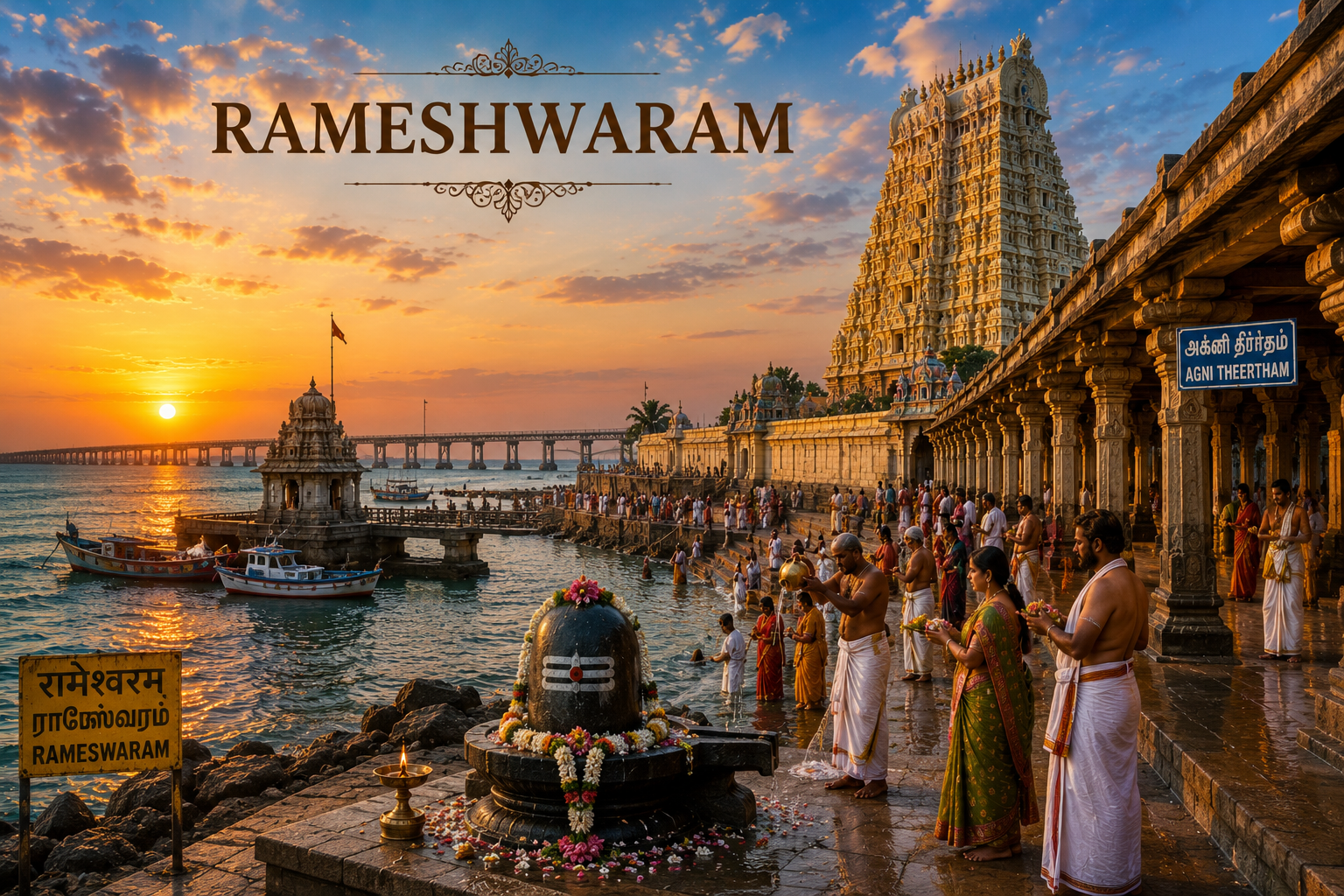
Rising from the turquoise waters of the Gulf of Mannar, the island of Rameshwaram is unlike any other place in India. It is at once a geological wonder, a living chapter of the Ramayana, one of the holiest Jyotirlinga shrines in the Hindu world, and the birthplace of one of modern India’s greatest scientists. For millions of pilgrims, Rameshwaram is the southernmost of the four sacred Char Dhamas — the journey’s end and, spiritually speaking, the beginning of liberation.
To stand at the tip of Dhanushkodi and gaze southeast across the shimmering shoals of Adam’s Bridge is to feel the Ramayana beneath your feet. The stones — some above water, some just beneath — trace the route that Lord Rama’s Vanara army built across fifty kilometres of open sea to reach Lanka and rescue Sita. That this geological formation exists, and that it aligns precisely with the mythological narrative, has kept scholars, devotees, and scientists in animated conversation for centuries.
This in-depth guide takes you through every dimension of Rameshwaram: its geography and geology, its profound Ramayana mythology, the extraordinary architecture of the Ramanathaswamy Temple (including its world-record corridor), the circuit of 22 sacred theerthams, the haunted ruins of Dhanushkodi, the APJ Abdul Kalam connection, and everything a pilgrim needs for a meaningful visit. Whether you come as a devotee, a traveller, or simply a curious mind, Rameshwaram will leave an indelible mark.
Geography: The Island at the Edge of India
Rameshwaram occupies Pamban Island — also known as Rameswaram Island — a slender strip of land measuring roughly 18 kilometres in length and 13 kilometres at its widest point, situated in the Gulf of Mannar at the southeastern tip of the Indian subcontinent. The island belongs to the Ramanathapuram district of Tamil Nadu and sits at the convergence of two great bodies of water: the Bay of Bengal to the northeast and the Indian Ocean to the south.
Pamban Island is separated from mainland India by the Palk Strait, a narrow, shallow channel that can seem almost walkable in places. The connection to the mainland is provided by the Pamban Bridge, built in 1914 and at the time of its construction the longest sea bridge in India. Stretching approximately 2 kilometres across the strait, the Pamban Bridge carries both the railway line and (via a parallel road bridge completed in 1988) motor traffic. The railway crossing is the more dramatic of the two: the train appears to glide across the open sea, with nothing but water visible in every direction for several minutes. It remains one of the most visually stunning railway journeys in all of South Asia, and for many pilgrims the approach by train is itself an act of devotion.
A new cable-stayed Pamban Bridge — billed as India’s first vertical-lift railway sea bridge — is currently under construction alongside the original, promising to extend this iconic crossing into a new era.
From the island’s southern tip at Dhanushkodi, a chain of limestone shoals, sandbanks, and small islands extends approximately 50 kilometres southeast toward Mannar Island in Sri Lanka. This formation — visible from satellite photographs as a broken but unmistakable arc — is known to geologists as Adam’s Bridge and to Hindus as Ram Setu (Rama’s Bridge). It is this structure that connects the living landscape of Tamil Nadu to the narrative world of the Ramayana.
The Ramayana Connection: When Myth and Earth Converge
No account of Rameshwaram can begin anywhere other than the Ramayana. The island’s every stone, well, and shrine is saturated with the narrative of Valmiki’s immortal epic. Understanding the mythological events that are said to have occurred here is not merely background knowledge — it is the lens through which the entire pilgrimage makes sense.
The Building of the Ram Setu
After the demon king Ravana abducted Sita and carried her to his island kingdom of Lanka, Lord Rama — accompanied by his devoted brother Lakshmana and the mighty Vanara (monkey) army led by Sugriva and Hanuman — arrived at the southern tip of the Indian mainland. The sea stood between him and Lanka, fifty kilometres of open water. No boat could carry an army of this magnitude.
The Valmiki Ramayana describes what happened next in extraordinary detail. The divine architect Nala, who had been blessed by his father Vishwakarma with the ability to build structures on water, directed the Vanara army to hurl boulders and trees into the sea. By divine grace, these stones floated rather than sank — the Ramayana’s account specifies that the stones were inscribed with the name of Rama, and it was this act of devotion that made them buoyant. Over five days, the bridge took shape: 100 yojanas long (a yojana being an ancient unit of distance, roughly 12–15 km) and 10 yojanas wide, a causeway of stone and timber that allowed Rama’s army to march across the sea to Lanka.
The geological reality is striking. The Adam’s Bridge shoals are composed of limestone and sand, and geological studies suggest they were once above sea level — connected India to Sri Lanka — until sea levels rose sometime after the last Ice Age. Whether the shoals were a natural land bridge, a human-modified formation, or something else entirely remains genuinely contested in academic and political circles. What is uncontested is that they exist, that they align with the mythological account, and that they have been venerated as Ram Setu for at least two millennia.
The floating stones of the Ram Setu are another enduring wonder. In Rameshwaram, you can see such stones on display at the Ramanathaswamy Temple and at various points on the island — pumice-like rocks that do indeed float on water. Geologists explain this as a property of certain volcanic rock types. Devotees see it as the lingering grace of Rama’s name, still alive in the stone.
Brahmahatya: The Sin Rama Needed to Expiate
After the great battle, Rama killed Ravana — demon king, ruler of Lanka, kidnapper of Sita. The victory was complete and just. But Ravana was not merely a demon. He was also a Brahmin — one of the most learned and accomplished Brahmins of his age, a devotee of Shiva, a master of the Vedas and the Shiva Tandava Stotram. By killing him, Rama — himself an avatar of Vishnu — had incurred the gravest of sins in the Hindu moral universe: Brahmahatya, the sin of killing a Brahmin.
Even an avatar of Vishnu, in his human incarnation, was bound by dharmic law. Rama did not seek to bypass this obligation. Instead, upon returning to the southern tip of India, he resolved to perform an act of penance that would both expiate the sin and leave a permanent mark of devotion on the landscape. He would install a Shivalinga and worship Shiva — the very deity whom Ravana had served — as an act of atonement and reconciliation.
Two Lingas, One Order of Worship: The Story of Hanuman’s Grief and Rama’s Wisdom
This is perhaps the most humanly touching story associated with Rameshwaram, and it explains one of the temple’s most distinctive ritual practices to this day.
Rama decided that the Shivalinga to be installed must come from Kashi (Varanasi) — the holiest of all Shiva shrines — to be properly consecrated. He sent Hanuman on this errand, instructing him to return before the auspicious muhurta (ritual moment) passed. Hanuman, ever tireless and devoted, flew to Kashi. But the journey was long, and the muhurta was approaching.
As the sacred moment neared and Hanuman had not returned, Sita — resourceful, devout, and herself a master of dharmic action — fashioned a Shivalinga from the sand of the seashore with her own hands. Rama installed this sand linga, called the Ramalingam (or Ramanathaswamy linga), at the auspicious moment. The penance was complete; the sin of Brahmahatya was expiated.
Then Hanuman returned, carrying the Kashi linga — a linga brought from the holiest city on earth by the greatest of devotees. His heart broke. He had flown to Kashi and back with perfect devotion, only to find that his effort had been rendered unnecessary. He tried with all his mighty strength to remove the sand linga, intending to replace it with the Kashi linga, but the Ramalingam would not move. Rama had permanently installed it.
Rama looked at his beloved Hanuman’s grief and, with the wisdom of the divine, found a solution that honoured both the sand linga and Hanuman’s devotion. He declared: the Kashi linga — called Kashilingam or Vishwalingam — would be installed beside the Ramalingam in the sanctum. And henceforth, the order of worship would be reversed: pilgrims must first worship the Kashilingam (Hanuman’s linga) before approaching the Ramalingam. Hanuman’s effort, far from being wasted, would be eternally honoured — every devotee who came to Rameshwaram would pay their respects to his linga first.
This custom is maintained to this day in the Ramanathaswamy Temple. In the sanctum, the Kashilingam is worshipped before the Ramalingam. It is a story of divine love, of a god who found a way to make his devotee’s grief into eternal glory.
The Ramanathaswamy Temple: Architecture of Devotion
The Ramanathaswamy Temple is one of the most architecturally magnificent religious structures in India — a claim that, on this subcontinent of extraordinary temples, is not made lightly. It is the principal shrine of Rameshwaram, one of the twelve Jyotirlingas (the most sacred Shiva shrines in Hinduism), and the custodian of the two lingas installed by Rama himself. The temple complex covers an area of approximately 15 acres and is a masterwork of Dravidian temple architecture, built and expanded over many centuries.
The World’s Longest Temple Corridor
The single most famous architectural feature of the Ramanathaswamy Temple is its third corridor — the longest temple corridor in the world. This extraordinary passageway forms a vast rectangle around the innermost sanctum, with the following dimensions:
- East corridor: 197 metres
- West corridor: 197 metres
- North corridor: 133 metres
- South corridor: 133 metres
- Total length: approximately 1,220 metres (over 1.2 kilometres)
The corridor is supported by 1,212 ornately carved pillars, each standing approximately 9 metres (30 feet) high, arranged in colonnades that create a hypnotic visual effect. Walking the length of this corridor — as pilgrims do as part of the ritual circumambulation — is a meditative experience of extraordinary power. The ceiling above is darkened by centuries of lamp smoke; the pillars cast deep shadows in the early morning light; the sound of conch shells and bells reverberates through the stone. Each pillar is unique, carved with figures from Hindu mythology, floral motifs, and geometric patterns in the Nayak style.
The corridor was built primarily during the Nayak period (16th–17th centuries), under the patronage of the Sethupathi kings of Ramnad — the hereditary guardians of the sea crossing (Setu) to Lanka. The Sethupathi ruler Muthu Krishnappa Nayakkar and his successors are credited with much of the corridor’s construction and embellishment.
The Gopurams: Towers That Touch the Sky
The temple is bounded by massive boundary walls and entered through towering gopurams (gateway towers) on all four sides. The eastern gopuram — the principal entrance — soars to a height of 53 metres (174 feet), making it one of the tallest gopurams in Tamil Nadu. Remarkably, this tower was begun in the medieval period but was only completed in 1973, a construction project that spanned centuries. It is densely covered with stucco sculptures of deities, mythological narratives, and celestial figures painted in vivid polychrome — a visual feast that greets every pilgrim on arrival.
The Jyotirlinga and the Sanctum
At the heart of the temple complex lies the Ramanathaswamy sanctum, housing both the Ramalingam (the sand linga fashioned by Sita) and the Kashilingam (Hanuman’s linga from Kashi). The presiding deity is Lord Shiva in the form of Ramanathaswamy — Rama’s Lord. The linga is designated as one of the twelve Jyotirlingas, the self-manifested columns of divine light that mark the most sacred Shiva shrines across India.
The goddess shrine within the complex is dedicated to Parvathavardini Amman (Goddess Parvati as the enhancer of the mountain), worshipped as the divine consort of Ramanathaswamy. The temple also contains shrines to Vishnu (as Sethumadhava), Hanuman, and numerous other deities, making it a complete religious universe within its walls.
The History of the Temple’s Construction
The Ramanathaswamy Temple as it stands today is the product of contributions across many dynasties and many centuries. The earliest recorded structures date to the 12th century, though the site’s sanctity is clearly far older — references to Rameshwaram appear in ancient Tamil Sangam literature and in Sanskrit texts predating the common era.
The great expansion of the temple took place between the 12th and 17th centuries. The Sethupathi kings of Ramnad — who bore the hereditary title of “guardians of the bridge” — were the most prolific builders. Sethupathi Ragunatha (17th century) oversaw major construction of the corridors and gopurams. The Vijayanagara Empire also contributed significantly, particularly in the 15th and 16th centuries when Vijayanagara rulers made grants, built mandapams, and enlarged the complex. Various Tamil chieftains, Pandya rulers, and later Nayak kings added their own contributions, resulting in the layered, organically grown architectural complex visitors see today.
The 22 Sacred Theerthams: A Temple of Waters
Rameshwaram is as much a temple of water as it is a temple of stone. The pilgrimage here involves not merely the worship of the linga in the sanctum, but the ritual bathing in 22 sacred theerthams (holy water sources — wells, tanks, and the sea itself) located within and immediately around the temple complex. This bathing circuit is the defining act of the Rameshwaram pilgrimage.
Agni Theertham: The Sea at the Temple’s Edge
The pilgrimage does not begin inside the temple. It begins in the sea. Agni Theertham — literally “the sacred ford of fire” — is the stretch of beach immediately adjacent to the eastern gopuram where the waters of the Bay of Bengal and the Gulf of Mannar meet. Pilgrims arrive at dawn, descend the steps to the shore, and immerse themselves in the sea before entering the temple complex. This is the first and most externally visible act of purification: the salt water of the confluence is believed to cleanse the body and the accumulated sins of a lifetime.
Before bathing, the pilgrim takes a sankalpa — a formal declaration of intent — stating their name, gotra, and the purpose of their pilgrimage. This sankalpa, witnessed by the sea, binds the pilgrim to the entire 22-theertham circuit.
The Wells Within the Walls
The remaining 21 theerthams are mostly wells sunk within the temple corridors and courtyards, each with its own name, mythological association, and reputed properties. The remarkable claim — made by pilgrims and priests alike — is that despite being situated within a few metres of each other on a small island entirely surrounded by salt water, each well tastes different. Some are sweet, some slightly mineral, some warm to the touch, some cool. Whether this is geological reality, psychological expectation, or a combination of both, the experience of moving from well to well and receiving a potful of water poured over the head by temple priests (for a modest fee) is one of the most distinctive ritual experiences in all of Hindu pilgrimage culture.
Among the named theerthams are the Chakra Theertham, the Brahma Theertham, the Surya Theertham, the Chandra Theertham, and many others, each associated with a specific deity, mythological event, or spiritual quality. Bathing in all 22 is said to cleanse the pilgrim of all sins and confer merit equivalent to bathing in all the sacred rivers of India simultaneously.
Pilgrims typically spend an entire morning completing the theertham circuit — a process that involves moving through the temple corridors in a prescribed sequence, being drenched with potfuls of well water at each stop, and then proceeding to the next. By the time the circuit is complete, the pilgrim is soaked through, exhausted, and — by all accounts — profoundly moved.
Kothandaramaswamy Temple: Where Vibhishana Surrendered
About 12 kilometres from the main Ramanathaswamy Temple, at the southeastern end of the island near Dhanushkodi, stands the Kothandaramaswamy Temple — a shrine of singular Ramayana significance. This is, according to tradition, the exact spot where Vibhishana — Ravana’s righteous younger brother — formally surrendered to Lord Rama and was accepted into his fold.
In the Ramayana, Vibhishana was the voice of dharma within Lanka. He repeatedly counselled Ravana to return Sita and avoid war with Rama. When Ravana refused, Vibhishana — at great personal risk — defected to Rama’s side. His surrender on this shore was a pivotal moment in the epic: Rama, over the initial scepticism of some of his generals, accepted Vibhishana with complete trust and named him the future king of Lanka. It was Vibhishana who then provided Rama with crucial intelligence about Ravana’s army and Lanka’s defences.
The temple enshrines this moment in its iconography: the principal image shows Rama, Lakshmana, and Sita seated in state, with Vibhishana kneeling in surrender before them and Hanuman in attendance. It is a moment of dharmic reconciliation — the acceptance of a repentant soul across the lines of enmity — and it is commemorated here on the shore where it is said to have occurred.
What makes this temple even more remarkable is its survival. In December 1964, a catastrophic cyclone swept over the island and completely destroyed the town of Dhanushkodi. The Kothandaramaswamy Temple, standing in the direct path of the storm, survived intact. Devotees view this as a miracle — the temple protected by the divine grace of Rama himself.
Dhanushkodi: India’s Most Haunting Ghost Town
At the very tip of Pamban Island, where the land narrows to a sandspit barely wide enough for a road, lies Dhanushkodi — one of the most eerie and affecting places in India. It is a ghost town in the most literal sense: a prosperous port town, an important point on the pilgrimage route, once connected by rail and served by a ferry to Sri Lanka, now reduced to ruins that rise from the sand like broken teeth.
On the night of 22–23 December 1964, Cyclone Rameswaram — one of the most powerful tropical cyclones ever to strike the Indian subcontinent — made landfall directly over Dhanushkodi. Waves of up to seven metres crashed over the narrow land. The storm surge swept away nearly everything: houses, the post office, the railway station, the churches, the market. More than 1,800 people died in the town and the surrounding area.
Most devastating of all was the fate of the Pamban–Dhanushkodi passenger train. Train No. 653, the Pamban–Dhanushkodi Express, was crossing the Pamban Bridge with approximately 110 passengers when the cyclone struck. The bridge survived, but the train was swept into the sea between Pamban and Dhanushkodi. All 110 passengers and crew members perished. The wreckage was never fully recovered.
After the cyclone, the Government of India declared Dhanushkodi a ghost town — unfit for habitation. The railway line was never rebuilt. The ruins were left where they fell, slowly being swallowed by sand and sea. Today, a rough road connects Pamban town to Dhanushkodi, passing through a surreal landscape of salt flats and windswept dunes before arriving at the ruined settlement.
Standing at Dhanushkodi, looking southeast across the shallow, turquoise water to where the Adam’s Bridge begins its broken arc toward Sri Lanka, the pilgrim experiences a layered vertigo: the ruins of the 20th century, the geology of the ancient world, the mythology of the eternal. It is a place of tremendous power — for those who find ruins sacred as well as for those who feel the weight of the Ramayana narrative.
APJ Abdul Kalam: The Missile Man from Rameshwaram
Rameshwaram carries a modern story as powerful as its ancient myths. On 15 October 1931, in a modest house in the predominantly Muslim neighbourhood of the island, Avul Pakir Jainulabdeen Abdul Kalam was born. The world would come to know him as Dr. APJ Abdul Kalam — India’s 11th President (2002–2007), the principal architect of India’s ballistic missile programme, and the beloved “Missile Man of India.”
Kalam’s childhood in Rameshwaram was a study in the communal harmony for which the island has long been known. His best friends were Hindu boys from the island. His father, Jainulabdeen, was a devout Muslim who was also deeply respected by his Hindu neighbours; he was friends with the temple priest Pakshi Lakshmana Sastry, and the two men often discussed matters of faith across their religious boundaries. Young Abdul Kalam helped support his family by distributing newspapers — he ran alongside the Pamban Bridge train as it slowed to toss bundles of papers from Madurai.
In his memoir Wings of Fire, Kalam wrote warmly of Rameshwaram, of the sound of the conch shells from the Ramanathaswamy Temple drifting over the island in the mornings, of the sea, of the simplicity and the dignity of life there. He returned to the island repeatedly throughout his life, and after his death on 27 July 2015 (he died of a cardiac arrest while delivering a lecture in Shillong), his body was brought back to Rameshwaram and interred there with full state honours. His memorial — a modest, dignified structure near the Kalam house — draws visitors from across India and the world.
The Kalam story is integral to the modern identity of Rameshwaram. The island that is sacred to Shiva and Rama, that marks the southernmost Char Dhama, is also a place where a Muslim boy who distributed newspapers grew up to lead India into the space age and then to its highest constitutional office. Rameshwaram, in this sense, is a model of what India at its best looks like — plural, respectful, and capable of producing greatness from its most remote corners.
The Adam’s Bridge Controversy: Ram Setu and the Sethusamudram Project
The Adam’s Bridge / Ram Setu is not merely a subject of mythology and geology — it has been at the centre of one of the most heated political and legal controversies in modern India.
The Sethusamudram Shipping Canal Project (SSCP) is a proposed shipping channel that would cut through the Palk Strait and allow vessels to pass between the Bay of Bengal and the Gulf of Mannar without circumnavigating Sri Lanka — a distance saving of approximately 400 nautical miles. The project was approved by the Government of India in 2005 and dredging work began, but it was stopped by the Supreme Court of India following a flood of petitions from Hindu religious organisations, scientists, and environmentalists.
The religious objections are straightforward: the Ram Setu is, for hundreds of millions of Hindus, a sacred structure built by Lord Rama. Dredging it would be an act of desecration comparable to demolishing a temple. The Vishwa Hindu Parishad, the BJP, and numerous Hindu religious leaders demanded that the channel be routed around the shoals rather than through them, at greater cost.
The environmental objections are also substantial. The Adam’s Bridge shoals and the Gulf of Mannar Marine National Park are among the most biodiverse marine ecosystems in the Indian Ocean, home to dugongs, dolphins, sea turtles, coral reefs, and hundreds of species of fish. Scientists argued that dredging would cause irreparable ecological damage.
The Supreme Court case has wound through the courts for nearly two decades. As of 2024, the project remains stalled — neither formally abandoned nor actively pursued. The controversy has become a standing example of the intersection of faith, ecology, and infrastructure in contemporary India, where ancient sacred landscapes must negotiate with the demands of economic development.
Pilgrimage Practicalities: Coming to Rameshwaram
How to Reach Rameshwaram
By Train: The most evocative and strongly recommended approach. Several trains connect Rameshwaram to Madurai (approximately 3–4 hours), Chennai (overnight, about 12–13 hours), and other major cities. The crossing of the Pamban Bridge is a genuine bucket-list railway experience — the train slows as it approaches the bridge, and passengers crowd the windows to watch the sea open up on either side. Major trains include the Rameswaram Express and various superfast services via Madurai.
By Road: The Pamban Road Bridge connects the island to the mainland. Buses ply regularly from Madurai (about 3–4 hours) and other Tamil Nadu towns. Private taxis and self-drive cars are also options. The road approach, while less dramatic than the train crossing, allows more flexibility and allows stops at the many small shrines along the route.
By Air: There is no airport at Rameshwaram. The nearest airports are Madurai Airport (approximately 170 km, about 3.5 hours by road/rail) and Tuticorin Airport (approximately 160 km). From either airport, onward travel is by road or rail.
Temple Customs and Dress Code
The Ramanathaswamy Temple maintains strict dress codes. Men must remove their shirts before entering the inner sanctum — this is a near-universal custom in South Indian temples and is not negotiable. Men typically enter in a dhoti or veshti (the traditional lower garment). Women must wear a saree or salwar with dupatta; short skirts or trousers are not permitted in the inner areas. Shoes must be removed at the temple entrance.
For the theertham circuit, bring a change of clothes — you will be thoroughly drenched. Many pilgrims undertake the circuit early in the morning and then change before entering the main sanctum. Lockers and changing rooms are available in the temple precincts.
Best Time to Visit
The ideal visiting period is October through April, when the weather is relatively cool (25–32°C) and the sea is generally calm. The summer months of May through July bring intense heat, with temperatures regularly exceeding 38°C, and the pilgrimage experience is considerably more physically demanding. The monsoon season (June–September) sees heavy rainfall and rough seas, though the island continues to receive pilgrims year-round.
Major Festivals
Maha Shivaratri (February–March) is the year’s most important festival, drawing lakhs of pilgrims to Rameshwaram. The night vigil, the special abhishekam (ritual bathing of the linga), and the festive atmosphere transform the entire island.
Brahmotsavam in the Tamil month of Aadi (July–August) is the temple’s primary annual festival, lasting ten days and featuring processions of the deities through the streets, classical music and dance performances, and elaborate ritual celebrations. The Thirukalyanam (divine wedding) of Ramanathaswamy and Parvathavardini Amman is performed with great ceremony during this festival.
Thai Amavasai (new moon day in the Tamil month of Thai, January–February) is another significant day when pilgrims come in large numbers to perform ancestor rites (pitru tarpana) at Agni Theertham.
Prasadam and Food
The temple distributes prasadam (consecrated food) daily. The Chidambareswarar prasadam — a sweet rice preparation — is particularly sought after. Rameshwaram town has numerous simple restaurants serving South Indian vegetarian food; being a pilgrimage town, non-vegetarian food is difficult to find near the temple. Seafood is available in Pamban and at some distance from the sacred precincts. The island is famous for its fresh fish, and those visiting for non-religious reasons will find the local catch excellent.
Other Sites to Visit on the Island
Beyond the Ramanathaswamy Temple and Dhanushkodi, the island offers several other sites of interest. The Gandhamadana Parvatham — a small hillock (the highest point on the island at approximately 7 metres, a reflection of the island’s flatness) topped with a shrine containing the footprints of Rama — offers a panoramic view across the island and sea. The Panchamukha Hanuman Temple, dedicated to the five-faced form of Hanuman, is another important shrine. The Villoondi Theertham on the beach, where Rama is said to have created a freshwater source by shooting an arrow into the ground to quench Sita’s thirst, is a serene coastal pilgrimage point.
The broader pilgrimage circuit often connects Rameshwaram with Kanyakumari (approximately 100 km to the southwest) — India’s southernmost tip, where the three seas meet, and where the Vivekananda Rock Memorial commemorates Swami Vivekananda’s meditation in 1892 before his historic address at the Parliament of the World’s Religions in Chicago. Together, Rameshwaram and Kanyakumari form the southern arc of the sacred geography of Tamil Nadu.
Key Takeaways
- Rameshwaram is one of the four Char Dhamas — the sacred pilgrimage circuit that every devout Hindu aspires to complete, placing it among the holiest sites in all of Hinduism.
- The Ramanathaswamy Temple houses one of the twelve Jyotirlingas — the Ramalingam, fashioned from sand by Sita herself and installed by Rama to expiate the sin of killing Ravana (a Brahmin).
- The temple’s third corridor is the longest temple corridor in the world — 1,220 metres total, supported by 1,212 carved pillars approximately 9 metres high, a masterwork of Nayak-period Dravidian architecture.
- Pilgrims must bathe in 22 sacred theerthams — wells within the temple complex each reputed to have different properties — before approaching the main sanctum; the circuit begins at Agni Theertham in the sea.
- The Adam’s Bridge (Ram Setu) — 50 km of shoals and sandbanks between Dhanushkodi and Sri Lanka — corresponds to the mythological bridge built by Rama’s Vanara army and remains geologically remarkable and religiously contested.
- Dhanushkodi was destroyed in the 1964 cyclone, killing 1,800+ people including all 110 passengers of a passenger train; its ruins are now a pilgrimage site in themselves, while the Kothandaramaswamy Temple there survived intact.
- Dr. APJ Abdul Kalam — India’s 11th President and father of its missile programme — was born and buried in Rameshwaram, making the island a symbol of India’s plural heritage and capacity for greatness.
- Best time to visit is October–April; arrive by train over the Pamban Bridge for the most memorable approach; men must remove shirts in the inner sanctum; plan a full day for the theertham circuit and temple darshan.
Frequently Asked Questions
Why is Rameshwaram considered one of the Char Dhamas?
The four Char Dhamas — Badrinath (north), Dwarka (west), Puri (east), and Rameshwaram (south) — form the sacred geographical compass of Hindu India, with each site associated with a different aspect of the divine and a different direction. Rameshwaram is the southern dhama, associated with Lord Rama and the Shaiva tradition. Completing the Char Dham pilgrimage is considered one of the highest meritorious acts available to a Hindu devotee, conferring moksha (liberation). Adi Shankaracharya in the 8th century CE is credited with formalising and reviving this four-dhama circuit as a means of unifying Hindu practice across the subcontinent.
Why must pilgrims worship the Kashilingam before the Ramalingam?
This practice honours Hanuman’s devotion. When Rama sent Hanuman to Kashi to bring a Shivalinga for the atonement ritual, Hanuman arrived late — Sita had already fashioned a sand linga (the Ramalingam) and Rama had installed it. To honour Hanuman’s effort and prevent his grief from being permanent, Rama decreed that the Kashilingam (the linga Hanuman brought from Kashi) would always be worshipped first by every devotee who enters the sanctum. This means that Hanuman’s devotion is honoured by every single pilgrim who visits Rameshwaram — an act of divine love that has been maintained without interruption for centuries.
What is the significance of the 22 theerthams, and must pilgrims bathe in all of them?
The 22 theerthams (sacred water sources) within and around the Ramanathaswamy Temple represent the complete purificatory circuit of the Rameshwaram pilgrimage. Each theertham has its own name, mythological association, and reputed spiritual merit. Bathing in all 22 — beginning with Agni Theertham in the sea — is said to cleanse all accumulated sins and confer merit equivalent to bathing in every sacred river in India. While the complete circuit is the ideal, pilgrims who cannot physically manage all 22 (due to age or health) are generally advised by priests to do as many as they can. The theertham circuit is a morning activity, typically completed before the main temple darshan.
What happened at Dhanushkodi, and can visitors go there now?
Dhanushkodi was a thriving port town at the tip of Pamban Island until the night of 22–23 December 1964, when a severe cyclone sent waves up to 7 metres crashing over the narrow land spit, killing more than 1,800 people and destroying the town entirely — including a passenger train with 110 people aboard. The Government of India declared it uninhabitable, and the town was never rebuilt. Today, visitors can reach Dhanushkodi via a rough road from Pamban, passing through salt flats and dunes to arrive at the haunting ruins. The Kothandaramaswamy Temple there survived the cyclone. The site is now a popular, if sobering, pilgrimage destination — both for its Ramayana associations (Adam’s Bridge begins here) and for the memorial weight of the 1964 disaster.
What is the Sethusamudram project, and why has it been so controversial?
The Sethusamudram Shipping Canal Project (SSCP) proposes to dredge a shipping channel through the Palk Strait — cutting through or around the Adam’s Bridge shoals — to allow vessels to travel between the Bay of Bengal and the Gulf of Mannar without circumnavigating Sri Lanka. The project would save about 400 nautical miles of voyage. It was approved in 2005 but has been stalled since by Supreme Court litigation. The objections are threefold: religious (the Adam’s Bridge / Ram Setu is a sacred structure for Hindus, and dredging it amounts to desecration); ecological (the Gulf of Mannar Marine National Park is a biodiversity hotspot that would be damaged); and scientific (some researchers argue the shoals may genuinely be a human-modified or divinely constructed structure, not merely a natural formation). The controversy remains unresolved as of 2024.
What is the connection between APJ Abdul Kalam and Rameshwaram?
Dr. APJ Abdul Kalam (1931–2015) — India’s 11th President, scientist, and the architect of India’s ballistic missile programme — was born in Rameshwaram into a Muslim family. He grew up on the island, distributed newspapers as a boy, and maintained deep affection for Rameshwaram throughout his life. His childhood friendships with Hindu neighbours and the island’s atmosphere of communal harmony profoundly shaped his humanistic worldview — themes he returned to repeatedly in his writing and speeches. After his death in 2015, he was buried in Rameshwaram with full state honours. His memorial is now a site of pilgrimage for admirers of science, national service, and the idea of a pluralistic India.
Related articles in History & Sacred Places

Complete encyclopaedia guide to all twelve Jyotirlingas — the sacred shrines of Lord Shiva from Somnath to Grishneshwar. Mythology, location, significance, and pilgrimage guide for each of the twelve divine light-pillars.
Sage Jaimini is the founder of the Purva Mimamsa school, honoured for his rigorous inquiry into dharma and the right interpretation of the Vedas.
Bhrigu is a Prajapati and founder of one of the great rishi lineages, linked to Vedic hymns and to traditions of astrology and dharmic reflection.
Comments(0)
Loading comments…