
Somnath Temple: The First Jyotirlinga and its Eternal Story of Destruction, Devotion and Renewal
Somnath Temple — the first of the twelve Jyotirlingas — stands on the shores of the Arabian Sea in Gujarat as one of the most sacred and historically significant shrines in Hinduism. Explore its mythological origins in the penance of Chandra, its seven destructions and reconstructions across the centuries, the famous raids of Mahmud of Ghazni, and the inspiring twentieth-century revival championed by Sardar Vallabhbhai Patel. A comprehensive pilgrimage guide for one of India’s most resilient and
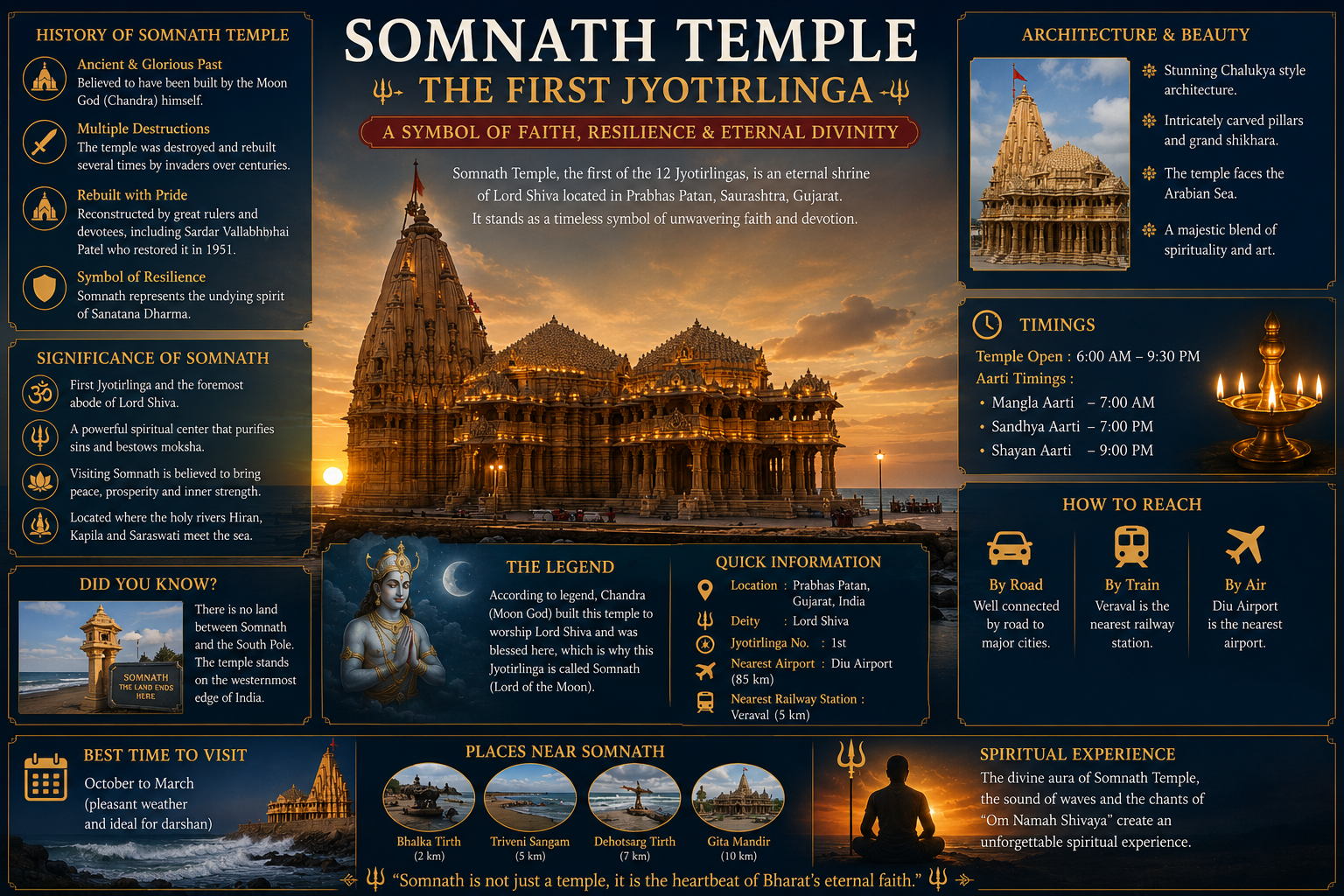
Rising majestically from the western shores of the Indian subcontinent, where the sacred waters of the Arabian Sea merge with the ancient land of Saurashtra, stands the Somnath Temple — one of the most revered, resilient, and historically significant shrines in all of Hinduism. Dedicated to Lord Shiva in his form as the first of the twelve Jyotirlingas, Somnath is not merely a temple; it is a living monument to the unbreakable spirit of Dharma, the endurance of devotion, and the eternal truth that the divine cannot be extinguished by the force of any earthly power.
The name “Somnath” is itself a theological declaration — it means “Lord of the Moon” or “Protector of Soma,” a title given to Lord Shiva when he restored the waning Moon God, Chandra, from a divine curse. This sacred etymology connects the temple to the very foundations of Vedic cosmology, linking lunar cycles, divine grace, and the sovereign power of Shiva in a single, resonant name. The temple stands at Prabhas Patan, near Veraval in the Saurashtra region of Gujarat, at a precise point where ancient texts describe the confluence of three sacred rivers — the Hiran, the Kapila, and the Saraswati — before they meet the ocean.
For thousands of years, pilgrims have walked across deserts and mountains, crossed rivers and seas, to stand before this Jyotirlinga — the luminous, self-manifested lingam of Shiva — and offer their prayers. The Somnath Temple has been destroyed and rebuilt at least seven times across its known history, each cycle of devastation followed by an act of renewal that speaks volumes about the devotion of the Hindu people. Its most famous reconstruction in the twentieth century, championed by Sardar Vallabhbhai Patel immediately after Indian independence, transformed Somnath into a symbol not only of religious faith but of national identity and civilisational pride.
This post explores the full depth of Somnath’s story — from its mythological origins in the Puranas, through centuries of invasions and reconstructions, to its enduring place as a beacon of pilgrimage and spiritual aspiration in the modern age.
Mythological Origins: The Penance of Chandra
The mythology surrounding Somnath reaches back to the Puranic age, to a cosmic drama involving the Moon God Chandra (Soma), the divine sage Daksha Prajapati, and the supreme grace of Lord Shiva. According to the Shiva Purana, the Skanda Purana, and the Bhagavata Purana, this story explains both the waxing and waning of the moon and the founding of one of the holiest sites in the Hindu world.
Daksha Prajapati, one of the progenitor-sages of creation, had twenty-seven daughters, each representing one of the twenty-seven Nakshatras — the lunar mansions that mark the moon’s path across the night sky. He gave all twenty-seven in marriage to Chandra, the Moon God. However, Chandra was particularly devoted to Rohini, the most beautiful and beloved of the sisters, and neglected the others. The rejected wives complained bitterly to their father Daksha, who summoned Chandra and repeatedly warned him to treat all his wives equally. When Chandra refused to change his ways, Daksha pronounced a terrible curse: Chandra would suffer from Kshaya — a progressive wasting away — and his light would diminish day by day until he was extinguished entirely.
The curse took effect immediately, and the Moon began to wane. As Chandra’s light faded, the entire world was plunged into crisis — crops failed, herbs lost their potency, the tides went wrong, and the oceans themselves trembled. The gods, distressed by the cosmic imbalance, approached Brahma the Creator and beseeched him for a solution. Brahma advised Chandra to perform penance at the sacred site of Prabhasa Kshetra on the western coast, worshipping Lord Shiva with absolute devotion, through the recitation of the Maha Mrityunjaya Mantra — the great mantra of liberation from death and decay.
Chandra undertook a severe tapasya — ascetic practice — for six months at Prabhasa. He chanted the Maha Mrityunjaya Mantra ten million times, fasting and meditating without rest, completely surrendering his ego and his sorrow at the feet of Mahadeva. Moved by such extraordinary devotion, Lord Shiva appeared before Chandra and, while he could not fully annul Daksha’s curse (for a patriarch’s curse carries cosmic weight), he modified it. Chandra would not be extinguished — rather, he would wax for fifteen days (Shukla Paksha, the bright fortnight) and wane for fifteen days (Krishna Paksha, the dark fortnight), in an eternal cycle. This is why the moon has its phases, according to the Puranic understanding.
In gratitude, Chandra is said to have constructed a magnificent temple at the site of his penance and installed the Shivalinga that Shiva himself had blessed. Because Chandra (Soma) had been restored by the “Natha” (Lord), the presiding deity and the sacred place became known as Somnath — the Lord who is the protector and restorer of Soma. The Prabhasa Kshetra, already considered sacred in the Vedic tradition, thus became doubly holy — both as the place where the Sarasvati River meets the sea and as the site of Chandra’s redemption.
The Puranas speak of Somnath’s antiquity in superlative terms. The Skanda Purana describes the Prabhasa Kshetra as one of the most sacred tirtha-kshetras (pilgrimage sites) in all creation, a place where the sins of countless lifetimes are dissolved by a single bath at the Triveni Sangam (confluence of the three sacred rivers). The Mahabharata also mentions Prabhasa in connection with events from the lives of the Yadavas, and it is at Prabhasa that Lord Krishna is said to have departed from his mortal form after being accidentally struck by a hunter’s arrow.
The Seven Reconstructions: A Temple That Refused to Die
One of the most remarkable facts about the Somnath Temple is that according to traditional accounts and historical records, it has been destroyed and rebuilt at least seven times. This cycle of destruction and reconstruction has become central to the temple’s symbolic identity — Somnath represents the indestructibility of faith itself, the truth that sacred consciousness, once established in a place and in the hearts of devotees, cannot be permanently erased by violence or conquest.
The earliest temple is described in ancient texts as having been built by Chandra himself, using gold. Later, the Sun God Surya is said to have rebuilt it in silver, followed by the great hero Ravana who rebuilt it in sandalwood (according to some Puranic accounts), and then Krishna who is said to have rebuilt it in stone. These accounts represent the mythological pre-history of the site. The historical record becomes clearer in the early centuries of the Common Era.
The first historically documented temple is believed to have been a grand structure built around the sixth or seventh century CE, possibly by the Maitraka dynasty that ruled Saurashtra at that time. Contemporary inscriptions and accounts from foreign travellers describe Somnath at this period as a temple of extraordinary wealth and grandeur — the richest and most famous temple in all of India, drawing pilgrims and merchants from across the known world. Al-Biruni, the Islamic scholar and traveller who came to India with Mahmud of Ghazni, described Somnath as having such legendary status that pilgrims came to it from as far as China, Central Asia, and Africa.
The temple that stood on the eve of Mahmud of Ghazni’s raids in the eleventh century was reportedly of immense scale — with a thousand Brahmin priests who performed the daily rituals, hundreds of dancing girls dedicated to temple service, a large community of attendants and administrators, and a treasury of incomprehensible wealth accumulated over centuries of royal patronage and pilgrims’ offerings. This was the temple that became the most famous target of Mahmud’s campaigns of plunder.
After the devastations of the medieval period, the temple was reconstructed multiple times by Hindu kings who refused to abandon the sacred site. The Solanki (Chaulukya) kings of Gujarat were particularly associated with temple-building and patronage in this region. Kumarpal, the great Solanki king of the twelfth century who was a devout Jain but also patronised Hindu temples, is credited with significant reconstruction work at Somnath. Later rulers of Saurashtra and Gujarat continued this tradition of restoration.
By the time of the Mughal emperor Aurangzeb in the seventeenth century, Somnath faced yet another episode of destruction. Aurangzeb’s orders for the demolition of Hindu temples extended to Somnath, and the shrine was damaged once more. Yet each time, the community of devotees around the site maintained the worship, even when the grand structure was no longer standing. A modest shrine, or even an open-air sacred space, preserved the continuity of ritual — because for devotees, the Jyotirlinga was eternal and did not depend on any man-made structure for its sanctity.
Mahmud of Ghazni: The Raids That Shook a Civilisation
No account of Somnath can avoid the shadow of Mahmud of Ghazni, the Turkic sultan from Afghanistan whose raids on the Indian subcontinent between 997 and 1030 CE became among the most consequential military events in the subcontinent’s medieval history. Mahmud conducted seventeen raids into northern India, motivated by a combination of religious iconoclasm, the desire for immense wealth, and the political ambition to establish himself as the supreme champion of his faith in the Islamic world.
The raid on Somnath in January 1026 CE was the most audacious and famous of all Mahmud’s campaigns. Having heard of the extraordinary wealth of Somnath — reputedly the richest temple in the world — Mahmud set out from Ghazni with an army of some fifty thousand soldiers, crossing the Sindh desert in the depths of winter to reach the Gujarat coast. The journey was extraordinarily difficult; the army suffered from heat and thirst in the Thar desert and attacked several smaller towns and temples along the way.
The Hindu kings of the region attempted to resist. The Paramara king Bhoj of Malwa and the Solanki king of Gujarat are said to have sent armies to defend the temple, and local chiefs mounted fierce resistance. According to the Persian chronicles that form our primary sources for this event, tens of thousands of defenders — including many pilgrims who had come to worship and took up arms to protect the shrine — fell in the battles around the temple. The accounts are certainly exaggerated in typical medieval fashion, but the scale of violence and resistance was evidently enormous.
Mahmud entered the temple, which was reportedly so rich that its treasury contained enough gold and jewels to fill multiple camel trains. He reportedly shattered the Shivalinga himself, in a dramatic act of iconoclasm that was carefully recorded by his court chronicler Utbi and later celebrated in Persian poetry as a great triumph of faith over idolatry. The temple’s riches — estimated by contemporary accounts as staggeringly vast — were carried back to Ghazni, where they helped fund the construction of Mahmud’s great mosque.
The political and cultural impact of the Somnath raid was enormous and long-lasting. For the Hindu world, it represented a traumatic rupture — the violation of one of the holiest shrines of the tradition. Yet remarkably, within a generation, Hindu rulers had begun to rebuild the temple. The Paramara king Bhoj, who had tried to defend Somnath, is credited with sponsoring its reconstruction shortly after Mahmud’s death in 1030 CE. Later, the Solanki rulers of Gujarat — particularly the great king Kumarpal in the twelfth century — undertook extensive reconstruction and renovation of the temple.
It is important to approach the history of this period with scholarly care. While the destruction was unquestionably real and traumatic, some later colonial-era British historians — notably James Mill and his followers — used the story of Somnath to construct a particular narrative of Hindu helplessness and Muslim aggression that served British imperial interests by emphasising religious conflict in Indian history. A more nuanced reading acknowledges the genuine violence of Mahmud’s campaigns while also recognising the agency and resilience of the Hindu response — the repeated reconstructions, the enduring pilgrimage traditions, and the theological understanding that the sacred power of a Jyotirlinga transcends any physical structure.
The Temple Through Medieval History
After Mahmud’s raid, the history of Somnath continued to be one of alternating patronage and destruction, but also of remarkable continuity in devotional life. The Chaulukya (Solanki) dynasty of Gujarat, which reached its peak of power in the eleventh and twelfth centuries, was an important patron of temple culture in Saurashtra. Under kings like Jayasimha Siddharaja and Kumarpal, Gujarat experienced a cultural renaissance, and Somnath received significant royal support.
The twelfth-century rebuilding of Somnath was done in the Chaulukya style of temple architecture — characterised by intricate stone carvings, towering shikharas (spires), and elaborate mandapas (pillared halls). The craftsmen of Gujarat had developed one of the most sophisticated stone-carving traditions in all of India, and their work at temples like Modhera, Girnar, and Somnath represented the pinnacle of the Maru-Gurjara architectural style.
The thirteenth and fourteenth centuries brought further upheavals. The Delhi Sultanate extended its power into Gujarat, and Sultan Alauddin Khalji’s forces attacked Somnath in the early fourteenth century, causing further damage to the temple. Under Muzaffar Shah I of the Gujarat Sultanate in the early fifteenth century, the temple was reportedly attacked once more. Each time, the devout rebuilt and restored what they could.
Throughout all these troubles, the Prabhasa Kshetra never lost its sanctity in the minds of devotees. Pilgrimage continued even when no grand temple stood, because the Jyotirlinga — understood as the cosmic pillar of light that pierces through all three worlds — does not require a human-built structure to be present. The sacred geography of Prabhasa, with its confluence of rivers, its ocean shore, and its ancient associations, continued to draw the devout from all over India.
By the time of the Mughal period, the temple was in a state that fluctuated between ruin and partial restoration depending on the local political situation. Akbar’s tolerant religious policies allowed some Hindu religious activities to be maintained more freely, but under Aurangzeb’s reign in the late seventeenth century, the temple faced another severe blow. Aurangzeb’s 1665 directive ordering the destruction of temples extended to Somnath, and the structure was significantly damaged. The Marathas, who came to power in western India in the eighteenth century, were significant patrons of Hindu temples and took an interest in Somnath’s restoration. Ahilya Bai Holkar, the legendary Maratha queen of Indore, who was famous for her temple-building and restoration work across India, is credited with building a small but significant temple adjacent to the ruins of the original Somnath, around 1783. This Ahilya Bai temple remained the primary site of active worship at Prabhasa for over a century and a half, until the great twentieth-century reconstruction.
The Colonial Era and the Debate Around Somnath
The colonial period brought Somnath into a new kind of prominence — as a site of cultural and political debate. British officials, scholars, and administrators grappled with the temple’s history in ways that were often coloured by their own imperial agendas. The most famous colonial intervention at Somnath involved the so-called “Gates of Somnath” controversy.
In 1842, the British Governor-General Lord Ellenborough issued a sensational proclamation declaring that the sandal-wood gates from the tomb of Mahmud of Ghazni at Ghazni in Afghanistan — which Ellenborough claimed were the original gates looted from Somnath in 1026 — would be restored to India as a gesture of redemption. The proclamation was intended to rally Indian public opinion behind the First Anglo-Afghan War, which had gone badly for the British. However, the entire episode quickly became an embarrassment: the gates proved to be of Egyptian workmanship and clearly not from any Indian temple. More significantly, Indian opinion — including many Hindu leaders — did not particularly welcome the British gesture, seeing it as a crass use of religion for political ends. The episode revealed more about British assumptions about Hindu sentiments than about the actual devotional life around Somnath.
Throughout the nineteenth and early twentieth centuries, the movement for Indian independence brought renewed cultural interest in the great monuments of Hindu civilisation. Somnath, with its story of repeated destruction and reconstruction, became a powerful metaphor for the Indian civilisational experience under colonial rule — battered but unbroken, despoiled but never truly defeated. Nationalist leaders and cultural figures began to speak of Somnath as a symbol of India’s civilisational resilience and the need for self-determination.
Reconstruction by Sardar Patel: A Temple for Independent India
The most significant event in the modern history of Somnath came in the immediate aftermath of Indian independence. On November 13, 1947 — just three months after independence — Sardar Vallabhbhai Patel, then India’s Deputy Prime Minister and Home Minister, visited the ruins at Prabhasa Patan and made a solemn resolve: the Somnath Temple would be rebuilt as a symbol of free India’s pride in its civilisational heritage.
Sardar Patel’s decision was both deeply personal and profoundly political. He was a proud Gujarati who had grown up knowing the story of Somnath, and he saw the rebuilding of the temple as an act of civilisational restoration — a declaration that independent India would honour and revive the traditions and monuments that centuries of foreign rule had damaged or suppressed. He declared that the reconstruction of Somnath would be the first act of the new Indian government in honouring the country’s cultural heritage.
However, the project was not without controversy. Prime Minister Jawaharlal Nehru had a different vision of India’s secular character and was uncomfortable with a government-sponsored temple reconstruction. He wrote to Patel expressing his concern that involving the government in temple-building would compromise the secular credentials of the new state. Patel’s response was characteristically blunt: he distinguished between the government spending public money on the temple (which he agreed should not happen) and individual citizens — including government ministers acting in their personal capacity — contributing to and championing the reconstruction (which he saw as entirely appropriate).
The reconstruction was accordingly funded by public donations rather than government money, and the managing trust was set up as an independent body. K. M. Munshi, a distinguished Gujarati author, lawyer, and politician who served in Nehru’s cabinet, became the driving force behind the project as the head of the Somnath Trust. Munshi worked tirelessly for years to see the project through, navigating administrative obstacles, raising funds from across India and the diaspora, and supervising the architectural and religious aspects of the reconstruction.
The newly rebuilt temple was designed by the architect Prabhashankarbhai Oghadabhai Sompura, a member of the famous Sompura family of temple architects — a hereditary community that has been designing and building Hindu temples for over a thousand years. The Sompuras are considered the foremost traditional architects of the Nagara style of Hindu temple architecture, and their involvement gave the Somnath reconstruction both technical excellence and cultural authenticity.
Construction began in 1950, and the temple was largely completed by 1951. On May 11, 1951, the first President of India, Dr. Rajendra Prasad, performed the consecration ceremony — the Pratishtha — installing the Jyotirlinga in the newly completed garbhagriha (inner sanctum). This was an act of immense symbolic significance: the head of the secular Indian state presiding over the consecration of a Hindu temple, honouring the ancient tradition while affirming that independent India celebrated rather than suppressed its civilisational heritage.
Sardar Patel had died in December 1950 and did not live to see the consecration, but his vision had been fulfilled. K. M. Munshi, who was present, later wrote movingly about the day, saying that he felt the spirit of all those who had died defending and rebuilding Somnath over the centuries was present in that moment of consecration.
Architecture and Layout of the Current Temple
The current Somnath Temple is a masterpiece of the Chaulukya (also known as Solanki or Maru-Gurjara) style of Hindu temple architecture, designed to evoke the grandeur of the medieval temples that once stood on this site while meeting the needs of modern pilgrims. The temple complex sits on a raised platform directly facing the Arabian Sea, and the views from the temple compound — with the ocean stretching to the horizon and the surf crashing on the rocks below — are among the most dramatic in any pilgrimage site in India.
The main temple tower (shikhara) rises to a height of approximately 155 feet (47 metres) and is constructed in the Nagara style — characterised by its curvilinear form that tapers to a point at the top, crowned by the amalaka (a ribbed stone disc) and the kalasha (a metal finial). The shikhara is richly ornamented with carved stonework, including bands of floral motifs, geometric patterns, and figures of deities and celestial beings. The overall effect is one of upward aspiration — the tower seems to reach from the earth toward the sky, embodying the cosmic axis (Axis Mundi) that the Jyotirlinga symbolises.
The temple is built in Chunnaar sandstone, a fine-grained stone that allows for intricate carving. The main mandapa (assembly hall) is a large, pillared space where pilgrims gather for darshan (the sacred seeing of the deity) and for the performance of rituals. The columns of the mandapa are decorated with carvings of apsaras (celestial nymphs), gods, mythological scenes, and ornamental motifs in the finest tradition of western Indian temple craft.
The garbhagriha (womb chamber), the innermost sanctum of the temple, houses the Jyotirlinga — the sacred lingam that represents Shiva’s infinite, self-luminous nature. The garbhagriha is deliberately small and dark, lit primarily by the oil lamps and the glow of the deity’s ornaments, creating an atmosphere of intense, focussed devotion. Access to the garbhagriha is carefully managed to ensure that pilgrims can have meaningful darshan while the sanctity of the inner space is maintained.
One of the notable features of the Somnath Temple complex is the famous “Arrow Pillar” (Baan Stambha) — an ancient monument near the sea that bears an inscription proclaiming that from this point, the next landmass in the southward direction across the ocean is the South Pole itself, with no land in between. This inscription speaks to the ancient Indian understanding of world geography and the sense that Somnath stands at the very edge of the known world, a place where the human meets the infinite.
The temple complex also includes several subsidiary shrines dedicated to other deities associated with Shiva — including Parvati, Ganesha, Nandi (the divine bull, Shiva’s vehicle), Hanuman, and the Navagrahas (the nine planetary deities). There are also shrines to local and regional deities who are associated with the Prabhasa Kshetra. A large dharamsala (rest-house complex) and facilities for pilgrims have been developed around the main temple.
Adjacent to the main Somnath Temple stands the older Ahilya Bai Temple — the eighteenth-century structure built by the Maratha queen Ahilya Bai Holkar that served as the primary shrine during the long period before the twentieth-century reconstruction. This temple is now maintained as a heritage site and continues to be a place of worship in its own right, connecting the modern pilgrimage experience to the unbroken chain of devotion that ran through even the darkest periods of the temple’s history.
The Jyotirlinga: Significance and Theology
To understand Somnath fully, one must understand the concept of the Jyotirlinga — for it is this that gives the temple its supreme status in Shaiva theology and its unique place in the Hindu pilgrimage tradition. The word “Jyotirlinga” means the “lingam of light” or the “luminous lingam,” and it refers to the form in which Shiva is said to have originally manifested himself as a pillar of infinite light that pierced through all the layers of the cosmos, without beginning and without end.
The Puranic story of the Jyotirlinga begins with a cosmic dispute between Brahma the Creator and Vishnu the Preserver, each of whom claimed to be the supreme deity. To resolve their quarrel, Shiva manifested as a blazing column of fire — stretching infinitely in both directions through the cosmos. Brahma flew upward as a swan to find the top of the column; Vishnu dug downward as a boar to find its base. Neither could find the beginning or the end. Shiva thus revealed himself as Anadi (without beginning) and Ananta (without end) — the supreme reality that underlies and transcends all creation.
From this primal manifestation of Shiva as infinite light, the twelve Jyotirlingas emerged at specific sacred sites across India, each representing a unique aspect of Shiva’s divine nature. Somnath, as the first of the twelve Jyotirlingas, holds a position of especial honour. The Shiva Purana lists all twelve and states that a pilgrimage to all twelve Jyotirlingas liberates the devotee from the cycle of birth and death — and indeed, the circuit of the twelve Jyotirlingas is one of the most sacred and sought-after pilgrimages in the Hindu tradition.
The twelve Jyotirlingas, in the traditional order, are: Somnath (Gujarat), Mallikarjuna (Andhra Pradesh), Mahakaleshwar (Madhya Pradesh), Omkareshwar (Madhya Pradesh), Kedarnath (Uttarakhand), Bhimashankar (Maharashtra), Vishwanath (Varanasi, Uttar Pradesh), Tryambakeshwar (Maharashtra), Vaidyanath (Jharkhand), Nagesh (Gujarat or Maharashtra, depending on the tradition), Rameshwaram (Tamil Nadu), and Grishneshwar (Maharashtra).
The Jyotirlinga at Somnath is known as “Somanath” or “Someshwara” — the Lord of the Moon, reflecting the site’s mythological connection to the penance of Chandra. The lingam in the garbhagriha is understood by devotees not as a human-made sculpture but as a swayambhu (self-manifested) lingam — a natural form that arose from the earth by divine will, not by human hands. Even though the physical lingam has been replaced multiple times through the temple’s turbulent history, the sacred presence — the Jyotis, the divine light — is understood to be eternal and uninterrupted.
Pilgrimage Guide: Visiting Somnath Today
For the modern pilgrim, a visit to Somnath is both a profoundly moving spiritual experience and a richly rewarding journey into one of the most historically layered sites in all of India. The temple is located at Prabhas Patan, near the town of Veraval in the Gir Somnath district of Gujarat, on the southwestern coast of the Saurashtra peninsula.
How to Reach Somnath
The nearest major airport is at Keshod (approximately 55 kilometres away) or Diu (approximately 95 kilometres). The nearest major railway junction is Veraval (approximately 6 kilometres from the temple), which is connected to Ahmedabad, Rajkot, Junagadh, and other major cities in Gujarat. Regular bus services connect Somnath to Ahmedabad, Rajkot, Junagadh, and Porbandar. The nearest major city is Junagadh, approximately 85 kilometres away.
Temple Timings and Darshan
The temple is open to pilgrims throughout the day, with darshan available from approximately 6:00 AM to 9:30 PM, with breaks for the major aarti (ritual lamp-waving) ceremonies. There are three major aartis each day: the Mangala Aarti at dawn (around 7:00 AM), the Madhyahna Aarti at noon, and the Sandhya Aarti at sunset, which is particularly spectacular — as the sun sets over the Arabian Sea and the temple is lit by hundreds of lamps, the atmosphere becomes truly transcendent. The evening aarti is one of the most beautiful religious experiences that any Hindu pilgrimage site in India can offer. Additionally, a magnificent Sound and Light Show (Jai Somnath Light and Sound Show) is held in the evenings, narrating the temple’s history against the backdrop of the illuminated temple — an experience not to be missed.
Nearby Sacred Sites
Somnath is embedded in the sacred geography of the Prabhasa Kshetra, and a complete pilgrimage involves visiting several associated sites. The Triveni Sangam — the confluence of the Hiran, Kapila, and Saraswati rivers at the sea — is considered highly auspicious, and pilgrims traditionally take a purifying bath here before entering the main temple. The Bhalka Tirth, about 4 kilometres from Somnath, is the sacred spot where Lord Krishna received the arrow wound from the hunter Jara that ended his earthly life — a site of immense poignancy for Vaishnavas and Shaivas alike. The Geeta Mandir and the Lakshmi Narayan Temple nearby offer additional opportunities for darshan and meditation. The Gir Forest National Park, home to the last Asiatic lions in the world, is approximately 40 kilometres away and makes for a memorable combination of pilgrimage and wildlife encounter.
Spiritual Significance and the Enduring Legacy of Somnath
The spiritual significance of Somnath operates on multiple levels simultaneously — cosmological, mythological, historical, and deeply personal. At the cosmological level, Somnath as the first Jyotirlinga represents the primacy of divine light — the truth that at the foundation of all creation is a luminous consciousness that has no beginning and no end, and that all of existence arises from and returns to this light. Worshipping Shiva at Somnath is thus understood as an act of aligning oneself with the deepest reality of existence.
At the mythological level, the story of Chandra’s penance at Prabhasa carries a teaching of profound psychological and spiritual relevance. Chandra’s affliction — the progressive wasting of his light — represents the condition of any soul that has fallen into excessive attachment (his obsessive favouritism of Rohini), neglected its broader responsibilities, and as a result attracted the consequences of its own imbalance. The remedy is not protest or retaliation but rather complete surrender to the Supreme — the offering of oneself entirely through devotion, prayer, and austerity. And the divine response is not a complete annulment of consequences (karma must work itself out) but a compassionate modification that transforms destruction into a cycle of renewal. The waxing and waning of the moon thus becomes a teaching about the rhythms of spiritual life — periods of light and darkness that are part of a larger, ultimately redemptive pattern.
At the historical level, Somnath carries the weight of centuries of civilisational experience. It has stood at the intersection of prosperity and violence, faith and aggression, loss and renewal, in a way that no other single site in India quite matches. For Hindus, visiting Somnath is to walk through the full arc of the tradition’s story — to feel the grief of desecration and the joy of restoration, to understand that the faith has endured not by avoiding suffering but by meeting it with an inexhaustible capacity for renewal. Somnath teaches that sacred spaces, once established in the heart of a living tradition, cannot be permanently destroyed — because what makes them sacred is not stone and gold but the unceasing devotion of the human spirit.
At the personal level, countless pilgrims have experienced transformative moments at Somnath — healings, visions, the resolution of long-standing sorrows, and the simple, overwhelming peace of standing before a deity who has been worshipped for thousands of years by millions of devoted souls. The accumulated devotion of millennia seems to lend Somnath an almost palpable spiritual atmosphere, a quality of presence that even first-time visitors often describe as immediately perceptible.
The Somnath Temple Trust, which manages the temple today, has worked diligently to maintain the highest standards of traditional worship while also developing the pilgrimage infrastructure to serve the millions of visitors who come each year. The trust has invested in restoration of the temple complex, development of pilgrimage facilities, research into the temple’s history, and education about its significance. Under the guidance of traditional scholars and priests, the rituals at Somnath follow the Shaiva Agamic tradition — the ancient scriptural guidelines for temple worship that have been transmitted continuously for thousands of years.
Somnath was also visited by Mahatma Gandhi in 1947 during his pilgrimage to Saurashtra, and by countless other national leaders who saw in it a symbol of India’s civilisational continuity. In recent decades, the temple has received renewed attention and investment as part of broader efforts to develop Gujarat’s religious tourism and to honour the cultural heritage of the region. Major infrastructure improvements — including road access, accommodation facilities, lighting, and sound systems — have made the pilgrimage experience more accessible without diminishing its spiritual depth.
The story of Somnath ultimately converges on a single, luminous truth that the Shaiva tradition has always proclaimed: Shiva is Mahadeva — the Great God, the God of gods — whose nature is pure, infinite, self-luminous consciousness. No force in creation can extinguish that light. The Jyotirlinga at Somnath is a window into that eternal reality, and every pilgrim who stands before it, however briefly, touches something of that eternal truth. In this sense, Somnath is not merely a historical monument or a religious institution — it is a living encounter with the divine, renewed in every moment by the devotion of every pilgrim who makes the journey to the shores of Prabhasa and calls out, from the depths of the heart: “Om Namah Shivaya.”
Key Takeaways
- Somnath is the first and most sacred of the twelve Jyotirlingas — self-manifested lingams of Lord Shiva — and is located at Prabhasa Patan on the Arabian Sea coast of Gujarat, at the confluence of three sacred rivers.
- The temple’s mythological origin traces to the penance of Chandra (the Moon God), who worshipped Shiva here to be released from a devastating curse, giving the site its name — Somnath, “Lord of the Moon.”
- Somnath has been destroyed and rebuilt at least seven times across its known history, most famously by Mahmud of Ghazni in 1026 CE, yet each destruction was followed by reconstruction — making it an enduring symbol of civilisational resilience and the indestructibility of faith.
- The modern temple was reconstructed after Indian independence under the leadership of Sardar Vallabhbhai Patel and K. M. Munshi, consecrated by President Rajendra Prasad in 1951 — a landmark moment in India’s cultural renewal as a sovereign nation.
- The Prabhasa Kshetra surrounding the temple is also sacred as the site where Lord Krishna ended his earthly sojourn, making Somnath a pilgrimage destination of significance for both Shaivas and Vaishnavas.
- Visiting all twelve Jyotirlingas, with Somnath at the head of the list, is one of the most spiritually meritorious pilgrimages in the Hindu tradition, said to confer liberation from the cycle of birth and rebirth.
Frequently Asked Questions
Why is Somnath considered the most important of the twelve Jyotirlingas?
Somnath is traditionally listed as the first of the twelve Jyotirlingas, giving it a position of precedence in Shaiva sacred geography. The Shiva Purana and other texts describe Prabhasa Kshetra as an exceptionally potent pilgrimage site even before the Jyotirlinga mythology, and the story of Chandra’s penance and redemption here adds a layer of Puranic significance that makes Somnath uniquely resonant. Additionally, Somnath’s long and dramatic history — of extraordinary patronage, devastating destruction, and repeated renewal — has given it a symbolic weight that transcends its strictly theological ranking.
How many times was the Somnath Temple destroyed and rebuilt?
Traditional accounts speak of seven major destructions and reconstructions, though the number and exact sequence are difficult to verify historically for the earliest periods. The most historically documented destructions include the raid by Mahmud of Ghazni in 1026 CE, attacks by the Delhi Sultanate in the thirteenth and fourteenth centuries, and damage under Aurangzeb in the seventeenth century. Each destruction was followed by reconstruction under the patronage of Hindu rulers, and the most recent and grandest reconstruction was completed in 1951 under the auspices of the Somnath Trust.
What is the connection between Somnath and Lord Krishna?
The Prabhasa Kshetra, where Somnath is located, is deeply associated with the end of Lord Krishna’s earthly life. According to the Mahabharata and the Bhagavata Purana, after the destruction of the Yadava clan in a fratricidal conflict at Prabhasa, Krishna withdrew into meditation in a forest nearby. A hunter named Jara, mistaking Krishna’s foot for a deer, accidentally shot him with an arrow. Krishna accepted this as the working out of an ancient karma and departed from his mortal body at Bhalka Tirth, a site approximately 4 kilometres from the main Somnath temple. This connection makes Somnath a place of pilgrimage for Vaishnavas as well as Shaivas.
Is the current Somnath Temple the original ancient temple?
The current structure dates to the 1950s reconstruction and is not the same physical building as any of the ancient temples. However, the sacred site itself — the Prabhasa Kshetra and the specific location of the Jyotirlinga — has been continuous throughout. In Hindu theological understanding, the sacred power of a Jyotirlinga is eternal and independent of any man-made structure; the rebuilding of the temple restores the physical vessel through which devotees access the divine presence that has never truly left the site. The current temple was designed in the traditional Chaulukya architectural style to honour the medieval tradition of temple building at Somnath.
What is the best time of year to visit Somnath?
The most comfortable time to visit Somnath is between October and March, when the weather in coastal Gujarat is mild and pleasant — daytime temperatures are in the range of 20–30°C and the ocean breeze makes even warm days bearable. The monsoon season (June to September) brings heavy rainfall and rough seas, which can be dramatic but may disrupt travel. The peak festival periods — Mahashivaratri (usually in February or March) and Kartik Purnima (the full moon of the month of Kartika, usually in November, which is particularly sacred at Somnath) — attract enormous numbers of pilgrims and offer the most intense devotional experience, though accommodation should be arranged well in advance.
What is the Maha Mrityunjaya Mantra and why is it important at Somnath?
The Maha Mrityunjaya Mantra — “Om Tryambakam Yajamahe Sugandhim Pushtivardhanam, Urvarukamiva Bandhanan Mrityor Mukshiya Maamritat” — is one of the most powerful mantras in the Vedic tradition, addressed to Shiva in his form as the three-eyed lord who conquers death. It is the mantra that Chandra recited during his penance at Prabhasa, and through which he obtained Shiva’s grace and was restored from his curse of wasting away. The mantra is understood to liberate the devotee from the fears of death, disease, and suffering, and to connect the individual consciousness to the infinite, deathless nature of Shiva. Chanting this mantra at Somnath — the very site where it was first offered in the Puranic age — carries special significance in the devotional tradition.
Related articles in History & Sacred Places

The definitive encyclopaedia guide to Goddess Lakshmi — origin myths, iconography, the Ashtalakshmi (eight forms), key mantras, Diwali connection, Varalakshmi Vrata, philosophical meaning of wealth in Hinduism, and her relationship with Vishnu.
*Part of the Bhagavad Geetha Complete Commentary by Guruji M. Mohan Sundar*

The deeper meaning of the festival of lights across regions, traditions, and inner symbolism.
Comments(0)
Loading comments…