
Adi Shankaracharya — The Philosopher Who Renewed Hinduism
Adi Shankaracharya was an 8th-century sage, philosopher, and reformer who consolidated Advaita Vedanta, traversed all of India in debate, composed hundreds of texts, and established four monastic centres that continue to guide the Sanatana tradition to this day. He accomplished all of this before the age of thirty-two.
Adi Shankaracharya — The Philosopher Who Renewed Hinduism
In the long sweep of Sanatana Dharma, certain figures appear at critical junctures — not merely as teachers but as restorers. Adi Shankaracharya (c. 788–820 CE) is foremost among them. He arrived at a time when the Vedic tradition had fragmented under the weight of competing schools, when Buddhist and Jain philosophies had captured the intellectual centres of the subcontinent, and when the essential unity underlying the diverse expressions of Dharma had grown obscure. In thirty-two years of life — spent walking, debating, composing, teaching, and building — he re-established that unity with a clarity and force that has not been equalled since.
His vehicle was Advaita Vedanta — the philosophy of non-duality. His method was both rigorous dialectic and living example. His legacy is the four great monasteries (Mathas) he founded at the four cardinal corners of India, the commentaries he wrote on the foundational scriptural texts, and hundreds of devotional hymns that brought the highest philosophy within reach of ordinary worshippers.
Birth and Early Life
Shankaracharya was born in Kaladi, a village on the banks of the Periyar river in present-day Kerala. His parents were Shivaguru and Aryamba, a devout Brahmin couple who had long prayed for a child. Tradition records that Aryamba received a vision of Shiva who offered her a choice — many ordinary sons, or one extraordinary son who would be a great illumined sage but live only briefly. She chose the latter. The child was named Shankara — one of the names of Shiva.
His father died when Shankara was still very young, and his mother raised him alone. The boy's intellectual gifts became apparent almost immediately. He memorised entire texts after hearing them once. He debated with scholars twice his age. By the time he was seven, he had completed his Vedic studies. By eight, he had mastered the Upanishads, the Brahma Sutras, and the principal philosophical positions of his time.
At eight years old, Shankara informed his mother that he wished to take sanyasa — to renounce householder life and become a wandering monk. His mother refused. Then came the incident that tradition has immortalised: while bathing in the Periyar river, Shankara's foot was caught by a crocodile. He told his mother that death was certain unless she permitted him to take sanyasa at that moment, so that he might at least die as a renunciant. She consented. The crocodile released him. Shankara emerged from the river as a renunciant, set his mother's grief aside with a promise to return to perform her last rites, and departed north.
Finding a Guru: Govinda Bhagavatpada
Shankara walked north to the banks of the Narmada river, where the sage Govinda Bhagavatpada lived in a cave in meditation. Govinda Bhagavatpada was himself a disciple of the great Gaudapada, whose Mandukya Karika had laid the philosophical groundwork for Advaita. When Shankara arrived, Govinda Bhagavatpada — still in deep meditation — asked from within the cave: "Who are you?" Shankara's reply was spontaneous, in perfect verse — a declaration of the Advaita position: I am neither earth nor water nor fire nor air nor ether. I am not the senses, nor the mind, nor the ego. I am that pure consciousness, the witness of all, the infinite Shiva. Govinda Bhagavatpada emerged and accepted him as a disciple at once.
Under Govinda Bhagavatpada, Shankara received the full transmission of Advaita Vedanta and the deep practices of meditation and self-inquiry. He was then commissioned to travel and establish Advaita's truth through commentary and debate. He was, at this point, twelve years old.
The Philosophy of Advaita Vedanta
Advaita Vedanta is among the most sophisticated philosophical systems ever articulated. Its central teaching can be stated simply, even if its implications require lifetimes to absorb:
Brahman alone is real. The individual soul (Jiva) is identical with Brahman. The world of multiplicity and change is real at the empirical level but not at the absolute level — it is Mithya, dependently real, appearing within Brahman through the power of Maya.
Shankaracharya's genius was to make this position rigorously defensible against every alternative:
Against Mimamsakas (who held that Vedic ritual alone leads to liberation): Shankara argued that karma can only produce results that are themselves impermanent. Eternal liberation cannot be the result of finite action. Only knowledge — direct recognition of one's identity with Brahman — liberates.
Against Buddhist schools (Madhyamika, Yogacara, Sarvastivada): Shankara agreed with the Buddhists in rejecting the substantial, permanent self of naive realism, but held that they erred in stopping at the negation. Beyond the absence of a constructed self lies the presence of pure consciousness — Brahman — which is self-evident and cannot itself be negated.
Against Samkhya (which posited a fundamental duality of Purusha and Prakriti): Shankara showed that if two ultimate realities are posited, the relationship between them becomes inexplicable. Unity is the more coherent foundation.
Against Vishishtadvaita and Dvaita (which would be articulated by Ramanuja and Madhvacharya in later centuries): The tradition of debate between these schools and the Advaita lineage is one of the great ongoing intellectual conversations in Vedic thought.
Shankara's tools were the three sources of valid knowledge recognised in Vedantic epistemology: Pratyaksha (direct perception), Anumana (inference), and Shabda (scriptural testimony). But above all three, he placed the direct experience of the Self — Anubhava — as the ultimate court of appeal.
His three foundational commentaries — on the Brahma Sutras, the Principal Upanishads, and the Bhagavad Gita — became the standard reference points for the entire Vedantic tradition. Together these three source texts are called the Prasthanatrayi (the triple canon), and Shankara's commentaries are considered their most authoritative exposition.
The Three Levels of Reality
Shankaracharya articulated a sophisticated three-tiered ontology that resolved the apparent contradiction between claiming the world is unreal while functioning normally within it:
1. Paramarthika Satta (Absolute Reality): Only Brahman exists — pure, undivided, self-luminous consciousness, without attributes, beginning, or end. At this level, individual souls and the world do not exist as separate realities.
2. Vyavaharika Satta (Empirical Reality): The world of ordinary experience — you, me, this text, the sun, mountains, relationships, history — is real at the practical level. It operates by consistent laws. Karma functions here. Dharma must be lived here. This is the level at which ritual, ethics, and devotion have their proper place.
3. Pratibhasika Satta (Apparent Reality): Dream experiences and hallucinations — real while occurring, recognised as unreal upon waking.
The error of the ordinary mind is to mistake Vyavaharika reality for Paramarthika reality — to take the empirical world as ultimately real rather than as a dependent appearance within Brahman. Liberation is the recognition that one has always been Brahman, that individuality is a superimposition on this pure consciousness.
The Digvijaya: Philosophical Conquest of India
Between approximately the ages of sixteen and thirty-two, Shankaracharya undertook a Digvijaya — a philosophical victory march across the whole of India. He walked the length and breadth of the subcontinent, from Kerala to Kashmir, from Gujarat to Bengal, meeting every major scholar in open debate.
The Debate with Mandana Mishra is the most celebrated of these encounters. Mandana Mishra was the foremost Mimamsaka scholar of the era, a householder of enormous prestige living in the city of Mahishi (present-day Bihar). Shankara arrived unannounced at Mandana's home during a yajna ceremony. The debate that followed lasted forty-five days. The judge agreed upon was Mandana's wife, Ubhaya Bharati — herself a scholar of formidable learning.
Shankara prevailed. Mandana Mishra accepted defeat and took sanyasa, becoming Shankara's disciple under the name Sureshvaracharya — who would later head the Sringeri Matha and write major independent works of Advaita philosophy.
But then Ubhaya Bharati herself challenged Shankara, arguing that since a husband and wife are considered one unit, defeating Mandana required defeating her also. She posed questions about the science of love and conjugal life — a domain of knowledge that a celibate monk could not be expected to possess. Shankara requested a pause. He located the body of a recently deceased king, temporarily entered it through yogic power (a practice called parakaya pravesha), lived in the king's body long enough to acquire full experiential knowledge of the domestic arts, then returned to his own body and answered Ubhaya Bharati's questions to her complete satisfaction. Ubhaya Bharati, recognising a divine being, withdrew her challenge.
Beyond Mandana Mishra, Shankara engaged scholars of Buddhism, Jainism, Shaivism, Vaishnavism, Shaktism, and the various sub-schools of each — integrating, refuting, absorbing, and ultimately demonstrating the Advaita position as the convergence point of all genuine spiritual seeking.
The Four Mathas: India's Institutional Spine
The most enduring structural legacy of Shankaracharya's life is the establishment of four Amnaya Mathas (teaching monasteries) at the four directions of India, each entrusted to a principal disciple and each responsible for a portion of the Vedic canon:
| Matha | Location | Direction | Head Disciple | Vedic Branch | Mahavakya |
|---|---|---|---|---|---|
| Sringeri Sharada Pitha | Karnataka | South | Sureshvaracharya | Yajur Veda | Aham Brahmasmi (I am Brahman) |
| Dwaraka Pitha (Sharada Matha) | Gujarat | West | Hastamalakacharya | Sama Veda | Tattvamasi (That thou art) |
| Jyotir Matha (Joshimath) | Uttarakhand | North | Totakacharya | Atharva Veda | Ayam Atma Brahma (This Self is Brahman) |
| Govardhan Pitha (Puri) | Odisha | East | Padmapadacharya | Rig Veda | Prajnanam Brahma (Consciousness is Brahman) |
Each of the four Mahavakyas (great sayings of the Upanishads) assigned to a Matha encapsulates the Advaita teaching from a different angle. The heads of these monasteries bear the title Shankaracharya through an unbroken lineage, and they continue to be among the most revered spiritual authorities in India.
Devotional Works: The Saint Behind the Philosopher
It is a common misunderstanding that Shankara's non-dualism left no room for devotion. In fact, he was among the most prolific composers of devotional poetry in the Sanskrit tradition. His bhakti compositions reveal the full human dimension of a being for whom philosophical realisation and heartfelt worship were not contradictions but complementary expressions of the same truth.
Bhaja Govindam (Mohamudgara): Composed spontaneously upon witnessing an elderly grammarian memorising grammatical rules near death, this poem urges: "Worship Govinda, worship Govinda, worship Govinda, O fool! When the appointed time comes, grammatical rules will not save you." Sixteen verses of piercing directness on the vanity of worldly pursuits.
Soundarya Lahari: One hundred verses of exquisite poetic beauty addressed to the Divine Mother Devi in her form as Parvati, spouse of Shiva. The first forty-one verses (Ananda Lahari) are said to have been brought by Shankara from Mount Kailash, written by Ganesha himself. They contain mantric formulations of great power and are used in Shakta ritual to this day.
Vivekachudamani (The Crest Jewel of Discrimination): Five hundred and eighty verses of systematic guidance through the practice of self-inquiry — from initial discrimination between the real and unreal, through the disciplines of renunciation, to the direct recognition of the Self. It remains one of the most complete practical manuals of Advaita sadhana ever written.
Kanakadhara Stotram: Composed when the young Shankara, begging alms as a monk, received only a single dried gooseberry (amla) from a desperately poor woman — she had nothing else to give. Moved by her piety and poverty, Shankara composed twenty-one verses to Lakshmi on the spot. The Goddess was so pleased that she caused a rain of golden gooseberries to fall upon the woman's home.
Manisha Panchakam: Five verses composed after an encounter with an outcaste (chandala) who, accompanied by four dogs, blocked Shankara's path near the burning ghats of Varanasi. When Shankara asked him to step aside, the chandala challenged him: "You speak of non-duality. Do you ask the body to move aside, or the consciousness within it? Is consciousness different in a Brahmin and an outcaste?" Shankara recognised that Shiva himself stood before him in this form. The five verses he composed declare: the conviction that pure consciousness is the same in all beings, in the learned Brahmin and the lowest of the low — the one who holds this conviction unwaveringly is the true guru, whatever caste he belongs to.
Other major works include Shivanandalahari, Atmabodha, Aparokshanubhuti, Upadeshasahasri, Dakshinamurthy Stotra, Nirvana Shatakam (also called Ashtapadi), and Hastamalakam.
The Dashanami Order
Beyond the four Mathas, Shankaracharya reorganised the Dashanami Sampradaya — the ten-named order of Shaiva monks. The ten names (Giri, Puri, Bharati, Saraswati, Vana, Aranya, Parvata, Sagara, Tirtha, Ashrama) are the surnames carried by initiated monks of this tradition. Each name is associated with one of the four Mathas. Today the Dashanami order includes millions of sanyasis across India. The largest gathering of humanity on Earth — the Kumbh Mela — is partly organised around the processions and rituals of the Dashanami Akharas (monastic orders).
His Passing
Shankaracharya is said to have attained Mahasamadhi — conscious and voluntary departure from the body — at Kedarnath in the Himalayan ranges of present-day Uttarakhand, at the age of thirty-two. Some traditions locate his passing at Kanchipuram in Tamil Nadu. The ambiguity reflects both the speed with which he moved and the difficulty of dating events from this era precisely.
What is beyond dispute is that thirty-two years were sufficient for one of the most extraordinary lives in the recorded history of human thought. He had composed hundreds of works. He had debated and defeated every major philosopher in India. He had walked the length of the subcontinent multiple times. He had established institutions that endure to this day. He had restored the Advaita tradition to its central position in Vedantic discourse.
The tradition says of him simply: He was Shiva, who took birth to restore the Dharma.
His Relevance Today
Shankaracharya's philosophy is more widely studied today than at any point in its history. His core insight — that the nature of reality is pure, undivided consciousness, and that the apparent separation between the individual and the infinite is a cognitive error rather than an ontological fact — resonates powerfully with contemporary developments in consciousness studies, quantum physics (in its interpretive debates around observer and observed), and the global interest in non-dual meditation.
More practically, his Mathas continue to be living institutions. The current Shankaracharyas are among the most respected religious authorities in India, consulted on matters of dharmic law, ritual, and national culture. The Kumbh Mela, the temple traditions of South India, the entire edifice of Vedantic scholarship — all bear the deep structural imprint of one man's thirty-two years of burning, purposeful life.
Key Takeaways
- Shankaracharya was born in Kaladi, Kerala around 788 CE and lived only thirty-two years, yet transformed the intellectual and institutional landscape of Indian spirituality permanently.
- His core philosophy — Advaita Vedanta — holds that Brahman (pure consciousness) alone is ultimately real, and that the individual self is identical with Brahman. Apparent separation is caused by Maya.
- He wrote masterly commentaries on the Brahma Sutras, Principal Upanishads, and Bhagavad Gita, establishing the Prasthanatrayi as the canon of Vedanta.
- His Digvijaya — a philosophical tour of India — resulted in decisive victories over the Mimamsaka, Buddhist, and other schools, and the reconciliation of the Shaiva, Vaishnava, and Shakta streams under the Advaita umbrella.
- He established four Mathas (Sringeri, Dwarka, Joshimath, Puri) at the four corners of India, each headed by a disciple and each carrying an unbroken lineage of Shankaracharyas to this day.
- He was not only a philosopher but a prolific devotional poet — Bhaja Govindam, Soundarya Lahari, Vivekachudamani, Kanakadhara Stotram, and Manisha Panchakam are among his most beloved works.
- He reorganised the Dashanami monastic order, whose Akharas form the backbone of the Kumbh Mela and the sanyasa tradition across India.
- His teaching holds that liberation is not a future attainment but a present recognition — the Self is already Brahman. The spiritual path is a process of removing the ignorance that obscures this fact.
Frequently Asked Questions
Why is he called "Adi" Shankaracharya? "Adi" means "the first" or "the original." It distinguishes him from later Shankaracharyas who carry the same title as heads of the four Mathas. He is the Adi (original) Shankara, the founder of the tradition.
Was Shankaracharya anti-devotion? No — this is a persistent misconception. He composed hundreds of devotional hymns to Shiva, Vishnu, Devi, Ganesha, and Surya. His position was that devotion is a valid and powerful path that naturally leads toward the non-dual understanding. He himself was deeply devoted. His philosophy explains the metaphysical relationship between the worshipper, the worshipped, and worship itself at the absolute level — it does not dismiss devotion.
Did he really only live thirty-two years? Traditional accounts give his lifespan as thirty-two years. Some modern scholars have questioned this, suggesting his life may have been longer given the volume of his work and travel. However, traditional chronology places his birth around 788 CE and his death around 820 CE, and the thirty-two year lifespan is universally accepted within the tradition itself.
What is the difference between Advaita, Vishishtadvaita, and Dvaita Vedanta? These are the three principal schools of Vedanta, differing on the relationship between the individual soul, the world, and Brahman. Shankara's Advaita holds that Brahman alone is real and that all apparent difference is superimposition. Ramanuja's Vishishtadvaita holds that souls and the world are real but are the "body" of Brahman — distinct yet inseparable from him. Madhvacharya's Dvaita holds that God, souls, and world are eternally and fundamentally distinct. The debate between these schools is one of the great ongoing conversations of Vedantic philosophy.
What are the four Mahavakyas? The four great utterances of the Upanishads, each assigned to one of the four Mathas: Prajnanam Brahma (Rig Veda) — "Consciousness is Brahman"; Aham Brahmasmi (Yajur Veda) — "I am Brahman"; Tattvamasi (Sama Veda) — "Thou art That"; Ayam Atma Brahma (Atharva Veda) — "This Self is Brahman." Each points to the same non-dual reality from a slightly different angle.
How did Shankara reconcile the different Hindu gods and traditions? Through the concept of Saguna and Nirguna Brahman. Nirguna Brahman is the Absolute beyond all attributes — pure consciousness with no form, name, or quality. Saguna Brahman is that same Absolute as it appears with qualities and form — which is the basis of all the gods: Shiva, Vishnu, Devi, Ganesha, and so on. All forms are valid approaches to the formless. Shankara called this synthesis Shanmata — the six-path system encompassing worship of Ganesha, Shiva, Shakti, Vishnu, Surya, and Skanda as equal paths toward the same Brahman.
What is the significance of the Kanakadhara Stotram? It is considered one of the most powerful hymns to Lakshmi in the tradition, with direct miraculous efficacy. It is recited during Lakshmi Puja, on Fridays, and on Diwali. It also illustrates a profound dharmic principle: the merit of even a single act of true generosity — the poor woman's single amla — is boundless in the eyes of the Divine.
Can a non-Brahmin attain liberation according to Shankaracharya? Yes. The Manisha Panchakam, composed in response to the chandala who challenged him, explicitly states that the one who recognises the non-dual nature of consciousness — regardless of birth, caste, or social station — is the true Brahmin, the true Guru. Shankaracharya's philosophy is radically non-sectarian at its metaphysical core: Brahman is the nature of all consciousness, everywhere, without exception.
Related articles in History & Sacred Places
Why Varanasi is considered the oldest continuously inhabited spiritual capital of the world.
The twelve Jyotirlingas — the sacred light-pillars of Lord Shiva — are among the holiest sites in all of Hinduism. Each represents a spontaneous self-manifestation of Shiva as an infinite column of light, at twelve sacred locations spanning the length and breadth of India. This encyclopaedic guide covers the origin myth, the philosophical meaning of the Jyotirlinga, and a complete guide to each of the twelve shrines — their location, mythology, architecture, significance, and practical pilgrimage information.
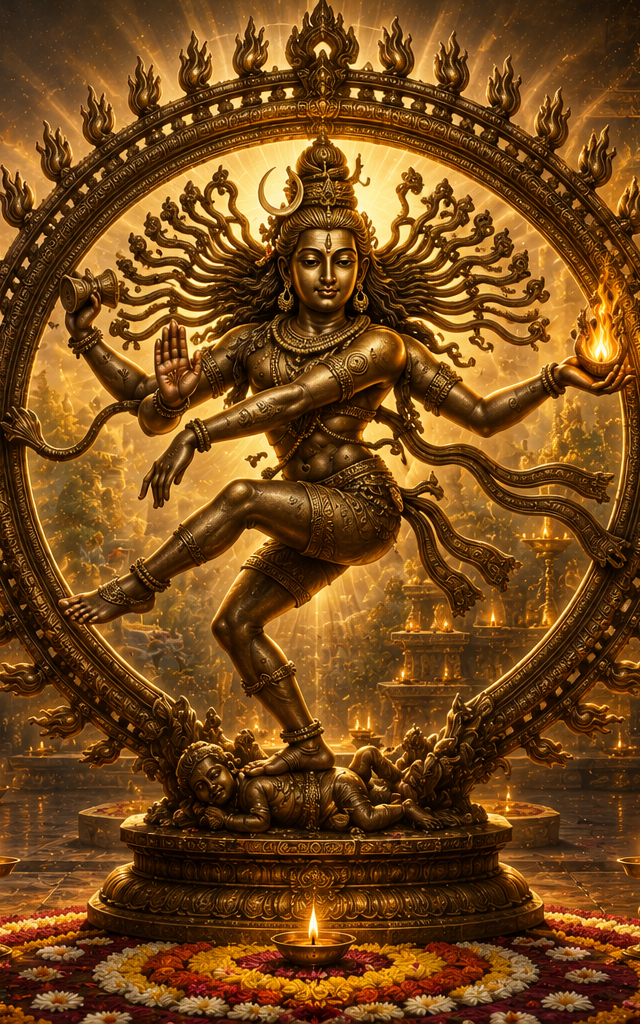
The Thillai Nataraja Temple at Chidambaram is one of Hinduism's most sacred and philosophically profound sites — housing the Akasha Lingam and the cosmic dance of Shiva. Discover its architecture, legends, and hidden mysteries.
Comments(0)
Loading comments…